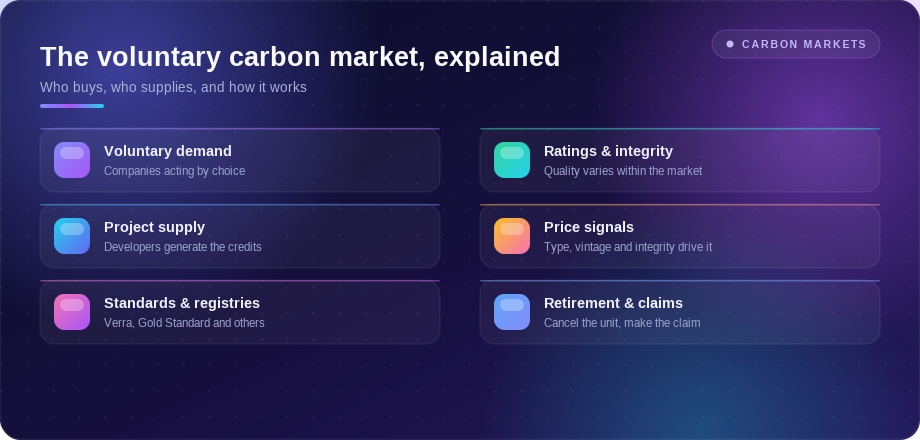
Quick answer: The voluntary carbon market (VCM) is where companies, governments and individuals buy carbon credits by choice rather than because a law requires it. Each credit stands for one tonne of carbon dioxide equivalent reduced or removed, issued under an independent standard and recorded in a registry. Buyers retire credits to support climate claims. Quality varies widely, so integrity frameworks such as the ICVCM Core Carbon Principles and the VCMI Claims Code now shape what credible buyers purchase and say.
The voluntary carbon market is the part of the carbon world in which buyers act by choice: a software company compensating for residual emissions, a consumer brand funding forest protection, an airline selling offsets to passengers, or a bank building a removals portfolio for its net-zero plan. No regulator forces these purchases, and that single fact shapes almost everything about how the market behaves. It explains why quality varies so much, why prices spread across a wide range, why claims are contested, and why a large layer of integrity bodies, ratings agencies and guidance has grown around it.
This guide explains who takes part, how credits move to retirement, the integrity rules, market size, the Middle East's role, links to compliance schemes and the main criticisms, with an illustrative buyer strategy. It is written for buyers and developers in the United States, the Middle East, Europe and India.
What Is the Voluntary Carbon Market?
In plain terms, the voluntary carbon market is a decentralised marketplace for carbon credits that no law requires anyone to buy. A carbon credit is a tradable certificate representing one tonne of carbon dioxide equivalent (tCO2e) either kept out of the atmosphere (an avoidance or reduction credit) or taken out of it (a removal credit). In the VCM these credits are issued by independent crediting programmes, sometimes called standards, rather than by governments.
The VCM sits alongside compliance carbon markets. In a compliance market, such as the EU Emissions Trading System, California's cap-and-trade programme or India's Carbon Credit Trading Scheme, a regulation sets an obligation and covered entities must surrender allowances or approved credits. In the voluntary market, the buyer decides whether to buy, how much, of what type and for what claim. The two worlds overlap more than they used to, but the distinction still matters. A full side-by-side comparison is in voluntary vs compliance carbon markets, so this guide only summarises it.
Three features define the VCM:
- Voluntary demand. Purchases are driven by corporate climate targets, customer and investor expectations, product claims and, increasingly, a sense that early action is cheaper than waiting for regulation.
- Private governance. Rules are written by independent standards such as Verra (the Verified Carbon Standard), Gold Standard, the American Carbon Registry (ACR), Climate Action Reserve (CAR), Isometric, Puro.earth and others, with integrity guidance layered on top by bodies such as the ICVCM and VCMI.
- Heterogeneous products. A credit from a landfill gas project in the United States, a cookstove programme in Kenya, a mangrove restoration in Indonesia and a direct air capture plant in Iceland are all "one tonne", but they differ in risk, durability, co-benefits and price. This is why the VCM is better thought of as many markets than one.
Who Participates in the Voluntary Carbon Market
The VCM has a recognisable cast. Understanding each role helps buyers know whom to question and helps developers know whose requirements they must satisfy.
| Participant | Role in the market | Examples (non-exhaustive) |
|---|---|---|
| Project developers | Design, finance and run projects that generate credits; prepare project documents and monitoring reports | Forestry developers, cookstove distributors, biochar producers, landfill gas operators, removals start-ups |
| Standards (crediting programmes) | Write the rules and methodologies, register projects, approve issuance | Verra, Gold Standard, ACR, CAR, Isometric, Puro.earth, Global Carbon Council |
| Validation and verification bodies (VVBs) | Independent auditors who validate project design and verify monitored reductions or removals | Accredited audit firms approved by each standard |
| Registries | Electronic ledgers that record issuance, transfer and retirement with unique serial numbers | Verra Registry, Gold Standard Impact Registry, ACR and CAR registries |
| Brokers and traders | Source supply, aggregate portfolios, take price risk, arrange offtake agreements | Specialist carbon brokers, commodity trading houses |
| Exchanges and platforms | Provide standardised contracts, price discovery and settlement | AirCarbon Exchange (Abu Dhabi), Xpansiv CBL, others |
| Ratings agencies | Assess project-level quality and risk independently of the standard | BeZero, Sylvera, Calyx Global, MSCI (formerly Trove) |
| Buyers | Purchase and retire credits for claims, or hold them for resale | Corporates, airlines, governments, individuals via retail platforms |
| Integrity and claims bodies | Set market-wide thresholds for credit quality and for how buyers may describe their use | ICVCM, VCMI, SBTi (on target-setting) |
Two points deserve emphasis. First, standards, registries and verifiers are distinct functions, even when a single organisation runs both the standard and its registry. Second, ratings agencies have become a significant part of buyer due diligence because a standard's approval is a floor, not a guarantee. For how the main programmes differ, see carbon credit standards explained and carbon credit registries compared; for ratings, see carbon credit ratings explained.
How the Voluntary Carbon Market Works: From Project to Retirement
The detailed life cycle of a credit is covered in what is a carbon credit. In summary, how the voluntary carbon market works can be described in seven steps:
- Project design. The developer selects an approved methodology and writes a project design document setting out the baseline (what would have happened without the project), the case for additionality, leakage and permanence treatment, and the monitoring plan.
- Validation. An accredited VVB checks the design against the methodology and the standard's rules.
- Registration. The standard lists the project on its registry, usually after a public comment period.
- Monitoring. The developer collects data over a monitoring period: fuel use, stove usage surveys, satellite imagery, plot measurements, metered gas flows or tonnes of biochar applied.
- Verification. A VVB audits the monitoring report and confirms the quantity of reductions or removals.
- Issuance. The registry issues credits with a vintage year and unique serial numbers into the developer's account. Some standards place a share into a buffer pool to insure against reversals.
- Transfer and retirement. Credits are sold, sometimes several times, and finally retired by or on behalf of the end user. Retirement permanently removes them from circulation and is the only point at which a claim can be made.
Credits are traded in several ways: through spot purchases from developers or brokers, through forward offtake agreements that pre-finance projects in return for future issuance, through exchange contracts that bundle credits meeting a defined specification, and through retail platforms for small buyers. Buyers new to the process can follow how to buy carbon credits, and developers can read how to sell carbon credits.
Avoidance Versus Removal Credits
A distinction that runs through every part of the VCM is between avoidance (or reduction) credits and removal credits.
| Feature | Avoidance or reduction credits | Removal credits |
|---|---|---|
| What they represent | Emissions that would have occurred but did not | CO2 taken out of the atmosphere and stored |
| Typical project types | Renewable energy, cookstoves, avoided deforestation (REDD+), landfill gas, methane capture | Afforestation and reforestation, biochar, enhanced rock weathering, direct air capture, BECCS |
| Main integrity questions | Baseline realism, additionality, leakage | Durability of storage, measurement uncertainty, reversal risk |
| Role in net-zero claims | Widely seen as supporting action beyond the value chain | Expected to neutralise residual emissions at net zero |
Removals are discussed in depth in carbon removal credits explained.
The Integrity Infrastructure: ICVCM, VCMI and SBTi
After a period of critical media and academic scrutiny in the early 2020s, the voluntary carbon market built a layer of governance intended to separate credible supply and credible claims from the rest. Three bodies matter most, and they work on different questions.
ICVCM and the Core Carbon Principles (Supply Side)
The Integrity Council for the Voluntary Carbon Market (ICVCM) is an independent governance body that published its Core Carbon Principles (CCPs) and Assessment Framework in 2023. The CCPs set a threshold for high-integrity credits covering governance, tracking, transparency, robust independent validation and verification, additionality, permanence, robust quantification, no double counting, sustainable development safeguards and contribution to net-zero transition.
The ICVCM assesses two things: whether a crediting programme as a whole is CCP-eligible, and whether specific methodology categories meet the CCPs. Credits that pass both can carry a CCP label in the registry. Since 2024 the Council has approved several programmes and a growing list of methodologies, and it has also declined some, most notably older grid-connected renewable energy methodologies, on additionality grounds. Because decisions continue to be published, buyers should check the ICVCM website for the current list rather than rely on any summary. Our dedicated guide, ICVCM Core Carbon Principles, covers the ten principles and the assessment process in detail.
VCMI Claims Code (Demand Side)
The Voluntary Carbon Markets Integrity Initiative (VCMI) addresses the other half of the problem: what a company may credibly say when it uses credits. The VCMI Claims Code of Practice, first published in 2023 and updated since, sets out a set of foundational criteria a company must meet before making a VCMI claim. These include a public science-aligned near-term target, a commitment to reach net zero by 2050 at the latest, evidence of progress on its own emissions, and public advocacy aligned with the Paris Agreement. Once those are met, a company may make a Silver, Gold or Platinum claim depending on the share of its remaining emissions it addresses with high-quality credits in a given year. VCMI has also published a Scope 3 Action Code of Practice, which sets conditions under which credits can temporarily help a company that is behind on its value chain target.
The VCMI Claims Code expects companies to use credits that meet CCP-level quality, linking the supply and demand frameworks together. VCMI also published a monitoring, reporting and assurance framework so that claims can be independently checked. As with the ICVCM, check the current version on the VCMI website before relying on specific thresholds.
SBTi and the Role of Credits in Targets
The Science Based Targets initiative (SBTi) does not govern credits, but its rules shape demand. Under its Corporate Net-Zero Standard, companies cannot count carbon credits towards their near-term or long-term emission reduction targets; credits may be used for "beyond value chain mitigation" and, at net zero, durable removals may neutralise residual emissions. SBTi has been revising the standard, with consultation drafts of a version 2 published in 2025 that discuss topics such as recognising ongoing removals and a more defined role for beyond value chain mitigation. At the time of writing the final text and its effective date should be confirmed directly with SBTi. Our SBTi explainer covers target-setting in more detail.
How the Three Fit Together
| Body | Question it answers | Main output |
|---|---|---|
| ICVCM | Is this credit high integrity? | CCP-eligible programmes, approved methodology categories, CCP label |
| VCMI | What can a company claim when it retires credits? | Claims Code of Practice (Silver, Gold, Platinum), Scope 3 Action code |
| SBTi | How should a company set and meet reduction targets? | Corporate Net-Zero Standard; credits outside the target boundary |
Alongside these, ratings agencies, registries' own reforms and national rules on green claims (for example the EU's rules on environmental claims to consumers, and guidance from regulators such as the UK Competition and Markets Authority and the US Federal Trade Commission) add further pressure. The practical result is that "buying offsets" has become a governed activity with documented expectations, rather than a marketing decision.
Voluntary Carbon Market Size and Price Trends
Measuring the voluntary carbon market size is harder than it sounds. There is no central exchange, many trades are private bilateral contracts, and different sources measure different things: issuance, retirements, transaction volume or transaction value. Figures should always be attributed to a named source and a date.
What named sources broadly report:
- Ecosystem Marketplace (Forest Trends), in its annual State of the Voluntary Carbon Market reports, recorded transaction value peaking at roughly two billion US dollars in 2021, during a demand surge linked to corporate net-zero pledges. Its later reports described a sharp fall in both traded volume and value in 2023 and a further decline in 2024, which it linked to integrity concerns, media scrutiny of forestry credits and buyer caution.
- MSCI Carbon Markets (formerly Trove Research) and other data providers have tracked retirements, which measure actual end use. Retirement volumes have been considerably steadier than transaction value, suggesting that underlying demand for claims has held up even while speculative trading fell.
- Industry analysts commonly describe a "flight to quality": a widening gap between low-priced older avoidance credits and higher-priced CCP-labelled, well-rated or removal credits. Durable removals such as direct air capture and biochar trade at many times the price of older renewable energy credits.
Long-term forecasts of the VCM's size vary by an order of magnitude depending on assumptions about corporate demand, CORSIA, Article 6 and whether companies are allowed or encouraged to use credits in target frameworks. They should be treated as scenarios, not predictions.
This guide does not quote specific current prices because they change quickly and depend heavily on project type, vintage, rating, labels and contract terms. For how prices are formed and what drives the spread, see carbon credit prices explained.
Main Drivers of Voluntary Carbon Credit Prices
| Driver | Effect on price |
|---|---|
| Project type (avoidance vs removal) | Durable removals command the highest prices |
| Vintage | Recent vintages are generally preferred over old ones |
| CCP label or high rating | Tends to support a premium |
| Corresponding adjustment | Authorised, adjusted credits trade above unadjusted ones |
| Co-benefits and SDG certification | Can add value for buyers seeking specific outcomes |
| Contract structure | Forward offtakes carry delivery risk and are priced accordingly |
| CORSIA eligibility | Eligible units for the first phase have traded at a premium in periods of tight supply |
The Voluntary Carbon Market in the UAE and the Middle East
The Middle East has moved from being a minor participant to an active hub for the voluntary carbon market, helped by sovereign climate commitments, large energy companies with net-zero targets and the UAE's hosting of COP28 in Dubai in 2023.
AirCarbon Exchange (ACX), Abu Dhabi. ACX operates in Abu Dhabi Global Market (ADGM), whose Financial Services Regulatory Authority (FSRA) treats carbon credits as regulated environmental instruments. ACX became one of the first regulated carbon credit exchanges and clearing houses, offering spot trading of credits from standards such as Verra and Gold Standard.
Regional Voluntary Carbon Market Company (RVCMC), Saudi Arabia. The RVCMC was established by the Public Investment Fund and Saudi Tadawul Group to build a voluntary carbon market in the region. It ran large auctions of credits, including one held in Riyadh in 2022 and another in Nairobi in 2023, and has been developing an exchange platform.
Corporate and government demand. National oil companies, airlines, utilities and banks in the Gulf have announced net-zero or carbon neutrality targets, and several are building portfolios of credits, often with interest in nature-based solutions in Africa and Asia and in engineered removals.
Supply links. Middle Eastern buyers and investors are increasingly financing projects in Africa and South Asia, including India, and some regional programmes have emerged, such as the Global Carbon Council based in Qatar.
For aircraft operators and companies in the Gulf dealing specifically with CORSIA-eligible units, our CORSIA services for the UAE and Middle East page explains how we support eligibility checks and due diligence.
Regional Snapshot
| Region | Main VCM characteristics |
|---|---|
| United States | Large corporate buyer base; strong removals and technology investment; ACR and CAR originate here; active FTC and state scrutiny of claims |
| Europe | Strict green claims rules; many corporate buyers focused on CCP labels, ratings and removals; EU certification framework for removals (CRCF) under development |
| Middle East | Regulated trading venues (ACX in ADGM), RVCMC auctions, sovereign and energy-sector demand, investment in overseas supply |
| India | Large supplier of credits (renewables, cookstoves, biogas, biochar, agriculture); domestic compliance scheme under the CCTS alongside an offset mechanism |
India's own compliance market and its offset mechanism are explained in India's carbon market under the CCTS.
How the VCM Interacts With Compliance Markets, Article 6 and CORSIA
The voluntary and compliance worlds were once separate. They now share infrastructure, supply and, increasingly, rules.
Compliance schemes. Some compliance systems allow limited use of offsets, which can draw on the same project pipelines as the VCM. India's CCTS includes an offset mechanism; other jurisdictions accept specified domestic offsets. Credits that become eligible for compliance use often trade at a premium.
Article 6 of the Paris Agreement. Article 6.2 allows countries to transfer mitigation outcomes (ITMOs) bilaterally, while Article 6.4 creates a UN-supervised crediting mechanism, now known as the Paris Agreement Crediting Mechanism. When a host country authorises a credit for international use, it must apply a corresponding adjustment so the same tonne is not counted twice. This has created a split in the VCM between authorised, adjusted credits and unauthorised "mitigation contribution" credits, which VCMI and others say can support contribution-style claims but not offsetting-style claims against another country's inventory. See Article 6 of the Paris Agreement explained and the knowledge base note on corresponding adjustments and Article 6.
CORSIA. ICAO's Carbon Offsetting and Reduction Scheme for International Aviation is a compliance scheme for airlines, but it draws its supply from VCM standards. ICAO's Council, on the recommendation of its Technical Advisory Body, approves which crediting programmes and units are CORSIA Eligible Emissions Units. For the first phase (2024 to 2026), eligible units require a host-country Letter of Authorization and a corresponding adjustment. This has created a premium segment within voluntary supply. The relationship is explained in CORSIA vs voluntary carbon markets.
| Link | Effect on the VCM |
|---|---|
| Compliance offset use | Adds demand for specific project types and standards |
| Article 6 authorisation | Splits supply into adjusted and unadjusted credits |
| CORSIA eligibility | Creates a premium segment with stricter requirements |
| ICVCM CCP labels | Increasingly used as a reference by compliance and quasi-compliance buyers |
Voluntary Carbon Credits: Risks and Criticisms
The voluntary carbon market has drawn sustained criticism, and anyone buying or selling voluntary carbon credits needs to understand it. Most concerns fall into a small number of categories.
- Over-crediting. Studies and investigations have argued that some project types, especially certain avoided deforestation projects and some cookstove methodologies, issued more credits than the real climate benefit justified, usually because of inflated baselines or optimistic usage assumptions. Standards have responded with revised methodologies, such as dynamic or jurisdictional baselines for REDD+ and updated cookstove rules.
- Additionality doubts. Where a project would have happened anyway, for example grid-connected renewables in markets where they are already cheaper than fossil power, its credits do not represent an additional tonne. This is why the ICVCM declined to approve older renewable energy methodologies. See additionality in carbon credits explained.
- Permanence and reversals. Forest carbon can be lost to fire, pests or illegal logging. Buffer pools are designed to cover this, but their adequacy is debated.
- Double counting. The same tonne can be claimed by a host country in its national inventory and by a buyer. Corresponding adjustments address this for authorised credits; for others, the claim type matters.
- Greenwashing and misleading claims. Phrases such as "carbon neutral product" based on cheap credits have been challenged by regulators and courts, particularly in Europe. Our guide to carbon credit greenwashing red flags lists warning signs, and carbon neutral vs net zero explains why the two terms are not interchangeable.
- Mitigation deterrence. Critics argue that cheap credits let companies delay cutting their own emissions. This is the concern the SBTi and VCMI frameworks try to address by requiring reductions first.
- Community and safeguard issues. Projects on land used by indigenous peoples and local communities must respect rights, consent and benefit-sharing. Failures here have damaged projects and buyers.
- Market opacity. Prices are often private, and intermediaries' margins can be hard to see.
None of these risks means the VCM cannot work. They mean buyers need structured due diligence and conservative claims, and developers need conservative quantification and good data. Our carbon credit quality assessment guide sets out a practical screening approach.
Worked Example: Building a Voluntary Carbon Market Strategy (Illustrative)
The following example is entirely illustrative. The company, numbers and choices are hypothetical and are included only to show how the pieces of the voluntary carbon market fit together in practice.
The company. A mid-sized technology services group headquartered in Europe, with offices in the United States, Dubai and India. It has validated near-term science-based targets and a net-zero target for 2050.
Step 1: Measure the footprint. Using the GHG Protocol (see GHG accounting Scope 1, 2 and 3 explained), the company estimates for the reporting year:
| Scope | Emissions (tCO2e, illustrative) |
|---|---|
| Scope 1 (offices, fleet, backup generators) | 1,200 |
| Scope 2 (market-based electricity) | 3,800 |
| Scope 3 (purchased goods, business travel, commuting, cloud) | 45,000 |
| Total | 50,000 |
Step 2: Reduce first. The company's transition plan, not credits, drives its targets: renewable electricity contracts for Scope 2, supplier engagement for purchased services, and a travel policy. Credits will not be counted against its SBTi targets.
Step 3: Choose the claim. The board decides to aim for a VCMI Silver claim in the first year, with a view to Gold later, subject to meeting the foundational criteria and checking the current VCMI thresholds. Under the illustrative policy, it commits to retire high-quality credits equal to at least 20% of its remaining emissions in year one, which is 10,000 tCO2e. It will describe this publicly as a contribution alongside its reduction pathway, not as carbon neutrality.
Step 4: Set quality criteria. The procurement policy requires:
- Credits from CCP-eligible programmes, preferring CCP-labelled methodologies where available.
- An independent rating at or above an agreed threshold from at least one ratings agency.
- Vintages no older than five years.
- No credits from methodology categories that the ICVCM has rejected.
- Documented safeguards and grievance mechanisms for nature-based projects.
Step 5: Build the portfolio.
| Component | Share | Tonnes (illustrative) | Rationale |
|---|---|---|---|
| Improved cookstoves or clean cooking (updated methodology, Africa or India) | 30% | 3,000 | Strong co-benefits; conservative quantification required |
| Jurisdictional REDD+ (rated, CCP-labelled where possible) | 30% | 3,000 | Supports forest protection at scale |
| Afforestation and reforestation removals | 25% | 2,500 | Builds exposure to removals |
| Biochar removals | 15% | 1,500 | Durable removals; pilots future neutralisation needs |
| Total | 100% | 10,000 |
Step 6: Contract and retire. The company buys spot credits for the current year and signs a small forward offtake for biochar removals to secure future supply, with delivery and replacement clauses. Credits are retired in the registries in the company's name, with the reporting year and claim stated in the retirement note.
Step 7: Disclose and assure. The company publishes its retirement serial numbers, the share of avoidance versus removal credits, the claim it makes and the frameworks it follows. It arranges limited assurance of the claim, consistent with the VCMI monitoring, reporting and assurance framework, and links the disclosure to its ESG reporting (see ESG reporting and carbon credits).
What the example shows. The VCM is not a substitute for reductions. A credible strategy fixes the claim first, sets quality criteria before looking at price, mixes credit types for risk management, and publishes enough information for others to check it.
How DSTechnoverse Helps
DSTechnoverse works on the data and integrity side of the voluntary carbon market. For buyers, we screen projects against standards, ICVCM decisions and buyer quality criteria, review registry records and documentation, and help structure portfolios and retirement records that support defensible claims. For aircraft operators and suppliers, our CORSIA carbon credit services cover eligibility checks, due diligence on CORSIA Eligible Emissions Units, offsetting estimates and registry cancellation support. We support clients in the Gulf through our UAE and Middle East services and in North America through our United States services. We are not a verification body. To discuss your needs, contact our team.
Frequently Asked Questions
What is the voluntary carbon market? The voluntary carbon market is where companies, governments and individuals buy carbon credits by choice rather than because a law requires it. Credits are issued by independent standards such as Verra or Gold Standard, recorded in registries and retired to support climate claims. Each credit represents one tonne of carbon dioxide equivalent reduced or removed.
What does VCM stand for? VCM stands for voluntary carbon market. The term covers the whole system of project developers, crediting programmes, verifiers, registries, brokers, exchanges and buyers trading carbon credits outside compliance obligations. It is sometimes used loosely to describe voluntary carbon credits themselves, but strictly it refers to the market in which those credits are traded and retired.
How does the voluntary carbon market work? A developer designs a project under an approved methodology, an independent auditor validates it, and the standard registers it. After monitoring and verification, credits are issued in a registry with serial numbers. They are sold directly, through brokers or on exchanges, and the end buyer retires them so they cannot be reused, at which point a claim may be made.
How big is the voluntary carbon market? Size depends on what is measured. Ecosystem Marketplace reported transaction value peaking at around two billion US dollars in 2021 and then falling sharply in 2023 and 2024. Retirement volumes tracked by data providers such as MSCI have been steadier. Long-term forecasts vary widely and should be treated as scenarios rather than predictions.
What is the ICVCM? The Integrity Council for the Voluntary Carbon Market is an independent governance body that sets the Core Carbon Principles, a threshold for high-integrity credits. It assesses crediting programmes and methodology categories, and credits that pass can carry a CCP label in the registry. It has approved some methodologies and rejected others, so buyers should check its current decisions.
What is the VCMI Claims Code? The VCMI Claims Code of Practice sets out how companies can credibly describe their use of carbon credits. A company must first meet foundational criteria, including science-aligned targets and progress on its own emissions. It can then make a Silver, Gold or Platinum claim based on the share of remaining emissions addressed with high-quality credits.
Can carbon credits count towards SBTi targets? No. Under the SBTi Corporate Net-Zero Standard, credits cannot be counted towards near-term or long-term reduction targets. They can be used for mitigation beyond the value chain, and durable removals may neutralise residual emissions at net zero. SBTi has been revising its standard, so check the current version.
What is the voluntary carbon market's role in the UAE and Middle East? The region hosts AirCarbon Exchange, a regulated carbon exchange in Abu Dhabi Global Market, and Saudi Arabia's Regional Voluntary Carbon Market Company, which has run large credit auctions. Energy companies, airlines and banks in the Gulf are building credit portfolios, and regional investors increasingly finance projects in Africa and South Asia.
How does the VCM relate to CORSIA and Article 6? CORSIA is a compliance scheme for international aviation, but its eligible units come from crediting programmes that also serve the VCM. Article 6 lets countries authorise credits for international use with corresponding adjustments. Together they have created a premium segment of authorised, adjusted credits within voluntary supply.
Are voluntary carbon credits a form of greenwashing? Not inherently. Credits can finance real reductions and removals, but low-quality credits or overstated claims can mislead. The risk falls when buyers reduce their own emissions first, choose high-integrity credits, follow claims guidance such as VCMI, and disclose retirements transparently. Regulators in Europe and elsewhere are tightening rules on environmental claims.
Navigating carbon credits and climate claims? DSTechnoverse works on the data and integrity side of carbon — project screening, registry and eligibility verification, MRV and monitoring-data analysis, reconciliation and defensible reporting. See our CORSIA carbon credit services and data analytics. We are based in Indore, Madhya Pradesh and work across India and internationally.
Apply as a carbon credit buyer or seller
Talk to our team, or start with the complete carbon credits guide.
Related services
Related articles
- Voluntary vs Compliance Carbon Markets: The Practical Differences
- CORSIA Carbon Credits: The Complete Guide for Buyers and Project Developers
- What Is a Carbon Credit? Definition, How It Works and Who Uses It
- Carbon Credit Registries Compared: Verra, Gold Standard, ACR, CAR, Isometric, Puro and National Registries