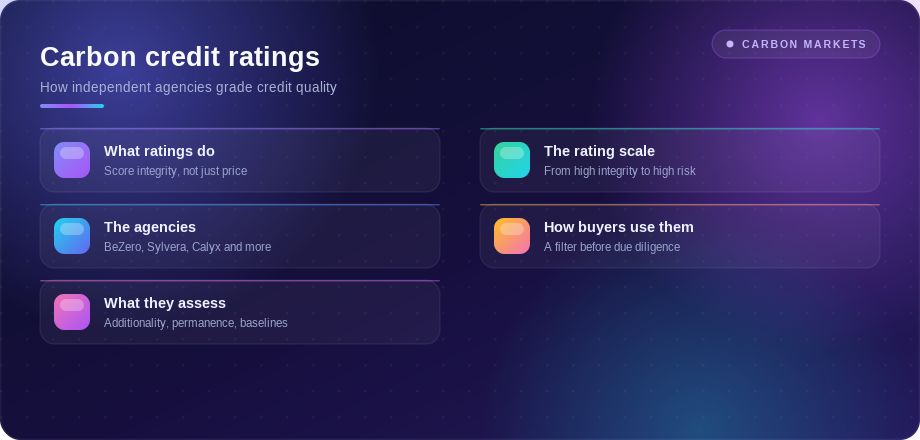
Quick answer: Carbon credit ratings are independent, project-level grades of how likely a credit is to deliver the one tonne of CO2e it claims. Agencies such as BeZero Carbon, Sylvera, Calyx Global and MSCI review additionality, baseline and over-crediting risk, permanence, leakage, co-benefits and policy risk, then publish a letter grade. BeZero, Sylvera and Calyx use AAA to D scales; MSCI uses AAA to CCC. Buyers use ratings to screen and price credits, not to replace their own due diligence.
Carbon credit ratings exist because the label on a credit tells you very little about what it actually achieved. Two credits issued under the same standard, with the same vintage and the same project type, can differ widely in how much real climate impact sits behind each tonne.
Rating agencies step into that gap: they test the project's evidence against independent data and publish a grade summarising the risk that a credit is worth less than a tonne. This guide explains what carbon credit ratings measure, who the main carbon credit rating agencies are and how their scales differ, how ratings sit alongside the ICVCM Core Carbon Principles and CORSIA eligibility, and how buyers can use them in procurement. It closes with steps for developers preparing for a rating.
If you are new to the market, start with what a carbon credit is and the voluntary carbon market overview, then come back here.
What Carbon Credit Ratings Are (and Are Not)
A carbon rating is a quality opinion on a specific project or batch of credits. It is not a price, not a certification and not a verification. The distinction matters because buyers often confuse the four.
| Instrument | Who issues it | What it tells you | What it does not tell you |
|---|---|---|---|
| Registry issuance | Crediting programme (Verra, Gold Standard, ACR, CAR and others) | The credit exists, has a serial number and passed the programme's rules | Whether the programme's rules were conservative enough for this project |
| Third-party verification | Accredited validation and verification body | The monitoring report matches the methodology and evidence at a point in time | Whether the methodology itself over-credits |
| ICVCM CCP label | Integrity Council for the Voluntary Carbon Market | The methodology and programme meet a threshold integrity standard | How an individual project performs within that methodology |
| Carbon credit rating | Independent rating agency | The relative likelihood that this project's credits deliver a tonne | Your legal exposure, your claim wording or your delivery risk under a contract |
The bond analogy helps: a bond rating describes the risk that an issuer will not pay, and a carbon credit rating describes the risk that the tonne is not really a tonne. Price then reflects that risk alongside vintage, project type and supply.
Ratings are also opinions. Each agency builds its own framework, weights risk factors differently and updates its view as new data arrives. That brings competition and scrutiny, but it also means two respected agencies can land in different places on the same project.
What Carbon Credit Ratings Assess
Most agencies organise their analysis around the same handful of integrity risks. The names and weightings differ, but the questions are shared across the market. Our carbon credit quality assessment guide explains each test in depth from a buyer's point of view; here we focus on how raters treat them.
Additionality
Additionality asks whether the project would have happened without carbon finance. Raters look at investment analysis, the share of revenue that comes from credits, regulatory requirements in the host country, common practice in the sector and the timeline of the carbon decision. A grid-connected solar plant in a market where solar is already the cheapest new power typically scores poorly here; a project that depends on credit revenue to cover operating costs scores better. For the underlying concept, see additionality explained.
Baseline and Over-Crediting
Over-crediting is often the largest single driver of a low rating. The baseline is the counterfactual: what emissions would have been without the project. If the baseline assumes high deforestation that was never likely, or high fuel use in cookstove households that never cooked that much, the project issues more credits than the real reduction. Raters test baselines against independent data such as satellite forest-cover records, usage surveys, grid emission factors and comparable reference areas.
Permanence and Reversal Risk
For forestry, soil and other nature-based projects, stored carbon can be released through fire, pests, drought, illegal logging or changes in land use. Raters assess the length of the commitment, the size and design of the programme's buffer pool, the project's exposure to physical climate risk, and the governance and tenure arrangements that protect the land.
Leakage
Leakage is the shift of emissions outside the project boundary, such as logging pushed into the next valley. Raters check whether the methodology's leakage deductions are realistic for the local context and whether the project monitors activity outside its boundary.
Co-Benefits and Safeguards
Agencies differ most on this factor. Some fold social and environmental safeguards into the headline carbon grade only where harm could undermine delivery, and report co-benefits separately. Calyx Global, for example, publishes a separate SDG impact rating alongside its greenhouse gas grade. Sylvera reports co-benefits as a distinct component alongside its carbon, additionality and permanence analysis. Buyers who care about community outcomes should read those sections directly.
Policy, Host Country and Double-Claiming Risk
Raters increasingly account for the policy context: whether the host country might claim the same reduction towards its Nationally Determined Contribution, whether it has signalled willingness to issue authorisations under Article 6 of the Paris Agreement, and whether domestic rules could change the project's status. This factor is distinct from the core question of whether the tonne is real, but it matters for claims and for compliance uses such as CORSIA, where authorisation and corresponding adjustment are required for first-phase units.
Summary of Risk Factors
| Risk factor | Typical evidence a rater reviews | Project types most exposed |
|---|---|---|
| Additionality | Financial analysis, regulation, common practice, carbon revenue share | Large renewable energy, some industrial efficiency |
| Baseline / over-crediting | Satellite data, usage surveys, reference areas, emission factors | Avoided deforestation (REDD+), cookstoves |
| Permanence | Buffer pool, commitment period, fire and drought exposure, tenure | Forestry, soil carbon, blue carbon |
| Leakage | Activity displacement analysis, regional land-use data | REDD+, improved forest management, agriculture |
| Co-benefits and safeguards | Grievance records, consultation evidence, SDG claims | All, especially community-based projects |
| Policy and host country | NDC scope, authorisation status, Article 6 frameworks | All, especially where compliance use is intended |
The Main Carbon Credit Rating Agencies
Several firms now publish carbon credit ratings. The four most widely cited by corporate buyers are BeZero Carbon, Sylvera, Calyx Global and MSCI. Each is independent of the crediting programmes, and each sells access to its research by subscription, with some summary ratings available publicly or on registry and marketplace platforms. The descriptions below reflect each agency's published methodology at the time of writing; methodologies are revised, so always check the current framework document before relying on a grade.
BeZero Carbon
BeZero Carbon is based in London. The BeZero Carbon Rating expresses the likelihood that a credit achieves one tonne of CO2e avoided or removed. Since March 2023 it has used an eight-point scale running from AAA (highest likelihood) through AA, A, BBB, BB, B and C to D (lowest likelihood). BeZero replaced an earlier seven-point scale (AAA+ down to A) so that its grades would be more familiar to financial markets. BeZero states that a D rating does not mean a credit or project has failed; it reflects the lowest relative likelihood on its scale. BeZero also offers pre-issuance ratings for projects that have not yet issued credits and a portfolio rating framework for baskets of credits.
Sylvera
Sylvera, also headquartered in London, rates projects on a scale from AAA (highest quality) to D (lowest quality). Its frameworks are published by project type, for example REDD+, afforestation and reforestation, and renewables, and it is known for heavy use of satellite and geospatial data in nature-based ratings. Alongside the headline grade, Sylvera reports analysis of carbon accounting, additionality, permanence and co-benefits, which lets a buyer see whether a mid-range grade comes from one weak factor or several moderate ones. Sylvera also rates projects before issuance.
Calyx Global
Calyx Global publishes greenhouse gas integrity ratings and separate SDG impact ratings. Its GHG grades historically ran on a ten-point A+ to E scale. In January 2025 Calyx moved its GHG ratings to an eight-point AAA to D scale to make comparison with other agencies easier, while its SDG ratings remain on a +1 to +5 scale. Calyx places particular weight on over-crediting and additionality risk and publishes a large number of tiered ratings, some of which are free to view. When you read older Calyx research, check which scale a grade is on before comparing it with a current rating.
MSCI Carbon Project Ratings
MSCI, the index and ESG data provider, entered carbon markets through its acquisition of Trove Research and now publishes MSCI Carbon Project Ratings. These use a seven-point scale from AAA (highest integrity) to CCC (lowest). The composite rating combines an assessment of emissions impact and of implementation approach against a set of criteria, and MSCI states that its methodology builds on industry integrity initiatives including the ICVCM Core Carbon Principles. MSCI also publishes periodic reports on the overall state of integrity across the projects it covers.
How the Scales Compare
| Agency | Headline scale | Number of grades | Separate co-benefit output | Pre-issuance ratings |
|---|---|---|---|---|
| BeZero Carbon | AAA to D | 8 | Not part of the headline grade | Yes |
| Sylvera | AAA to D | Letter grades AAA to D | Co-benefits reported as a component | Yes |
| Calyx Global | AAA to D (GHG); +1 to +5 (SDG) | 8 for GHG | Yes, SDG rating | Check current offering |
| MSCI | AAA to CCC | 7 | See current methodology | Check current offering |
Shared letters do not mean shared meaning. An A from one agency is not calibrated to an A from another, because each defines its grades against its own framework and its own view of the risk factors. Mapping one agency's grade onto another's is a rough exercise at best. The safer approach is to read each agency's grade definitions and set your procurement thresholds per agency.
Other firms have offered ratings or integrity scores at various points, and some marketplaces and exchanges publish their own screening scores. Treat any newcomer's grade with the same questions you would ask of the established agencies: is the methodology published, who funds the rating, how often is it updated, and can you see the reasoning behind a grade?
How Carbon Credits Are Rated: The Process
Although each agency runs its own process, the broad sequence is similar. Understanding it helps buyers judge what a grade rests on and helps developers prepare.
- Selection. The agency chooses projects to rate, usually by issuance volume, market interest or subscriber request. Some agencies also accept commissioned pre-issuance ratings from developers.
- Document review. Analysts read the project design document, validation and verification reports, monitoring reports and registry records.
- Independent data analysis. The agency tests key assumptions against outside data: satellite imagery for forest cover, national statistics for fuel use, grid data for emission factors, market data for technology costs.
- Risk scoring. Each risk factor is scored under the agency's framework, and the factors are combined into a headline grade using the agency's weightings.
- Developer engagement. Many agencies give the developer a chance to supply missing evidence or correct facts before publication. The rating itself remains the agency's opinion.
- Publication. The grade and a summary rationale are published to subscribers, and sometimes publicly.
- Monitoring and review. Ratings are revisited when new monitoring reports, methodology changes, policy developments or physical events (such as a fire) occur. Grades move up and down.
Agencies generally rate at project level, and sometimes distinguish between vintages or crediting periods where the evidence differs. A buyer should confirm which vintages a grade covers before applying it to a particular lot.
How Carbon Credit Ratings Relate to ICVCM CCP Labels and CORSIA Eligibility
Ratings, the ICVCM CCP label and CORSIA eligibility are three separate gates. Buyers often treat them as interchangeable, which leads to mistakes in procurement policies.
ICVCM Core Carbon Principles
The Integrity Council for the Voluntary Carbon Market sets a threshold for integrity through its Core Carbon Principles. It assesses crediting programmes and then categories of methodologies, and credits issued under approved methodologies by eligible programmes can carry a CCP label on the registry. The label is a pass or fail at methodology and programme level. It does not grade individual projects against each other. For the detail, see our guide to the ICVCM Core Carbon Principles.
Ratings work at a finer level. Within a CCP-approved methodology there will still be stronger and weaker projects, and a rating agency may grade some of them highly and others poorly. Equally, a project under a methodology that has not yet received CCP approval might still receive a respectable rating. The two signals complement each other: the CCP label tells you the rules are acceptable, and the rating tells you how well this project performs under those rules.
CORSIA Eligibility
Under ICAO's Carbon Offsetting and Reduction Scheme for International Aviation, airlines may only use CORSIA Eligible Emissions Units. Eligibility is decided by the ICAO Council on the recommendation of its Technical Advisory Body, which assesses crediting programmes against the CORSIA Emissions Unit Eligibility Criteria and sets the eligible unit dates and project scope. For the first phase (2024 to 2026), units must also carry a host-country Letter of Authorization and a corresponding adjustment. Ratings are not part of that eligibility decision.
That means a credit can be CORSIA eligible and still receive a modest rating, and a highly rated credit may be ineligible for CORSIA because it lacks authorisation or falls outside the approved programme scope or dates. Airlines and their advisers increasingly use ratings as an additional quality screen among eligible units, partly for reputational reasons and partly because higher-integrity units may face less scrutiny. For how eligibility works, see CORSIA eligible emissions units criteria and our knowledge base entry on CORSIA eligible emissions units.
| Gate | Decided by | Level | Output | Mandatory for |
|---|---|---|---|---|
| Registry issuance | Crediting programme | Project and issuance | Serialised credit | All uses |
| CCP label | ICVCM | Programme and methodology category | Label on eligible credits | No one, but widely referenced in voluntary claims |
| CORSIA eligibility | ICAO Council on TAB advice | Programme, scope and unit dates, plus authorisation | Eligible unit status | Aircraft operators meeting CORSIA offsetting requirements |
| Carbon rating | Independent agency | Project, sometimes vintage | Letter grade with rationale | No one, but often required by internal procurement policy |
How Buyers Use Carbon Credit Ratings in Procurement
Ratings work best when written into a procurement policy. A typical policy uses them in four ways.
- Screening. Set a minimum grade per agency below which credits are excluded, then run your own due diligence only on the shortlist. This saves time when brokers present long lists.
- Pricing. Use grades to explain price differences between lots and to test whether a premium is justified. Market sources consistently report that higher-rated credits trade at a premium to lower-rated credits of similar type and vintage, though the size of the premium varies with supply and project type.
- Portfolio construction. Blend project types and set a weighted-average grade target, so that no single weak project dominates the portfolio's risk.
- Contract protection. Include rating-related clauses in offtake agreements, such as the right to substitute or terminate if a project is downgraded below a set grade before delivery.
The carbon credit due diligence buyer case study shows how a buyer combines these steps in practice, and our step-by-step guide to buying carbon credits covers the wider purchasing process.
Worked Example: Comparing Three Illustrative Lots
The following example is illustrative only. The project descriptions, grades and figures are invented to show the method; they do not refer to real projects or reflect any agency's actual opinion.
A European manufacturer with operations in the United States and the Gulf has a policy to retire 20,000 tonnes a year against residual emissions. Its policy requires at least one rating from an approved agency, a minimum headline grade of A (or the agency's equivalent band) for at least 70% of the volume, and a CCP label where one is available. A broker offers three lots.
| Illustrative lot | Project type | Agency X grade | Agency Y grade | CCP label | Authorised with corresponding adjustment | Relative price |
|---|---|---|---|---|---|---|
| Lot 1 | Avoided deforestation, older vintage | BB | B | No | No | Lowest |
| Lot 2 | Efficient cookstoves, recent vintage | A | BBB | Yes | No | Middle |
| Lot 3 | Afforestation removal, recent vintage | AA | A | Yes | Yes | Highest |
Step 1: Apply the hard screen. Lot 1 fails the policy's minimum grade with both agencies. The buyer removes it, regardless of price.
Step 2: Read the rationale, not just the letter. Lot 2 meets the threshold with Agency X but not Agency Y. On reading both reports, the buyer finds that Agency Y's lower grade comes mainly from doubts about the stove usage rate assumed in the baseline. Agency X accepted the developer's recent usage surveys. The buyer asks the seller for those survey results and the sampling method behind them.
Step 3: Estimate risk-adjusted cost. To compare lots on a like-for-like basis, the buyer applies its own illustrative haircut to each lot, reflecting the share of tonnes it judges might not be real. For this exercise it assumes a 10% haircut for Lot 3 and a 30% haircut for Lot 2 (reflecting the split view). If Lot 2 costs 60 units per credit and Lot 3 costs 100 units per credit (illustrative units, not market prices), the cost per risk-adjusted tonne is 60 / 0.70 = about 86 units for Lot 2 and 100 / 0.90 = about 111 units for Lot 3. Lot 2 is still cheaper per adjusted tonne, but the gap is much narrower than the headline price suggests.
Step 4: Consider claims and use. Lot 3 carries authorisation and a corresponding adjustment, which gives the buyer more flexibility if it later wants to make contribution or compensation claims that depend on avoiding double claiming, and it is a removal, which suits the company's net zero residual-emissions policy. Lot 2 is an avoidance credit without authorisation.
Step 5: Decide and document. The buyer takes 14,000 tonnes of Lot 3 (70% of volume, all above threshold with both agencies) and 6,000 tonnes of Lot 2, conditional on satisfactory usage survey evidence and a downgrade clause in the contract. It records the grades, the reports read, the haircuts applied and the reasons for the split in its procurement file.
The letter grade started the analysis rather than ending it: it excluded one lot, focused questions on another and justified paying more for a third.
Using Ratings Across Regions
US buyers facing scrutiny of environmental marketing claims use a documented rating policy to show that claims rest on a reasoned process; US operators under CORSIA can pair eligibility checks with ratings (see our CORSIA services in the United States). In the Gulf, ratings give international sellers and regional buyers a common language on quality (see our CORSIA services in the UAE and Middle East). European buyers combine ratings with CCP labels and a clear claims policy under tighter claims rules, and Indian companies weighing the voluntary market against the domestic Carbon Credit Trading Scheme increasingly find a rating on the foreign buyer's checklist.
Limitations and Disagreement Between Raters
Carbon credit ratings have raised the standard of scrutiny in the market, but buyers should understand their limits.
Raters disagree. Different frameworks weight factors differently, use different data and reach different conclusions on contested questions such as cookstove usage rates or REDD+ baselines. Independent reviews by civil society groups have noted that the same letter can mean different things from agency to agency and that agencies sometimes diverge sharply on the same project. Disagreement is information: it tells you where the evidence is contested and where to dig.
Methodologies are proprietary in part. Agencies publish their frameworks, but the detailed scoring and the data behind a specific grade are usually available only to subscribers, and some judgement calls are not fully transparent. Buyers should ask for the rationale rather than accept the letter alone.
Commercial model. Agencies earn revenue from subscribers, and some offer commissioned ratings to developers. Buyers should ask who paid for a rating, particularly for pre-issuance grades.
Coverage is incomplete. Not every project is rated by every agency. Smaller projects, newer methodologies and some regions have thin coverage. An unrated project is not necessarily low quality; it simply has not been assessed.
Ratings move. A grade is a point-in-time opinion. Downgrades follow new monitoring data, methodology changes, policy developments or physical events. A grade from two years ago may not reflect today's view.
Ratings are not legal or claims advice. A high grade does not protect a buyer from a misleading claim if the wording overstates what the credit achieves. For the warning signs that lead to greenwashing complaints, read carbon credit greenwashing red flags.
How to Improve a Carbon Credit Rating: Guidance for Developers
For project developers, a rating is becoming a market-access requirement. Buyers in the United States, Europe and the Gulf often will not consider unrated projects for large purchases, and a weak grade can lock a project out of premium demand. You cannot buy a better rating, but you can make sure the agency sees the strongest honest version of your evidence.
Step-by-Step Preparation
- Read the agency's framework for your project type. Each agency publishes frameworks or methodology notes. Map your project against every risk factor and note where your evidence is thin.
- Stress-test your own baseline. Compare your baseline assumptions with independent sources the agency is likely to use. If your assumed deforestation rate or fuel use is above what national data suggests, expect a challenge and prepare a reasoned response, or consider a more conservative approach in future crediting periods.
- Document additionality properly. Keep the board papers, financial models and correspondence that show carbon revenue was considered before the investment decision. Show the share of project revenue from credits and explain any regulatory context.
- Strengthen monitoring data. Good monitoring is often the single most effective improvement available. Well-designed usage surveys, sensor data, sound sampling and clear data management can narrow the uncertainty that drives conservative assumptions. Our guide to digital MRV for carbon projects explains the options.
- Address permanence and leakage directly. For nature-based projects, document tenure, fire management, community agreements and buffer contributions. Show how you monitor activity outside the project boundary.
- Evidence safeguards and co-benefits. Keep records of consultation, grievance mechanisms and benefit-sharing. Where you claim SDG contributions, back them with data rather than narrative.
- Clarify the policy position. Record your host country's stance on the project type, any authorisation applications under Article 6 and whether the reductions fall within the NDC.
- Engage during the review. Respond quickly and factually when the agency asks for evidence. Correct factual errors with documents; do not argue opinion.
- Plan for re-rating. After each monitoring and verification cycle, update the agency with new data. Improvements in evidence can lead to upgrades over time.
If you are preparing a project that may also be sold into CORSIA, the documentation work overlaps heavily. Our CORSIA project documentation pack and guide to projects that qualify for CORSIA set out what eligibility requires alongside what raters look for.
How DSTechnoverse Helps
DSTechnoverse supports buyers and developers on the data side of carbon credit integrity. For buyers, we screen offered lots against CORSIA eligibility rules, check registry records, authorisation and corresponding adjustment status, and help read rating reports alongside your own due diligence. For developers, we review monitoring data, design and analyse usage and household surveys, and help organise the evidence that rating agencies and buyers request. We do not issue ratings and we are not a verification body. See our CORSIA carbon credit services, statistical and research data analysis and socio-economic and baseline surveys, or contact us to discuss a specific purchase or project.
Frequently Asked Questions
What are carbon credit ratings? Carbon credit ratings are independent opinions on how likely a project's credits are to deliver the one tonne of CO2e each credit claims. Agencies review additionality, baseline and over-crediting risk, permanence, leakage, safeguards and policy risk, then publish a letter grade. A rating is separate from price, from registry issuance and from third-party verification.
What rating agencies review carbon credit projects? The most widely cited carbon credit rating agencies are BeZero Carbon, Sylvera, Calyx Global and MSCI Carbon Project Ratings. Each publishes its own framework and scale, and each sells research by subscription, with some summary grades visible publicly or on marketplaces. Other firms and exchanges also publish screening scores, which should be judged on the transparency of their methods.
How do the BeZero, Sylvera, Calyx Global and MSCI scales differ? BeZero uses an eight-point AAA to D scale. Sylvera grades from AAA to D. Calyx Global moved its greenhouse gas ratings to an eight-point AAA to D scale in January 2025 and rates SDG impact separately on +1 to +5. MSCI uses a seven-point AAA to CCC scale. The same letter is not calibrated across agencies.
How are carbon credits rated? An agency selects a project, reviews its design, validation, verification and monitoring documents, tests key assumptions against independent data such as satellite imagery and national statistics, scores each risk factor, combines them into a headline grade and publishes it with a rationale. Grades are reviewed when new data, policy changes or physical events arise.
Is a CCP-labelled credit automatically highly rated? No. The ICVCM CCP label confirms that the programme and methodology meet a threshold integrity standard. Ratings assess individual projects, so projects under the same CCP-approved methodology can receive quite different grades, so buyers often require both.
Does a high rating make a credit CORSIA eligible? No. CORSIA eligibility is decided by the ICAO Council on Technical Advisory Body recommendations and depends on the crediting programme, project scope and unit dates. First-phase units also need a host-country Letter of Authorization and a corresponding adjustment. Ratings are an extra quality screen that some operators apply among eligible units.
Why do rating agencies disagree? They use different frameworks, weight risk factors differently and rely on different data, particularly for contested questions such as REDD+ baselines and cookstove usage rates. Disagreement signals that the evidence is contested. For material purchases, read both rationales and focus your own due diligence on the factor causing the split.
How should buyers use ratings in procurement? Write ratings into a procurement policy: set a minimum grade per agency, use grades to test price premiums, set a portfolio-level target and include downgrade clauses in offtake contracts. Treat the grade as a screen and starting point, then complete project-level due diligence on the shortlisted lots before signing.
How can a developer improve a carbon credit rating? Read the agency's framework for your project type, test your baseline against independent data, document additionality with contemporaneous financial evidence, strengthen monitoring with sound surveys or sensors, and evidence safeguards and host country policy. Engage factually during the review and share new monitoring data so the grade can be revisited.
Can I rely on a carbon rating alone? No. A rating is a strong, independent signal but it is a point-in-time opinion that may not cover every vintage and does not address contract, delivery or claims risk. Combine ratings with registry checks, your own due diligence and a written claims policy, and re-check grades before contract signature and delivery.
Working with carbon credits or a climate target? DSTechnoverse works on the data and integrity side of carbon — project screening, registry and eligibility verification, MRV and monitoring-data analysis, reconciliation and defensible reporting. See our CORSIA carbon credit services and data analytics. We are based in Indore, Madhya Pradesh and work across India and internationally.
Apply as a carbon credit buyer or seller
Talk to our team, or start with the complete carbon credits guide.