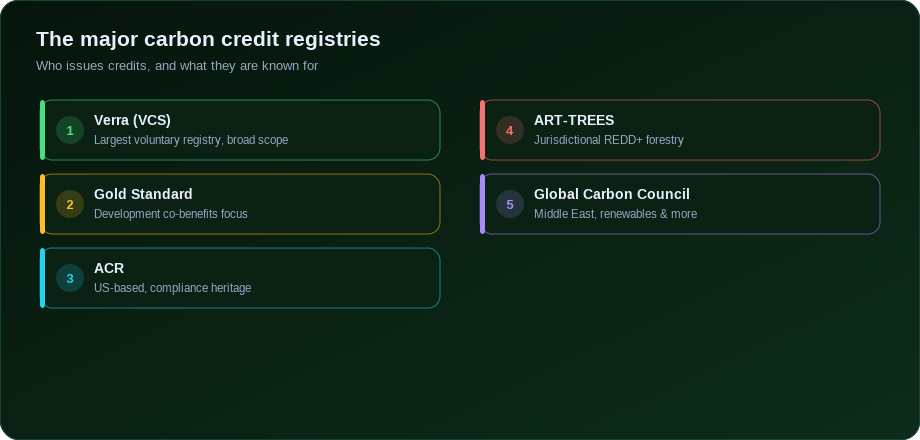
Quick answer: Carbon credit registries are the databases that issue, track, transfer and retire carbon credits, giving every tonne a unique serial number so it can only be claimed once. The main independent registries are Verra, Gold Standard, ACR, Climate Action Reserve, ART, Global Carbon Council, Isometric and Puro. National registries, such as the UAE National Register for Carbon Credits and India's CCTS registry, sit alongside them. A credit only counts once it is retired or cancelled in the right registry, for the right purpose, with the beneficiary named.
Carbon credit registries are the plumbing of the carbon market. Contracts, ratings and marketing all happen around them, but the registry entry is the only thing that proves a credit exists, who owns it and whether it has already been used. If a buyer cannot point to a retirement record in a public registry, they do not have an offset claim. They have an invoice.
This guide explains what a carbon credit registry does, compares the main independent registries, sets out how national and compliance registries in the UAE and India fit in, and walks through opening an account, retiring credits and checking a credit's history yourself. It is written for buyers and sellers in the United States, the Middle East, Europe and India. If you are new to the subject, start with what a carbon credit is. For the rulebooks behind the registries (methodologies, additionality tests and programme approval), see carbon credit standards explained. This page stays on the registry layer.
What a Carbon Credit Registry Actually Does
A standard writes the rules. A registry keeps the ledger. In most independent programmes the two are run by the same organisation, which is why people say "Verra registry" and "Verra standard" almost interchangeably. Some registries are operated on software supplied by a third-party technology provider, but the programme remains responsible for the records.
Every registry, whatever its branding, performs the same core functions.
Issuance
When a project has been validated and its emission reductions or removals have been verified by an independent verification body, the programme reviews the verification report and issues credits into the project developer's account. One credit normally represents one tonne of carbon dioxide equivalent. Issuance is the moment a tonne becomes a tradable unit.
Serial Numbers
Each credit, or each block of credits, receives a unique serial number. The serial number usually encodes the programme, the project ID, the vintage (the year the reduction or removal took place), the issuance batch and the range of units within it. Serial numbers are what make double counting detectable: two certificates cannot honestly carry the same number.
Accounts and Transfers
Registry accounts are held by project developers, traders, brokers and end buyers. A transfer moves credits from one account to another and is recorded with a date and the serial range. A transfer changes ownership but does not use the credit. Credits can change hands many times before anyone claims them.
Retirement
Retirement permanently removes credits from circulation so that the holder, or a named beneficiary, can claim the climate benefit. A retired credit cannot be transferred or retired again. Most registries let the retiring party record a beneficiary name, a purpose (for example "voluntary offsetting of 2025 Scope 1 emissions") and sometimes a reporting period. The retirement record is the evidence behind any offset claim.
Cancellation
In everyday use "cancellation" and "retirement" are often treated as the same thing, and some registries use the words differently. Under CORSIA the formal term is cancellation: an aircraft operator cancels eligible units in a registry for its CORSIA obligation. In some registries cancellation also describes removing credits for administrative reasons, such as correcting an error or reversing over-issuance. The details of CORSIA cancellation and reporting are covered in our knowledge base page on CORSIA registries and cancellation.
Buffer Pools
For projects where stored carbon could be lost, such as forests, soils or some removals, registries hold back a share of each issuance in a pooled buffer account. If a fire, pest outbreak or illegal logging reverses some of the stored carbon, credits are cancelled from the buffer to cover the loss. The buffer share depends on the project's risk rating under the programme's tool. Buffer credits are not saleable and are visible in the registry as a separate account.
Labels and Attributes
Modern registries attach labels to credits to show additional attributes. The most important for buyers are:
| Label or attribute | What it signals | Why it matters |
|---|---|---|
| CORSIA eligibility label | The unit meets CORSIA criteria for a compliance phase, including host-country authorisation where required | Only labelled units can be cancelled for CORSIA obligations |
| Article 6 authorisation label | The host country has authorised the mitigation for international use | Signals that a corresponding adjustment is expected or has been applied |
| CCP label | The credit comes from a programme and methodology approved by the ICVCM under its Core Carbon Principles | A widely used integrity benchmark in the voluntary market |
| Co-benefit or SDG labels | Certified social or environmental outcomes, such as Gold Standard SDG impacts or Verra's CCB and SD VISta | Supports claims beyond tonnes |
| Removal or reduction flag | Whether the tonne was avoided or physically removed | Relevant for net-zero claims and removal-only buyers |
Verra, for example, now separates a CORSIA "scope" label (the unit falls within a phase's eligibility window) from a CORSIA "eligible" label (the unit also carries the Article 6 authorisation and the assurance against double claiming). Only the second allows retirement for CORSIA compliance. Programmes update this guidance regularly, so always read the current label guidance before relying on it. Our guide to the ICVCM Core Carbon Principles explains the CCP label in more depth, and corresponding adjustments for CORSIA covers the authorisation side.
The Main Carbon Credit Registries Compared
The table below summarises the main independent carbon credit registries. Names, unit types and features were checked against programme websites at the time of writing, but registry platforms change. ACR, for instance, has recently moved to a new registry platform, and several programmes are adding labels for Article 6 and CORSIA. Treat the table as orientation, not a substitute for checking the live registry.
| Registry | Unit name | Typical project types | Public search | Notable features |
|---|---|---|---|---|
| Verra Registry (VCS Program) | Verified Carbon Unit (VCU) | REDD+, improved forest management, cookstoves, renewables, methane, blue carbon | Yes, project and issuance/retirement search | Largest volume; CORSIA, Article 6 and CCP labels; AFOLU pooled buffer |
| Gold Standard Impact Registry | Gold Standard VER (and certified SDG impacts) | Cookstoves, water filters, renewables, community projects | Yes | Certified SDG impact statements alongside tonnes |
| ACR Registry (American Carbon Registry) | Emission Reduction Tonne (ERT) | Forestry, landfill and industrial gases, US offset projects | Yes | Long US history; serves voluntary and compliance markets |
| Climate Action Reserve (CAR) | Climate Reserve Tonne (CRT) | US and Mexico forestry, livestock methane, landfill, ozone-depleting substances | Yes | Protocol-based approach; strong North American base |
| ART registry (TREES standard) | TREES credit | Jurisdictional REDD+ at national or large subnational level | Yes | Credits issued to governments for jurisdiction-wide results |
| Global Carbon Council (GCC) | Approved Carbon Credit (ACC) | Renewables, energy efficiency, waste, increasingly other types in the Middle East, South Asia and beyond | Yes | Gulf-based programme; CORSIA-approved for specified scopes |
| Isometric Registry | Isometric credit | Durable carbon removal: biochar, enhanced weathering, direct air capture, bio-oil and similar | Yes, with credit-level data and evidence | Removal-only; publishes calculations and evidence for each credit |
| Puro Registry (Puro.earth) | CO2 Removal Certificate (CORC) | Biochar, carbonated materials, bio-based construction, geologically stored removals | Yes | Removal-only; CORCs used by many corporate removal buyers |
Verra Registry
The Verra registry is the largest by volume of credits issued and retired. Its scale means buyers can find almost any project type there, from large forest conservation programmes to small renewable energy projects. That breadth is also why Verra credits attract scrutiny: the registry carries both well-run and weak projects, and the logo alone tells you little. Verra's labels are now central to how its credits are used. A VCU intended for CORSIA must carry the CORSIA eligible label, and credits from methodologies the ICVCM has approved can carry a CCP label.
Gold Standard Registry
The Gold Standard registry, known as the Impact Registry, tracks projects from listing through certification and records the issuance, transfer and retirement of credits. It also displays certified SDG impacts, which is why it is popular with buyers who need to show community or health benefits, for example from clean cooking or safe water projects. Gold Standard is folding some older registries for other products into the Impact Registry over time.
ACR and CAR Registries
The ACR and CAR registries are the two long-standing US programmes. ACR began as the first private voluntary GHG registry in the United States, and Climate Action Reserve built its reputation on standardised protocols for North American project types. Both have supplied offsets into compliance systems, notably California's cap-and-trade programme, where offsets from approved protocols are listed by those registries before being issued as compliance instruments by the state. For US corporate buyers they remain natural first stops. ACR's registry records transactions negotiated between buyers and sellers; it is not an exchange.
ART and Global Carbon Council
ART's registry is specialised: it issues credits to national or large subnational governments under the TREES standard for reduced deforestation across a whole jurisdiction. Our jurisdictional REDD+ case study shows how that differs from project-level forestry. The Global Carbon Council, based in Qatar, issues ACCs and is relevant to buyers in the Gulf. It is among the programmes ICAO has approved for CORSIA, though, as with every programme, approval applies to specified scopes and vintages, not every credit on the registry.
Isometric and Puro Registries
The Isometric registry and the Puro registry focus on carbon removal rather than avoided emissions. Isometric publishes the data, calculations and evidence behind each credit and issues a retirement certificate once a credit is used, after which the record cannot change. Puro.earth issues CORCs for removal methods such as biochar and carbonated building materials. Both are used by buyers building removal portfolios for net-zero targets. See our guide to carbon removal credits for the methods themselves.
National and Compliance Carbon Credit Registries
Independent registries are no longer the whole picture. Governments are building their own registries to support domestic carbon pricing and Article 6 of the Paris Agreement. These registries can hold domestic compliance units, track international transfers, or record the use of independent credits by regulated companies. The relationship between national registries and independent registries is still developing in most countries, so buyers should expect procedures to change.
UAE National Register for Carbon Credits
The UAE National Register for Carbon Credits was established under Cabinet Resolution No. 67 of 2024 and is run by the Ministry of Climate Change and Environment (MOCCAE). The resolution took effect at the end of December 2024. Its purpose is to record the ownership and retirement of carbon credits held by participating entities in the UAE, linked to emissions reporting by larger emitters. Law-firm summaries describe registration as involving licences, activity reports and facility data, with annual emissions reporting to the ministry.
Compliance deadlines and thresholds under the resolution have been discussed publicly and may be extended or adjusted, so UAE companies should confirm the current position with MOCCAE or legal counsel rather than relying on early summaries. For aviation and other buyers in the region, the practical point is that credits bought from independent registries may also need to be reflected in the national register. Our CORSIA services for the UAE and Middle East page covers how this fits with aviation compliance.
India CCTS Registry
India's Carbon Credit Trading Scheme (CCTS) creates the Indian Carbon Market. The Bureau of Energy Efficiency (BEE) is the administrator, the Central Electricity Regulatory Commission (CERC) regulates trading, and Grid Controller of India Limited (Grid-India) is designated as the registry. The registry maintains electronic records of the issuance, holding, transfer and surrender of Carbon Credit Certificates (CCCs). BEE registers eligible entities and manages the procedures around CCCs, and trading is expected on power exchanges.
The India CCTS registry covers both the compliance mechanism, where obligated entities in notified sectors must meet emission intensity targets, and an offset mechanism for voluntary projects. Its systems and procedures were still being finalised at the time of writing, so check BEE and Grid-India notices for current status. Our explainer on the Indian carbon market and CCTS goes deeper into targets and sectors.
CORSIA and Registry Labels
ICAO does not run a CORSIA registry. Aircraft operators cancel CORSIA Eligible Emissions Units in the registries of the approved programmes (such as Verra, Gold Standard, ACR, CAR, ART or GCC, within their approved scopes) and then report the cancellation to their state authority. For first-phase units (2024 to 2026 compliance), a credit needs a host-country Letter of Authorisation and a commitment to a corresponding adjustment, which is why registries now show CORSIA eligibility labels. Under the second phase (2027 to 2035) the same logic applies to the units approved for that period.
The CORSIA registry labels are therefore the buyer's first check: a unit without the right label cannot be cancelled for compliance, however good the project. Our knowledge base lists the ICAO-approved crediting programmes, and our CORSIA services for the United States page covers US operators.
How to Open a Registry Account
You do not need your own registry account to buy and retire credits. Many buyers, especially smaller companies, retire through an intermediary. Larger buyers, traders and aircraft operators often prefer their own accounts for control and auditability.
Opening Your Own Registry Account
Opening a registry account follows a similar pattern across programmes.
- Choose the registry. Decide which programmes you will buy from. Each registry requires its own account.
- Submit the application. Provide company details, authorised representatives and the intended use of the account (holding, trading, retirement only).
- Complete KYC checks. Expect to provide incorporation documents, proof of address, details of beneficial owners and identity documents for account users. Sanctions and anti-money-laundering screening is standard.
- Sign the terms of use. These set out the account holder's obligations and the programme's rights to correct errors.
- Pay the fees. Most registries charge an account opening or annual fee, and some charge per transaction or per retirement. Check the current fee schedule on the programme's site.
- Set up users and controls. Assign roles so that one person initiates a transfer or retirement and another approves it.
Timelines vary from days to several weeks, depending on how complete your documents are and how busy the registry is. Aircraft operators should open accounts well before a compliance deadline. Our guide to CORSIA registry account setup covers the operator side in more detail.
Retiring Through an Intermediary
The alternative is to buy from a broker, retailer or platform that holds its own registry account and retires the credits on your behalf, naming you as the beneficiary.
| Option | Advantages | Drawbacks |
|---|---|---|
| Own registry account | Full control, direct evidence, easier audit trail, no reliance on a third party | KYC effort, fees, internal controls needed |
| Retirement through an intermediary | Fast, no account administration, suitable for small volumes | Depends on the intermediary naming you correctly; you must check the record yourself |
If you use an intermediary, write into the contract that the retirement must name your legal entity as beneficiary, state the purpose and period, and be completed by a set date, and that the intermediary will send the registry link and serial numbers. Our how to buy carbon credits guide covers sourcing and contracts.
How Retirement Works: A Step-by-Step Walkthrough
Here is how retirement works in practice, from purchase to evidence.
- Agree the purchase. Confirm the project, registry, vintage, quantity, labels required and the serial ranges or batch to be delivered.
- Check the credits before transfer. Look up the project and batch in the public registry. Confirm they are issued, not already retired, and carry any labels you need.
- Receive the transfer. The seller transfers the credits to your account, or the intermediary allocates them in its account. Check the serial range against the contract.
- Prepare the retirement details. Decide the beneficiary name (your legal entity), the purpose and the reporting period. Use consistent wording year to year.
- Submit the retirement. In your account, select the credits, enter the details and submit. Many registries require a second user to approve.
- Wait for confirmation. The registry processes the request and moves the credits to a retired status. This can take from hours to several days.
- Download the evidence. Save the retirement certificate or statement, the public registry link and the serial numbers.
- Reconcile and report. Match the retired quantity and serial numbers to your emissions inventory, your claims and, for CORSIA, your cancellation report to the state authority.
Worked Example (Illustrative)
The numbers below are illustrative only and do not refer to any real company or project.
A logistics company in Europe estimates residual emissions of 4,800 tCO2e for 2025 after its reduction programme. It decides to offset this with a mix of credits and buys from two registries.
| Item | Registry | Quantity (tCO2e) | Labels required |
|---|---|---|---|
| Clean cooking project credits, 2023 vintage | Gold Standard | 3,000 | SDG impact certified |
| Biochar removal credits, 2024 vintage | Puro | 1,800 | Removal |
| Total retired | 4,800 |
The company has its own Gold Standard account, so it receives 3,000 credits from the seller, checks the serial range, and retires them with the beneficiary "Example Logistics BV", purpose "Voluntary offsetting of 2025 residual emissions". It does not have a Puro account, so its broker retires 1,800 CORCs on its behalf with the same beneficiary and purpose.
When the auditor reviews the 2025 sustainability report, the company provides both registry links and serial ranges. The auditor finds that the broker's retirement listed the broker's own name as beneficiary, with the client named only in a free-text note. The company asks the broker to provide a written confirmation and, for future purchases, adds a contract clause requiring the client's legal name in the beneficiary field. The quantity reconciles (3,000 plus 1,800 equals 4,800), but the evidence was weaker than it should have been. This is a common, avoidable problem.
How to Verify a Credit's History in a Public Registry
Anyone can check a credit's history in the public view of most registries without an account. This is the single most useful due diligence step a buyer can take, and it takes minutes.
- Find the project. Search by project ID or name. Note the status (registered, under verification, on hold, withdrawn).
- Read the issuance records. Check vintages, quantities and issuance dates. Compare against the project's monitoring and verification reports, which are usually attached.
- Look up the serial range. Confirm the serial numbers you are offered belong to this project and vintage, and that they are not shown as retired or cancelled.
- Check labels. Confirm CORSIA, Article 6, CCP or co-benefit labels if your purpose needs them.
- Check the buffer and reversals. For forestry and removal projects, see whether any reversals have been reported and how much went to the buffer.
- Review retirements. See who else has retired credits from the project and for what purpose. Very heavy retirement by one party, or retirement long after issuance, can reveal how the credits have been traded.
- Read the documents. Validation and verification reports, the project description and any registry notices about holds, reviews or corrections.
For a fuller quality review, combine the registry check with the approach in our carbon credit quality assessment guide and independent carbon credit ratings.
Red Flags in Carbon Credit Registries and Records
Most problems with carbon credits show up first in the registry record, or in the absence of one. Watch for the following.
- No serial numbers offered. A seller who cannot give serial ranges or a registry link before payment is a serious warning sign.
- Credits on an unfamiliar registry. Some registries are little known, have no public search or are not recognised by any established integrity body. If you cannot find the registry in mainstream market sources, do not buy.
- Mismatch between certificate and registry. A PDF "certificate" that does not match the public record, or cannot be found in it, should be treated as void.
- Already retired credits being resold. Check the status of the specific serial range, not just the project.
- Missing labels. For CORSIA, a unit without the eligibility label cannot be used for compliance, whatever the seller says.
- Project on hold or under review. Registries flag projects under investigation. Buying during a review carries real risk.
- Retirements in a seller's name. If an intermediary retires credits under its own name with no clear beneficiary, your claim is weak.
- Tokenised credits with unclear links. Some digital platforms wrap registry credits into tokens. Ask whether the underlying credits are retired or immobilised in the originating registry, and whether that registry permits the arrangement.
- Double listing. The same project appearing on two registries for the same period and activity needs a clear explanation, such as a formal transfer between programmes.
Our article on carbon credit greenwashing red flags covers how weak claims arise further down the chain, and the registry cancellation error case study shows what goes wrong when the cancellation step is mishandled.
Choosing Between Carbon Credit Registries
The right carbon credit registry depends on what you need the credits for.
| Purpose | Registries usually considered | Key requirement |
|---|---|---|
| CORSIA compliance | Programmes approved by ICAO for the relevant phase | CORSIA eligible label, Letter of Authorisation, corresponding adjustment |
| Voluntary net-zero claims with removals | Isometric, Puro, and removal projects on Verra or Gold Standard | Removal flag, durability, transparent evidence |
| Community and SDG outcomes | Gold Standard, Verra with co-benefit labels | Certified co-benefit statements |
| US compliance-linked offsets | ACR, CAR | Protocol approved by the relevant state programme |
| Domestic compliance in India | India CCTS registry | Registration with BEE and Grid-India |
| UAE regulatory reporting | UAE National Register for Carbon Credits, alongside source registries | Registration with MOCCAE |
Developers face the mirror image of this choice: choose the programme whose methodologies fit your project and whose registry your target buyers trust. The detailed comparison of methodologies and approval criteria is in carbon credit standards explained, and the broader context of authorised units is in our guide to Article 6 of the Paris Agreement.
Good Record-Keeping After Retirement
Retirement is the end of the credit's life but not the end of the buyer's work. Keep a simple retirement register for every year.
- Registry name, project ID and project name
- Vintage, quantity and serial range
- Date of retirement and beneficiary name as shown in the registry
- Purpose and reporting period as entered
- Public registry link and downloaded certificate
- Contract reference and invoice
- The emissions inventory line or compliance report the retirement supports
Auditors and, for CORSIA, verification bodies and state authorities may ask for this evidence years later, so store downloaded copies as well as links.
How DSTechnoverse Helps
DSTechnoverse supports buyers, sellers and aircraft operators on the data and integrity side of carbon credits. We check registry records, serial ranges and labels before purchase, review CORSIA eligibility and host-country authorisation, support registry account setup and cancellation, and reconcile retirements against emissions inventories and compliance reports. We do not act as a verification body. See our CORSIA carbon credit services, our regional pages for the UAE and Middle East and the United States, and data analytics support. To discuss a purchase or a registry question, contact our team.
Frequently Asked Questions
What is a carbon credit registry? A carbon credit registry is the database that issues, tracks, transfers and retires carbon credits. Each credit receives a unique serial number recording its project, vintage and batch. The registry shows who holds each credit and whether it has been used, which prevents the same tonne from being claimed twice. Most registries are run by the carbon standard that certifies the projects.
What is the difference between a carbon standard and a registry? The standard sets the rules: methodologies, additionality tests, verification requirements and programme governance. The registry is the ledger that records the units the standard issues. In most independent programmes, such as Verra and Gold Standard, the same organisation runs both, but the functions are distinct. A good registry cannot fix a weak methodology.
Do I need my own registry account to retire carbon credits? No. Many buyers retire through a broker or platform that holds an account and retires credits on their behalf. If you do this, require that the retirement names your legal entity as beneficiary, states the purpose and period, and that you receive the registry link and serial numbers. Larger buyers and aircraft operators usually prefer their own accounts.
How do I check whether a carbon credit has already been retired? Use the registry's public search. Look up the project, then the specific serial range you are being offered. The record will show whether the units are issued and available, retired or cancelled. Check the labels on the same batch. If the seller cannot give you serial numbers or the credits do not appear in the public registry, do not proceed.
What is the difference between retirement and cancellation? Both permanently remove credits from circulation. Retirement is the usual term for voluntary claims. Under CORSIA, aircraft operators cancel eligible units for their compliance obligation and report the cancellation to their state. Some registries also use cancellation for administrative removals, such as correcting errors or covering reversals. Always check the registry's own definitions.
Which registries can be used for CORSIA? Only programmes approved by ICAO, and only units within each programme's approved scope and eligibility window. Operators cancel units in the programme's own registry. ICAO does not operate a central registry. For first-phase compliance, units also need a host-country Letter of Authorisation and a corresponding adjustment, which registries show through CORSIA eligibility labels.
What is the UAE National Register for Carbon Credits? It is a national register established under Cabinet Resolution No. 67 of 2024 and run by the UAE Ministry of Climate Change and Environment. It records the ownership and retirement of carbon credits by participating entities, linked to emissions reporting by larger emitters. Deadlines and thresholds may be adjusted, so confirm the current requirements with the ministry.
Who runs the India CCTS registry? Under India's Carbon Credit Trading Scheme, Grid Controller of India Limited acts as the registry, keeping electronic records of Carbon Credit Certificates. The Bureau of Energy Efficiency is the administrator and registers entities, and the Central Electricity Regulatory Commission regulates trading. Procedures were still being finalised at the time of writing, so check official notices.
What is a buffer pool in a carbon registry? A buffer pool is an account where a registry holds back a share of credits from projects whose stored carbon could be lost, such as forests. If a fire or other event reverses some of the carbon, credits are cancelled from the buffer to cover it. The share withheld depends on the project's risk rating. Buffer credits cannot be sold.
Does a well-known registry guarantee credit quality? No. A registry records units accurately, but quality depends on the specific project's additionality, baseline, permanence and monitoring. Every major registry holds both strong and weak projects. Use the registry to confirm the facts about a credit, then assess the project itself through documents, ratings and independent due diligence.
Apply as a carbon credit buyer or seller
Buying, selling or evaluating carbon credits? DSTechnoverse works on the data and integrity side of carbon procurement — project screening, registry and eligibility verification, MRV and monitoring-data analysis, reconciliation and defensible reporting. See our CORSIA carbon credit services and data analytics. We are based in Indore, Madhya Pradesh and work across India and internationally.
Apply as a carbon credit buyer or seller
Talk to our team, or start with the complete carbon credits guide.