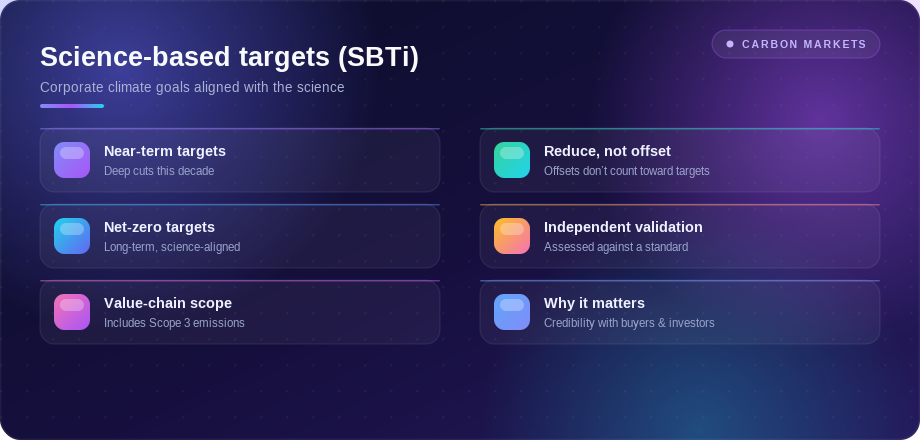
Quick answer: Science based targets are corporate emissions-reduction goals set in line with what climate science says is needed to limit warming to 1.5°C, and the Science Based Targets initiative (SBTi) is the body that sets the rules and checks each target. A company sets a near-term target (5 to 10 years), can add a long-term or net-zero target, submits it to the SBTi for validation, then reports progress every year. Carbon credits do not count towards the reductions. They only have a role beyond the value chain and, at net zero, for neutralising residual emissions with removals. Version 1.3.1 still applies to most 2026 and 2027 submissions; version 2.0, published in June 2026, opens for target setting from February 2027.
Science based targets are now the reference point for corporate climate goals, asked about in supplier questionnaires, tenders and investor screens. Yet many companies think a science-based target means "net zero by 2050", or assume they can buy carbon credits to meet it. Both assumptions are wrong. This guide covers the criteria, validation, the SME route, sector guidance, carbon credits and version 2.0, with a worked example and the common reasons targets are rejected.
We do not repeat the basics of emissions accounting here. If scope 1, 2 and 3 are new to you, start with GHG accounting explained: scope 1, 2 and 3. If you want to know how a net-zero claim differs from a carbon-neutral one, see carbon neutral vs net zero.
What Is SBTi? The Science Based Targets Initiative in Brief
The Science Based Targets initiative began in 2015 as a partnership between CDP, the UN Global Compact, the World Resources Institute (WRI) and WWF. The We Mean Business Coalition was involved as well. It has since become an independent organisation with its own governance. A Technical Council approves standards and a Board of Trustees adopts them. Validation is run by a separate services entity.
The SBTi does three things.
- It writes standards. The SBTi Corporate Net-Zero Standard, the near-term criteria and a set of sector guidance documents define what counts as a science-based target.
- It validates targets. Companies submit their targets and supporting data. SBTi reviewers check them against the criteria and either approve them or explain why they cannot be approved.
- It publishes results. Approved targets, and the status of companies that have committed, appear on the SBTi's public Target Dashboard.
What "Science-Based" Actually Means
A target is science-based if the cut it commits to matches the pace and depth of decarbonisation that climate science says is needed to keep warming to 1.5°C above pre-industrial levels. The SBTi derives these pathways from scenarios assessed by the Intergovernmental Panel on Climate Change (IPCC) and from the International Energy Agency (IEA). Then it turns them into either a uniform global reduction rate (the "absolute contraction" approach) or sector-specific intensity pathways (the "sectoral decarbonisation" approach).
So the minimum ambition is set by the pathway, not chosen because a round number sounds good. A target that falls short of it is not science-based.
Near-Term and Long-Term Targets, and the Net-Zero Target
Under the framework most companies use today (Corporate Net-Zero Standard version 1.3.1 with near-term criteria version 5.3.1), there are three kinds of target.
| Target type | Timeframe | What it requires | Mandatory? |
|---|---|---|---|
| Near-term target | 5 to 10 years from the date of submission | Cuts in scope 1 and 2 at least in line with 1.5°C; a scope 3 target where scope 3 is material | Yes, for every company setting a science-based target |
| Long-term target | Net-zero year, no later than 2050 | Cuts of at least 90% in most sectors across scopes 1, 2 and 3 (some sector pathways differ) | Required only if the company sets a net-zero target |
| Net-zero target | By 2050 at the latest | A long-term target plus neutralising residual emissions with permanent removals | Optional under V1, but most large companies set one |
The near-term target matters most because it drives action this decade. Submit in 2026 and the target year must fall between 2031 and 2036. The base year should be the most recent year with complete data, and no earlier than 2015.
The long-term target sets the destination: for most sectors, at least a 90% absolute cut by 2050, though some sector pathways are set as intensity rates. A company reaches net zero under V1 when it has met that target and neutralised the residual (no more than about 10% of base-year emissions in most sectors) with permanent removals such as direct air capture with storage or biochar, not avoidance credits. See carbon removal credits explained.
SBTi Criteria: What a Valid Science-Based Target Must Include
The near-term criteria are a long, detailed document, but most of the requirements fall into a few groups. The table below summarises the main requirements under the near-term criteria (version 5.x) used with Net-Zero Standard version 1.3.1. They apply to companies outside the SME route and outside sectors with mandatory sector guidance.
| Criterion | Requirement (V1 framework) |
|---|---|
| Inventory | A complete GHG inventory under the GHG Protocol, covering all seven Kyoto gases, with a full screening of all 15 scope 3 categories |
| Scope 1 and 2 boundary | The target must cover at least 95% of company-wide scope 1 and 2 emissions |
| Scope 3 trigger | A scope 3 target is required if scope 3 is 40% or more of total scope 1, 2 and 3 emissions |
| Scope 3 near-term coverage | Near-term scope 3 targets must together cover at least two-thirds (67%) of total scope 3 emissions |
| Scope 3 long-term coverage | Long-term targets must cover at least 90% of scope 3 emissions |
| Scope 1 and 2 ambition | At least 1.5°C-aligned; for absolute contraction, a minimum linear annual reduction of 4.2% |
| Scope 3 ambition | At least well-below 2°C for near-term; for absolute contraction, a minimum linear annual reduction of 2.5% |
| Timeframe | Near-term: 5 to 10 years from submission; base year no earlier than 2015 |
| Exclusions | Offsets and avoided emissions cannot count towards reductions |
| Recalculation | Targets must be reviewed, and recalculated where needed, at least every five years, or sooner if significant changes occur |
Scope Coverage Thresholds
The 95% boundary means a company cannot leave out a factory, fleet or subsidiary because it is hard to decarbonise; exclusions up to 5% must be justified. For most manufacturers, retailers and service firms scope 3 is well over 40% of the total, so a scope 3 target is almost always required, and companies add their largest categories until they pass the 67% mark.
Ambition Aligned to 1.5°C
Under absolute contraction, every company applies the same minimum rate: 4.2% a year, linear, for scope 1 and 2 (about 38% over nine years) and 2.5% a year for scope 3. Companies in sectors with a sectoral decarbonisation approach, such as power, cement, steel and buildings, can set physical intensity targets instead. A "per unit of revenue" target that lets absolute emissions rise is not accepted for scope 1 and 2.
SBTi Scope 3 Target Options
The SBTi scope 3 target is where companies have the most choice. Under V1 a company can use:
- Absolute reduction targets, for example a 25% cut in purchased goods emissions by 2033.
- Physical intensity targets, for example emissions per tonne of product, which must reach the required ambition level.
- Supplier or customer engagement targets, for example a commitment that suppliers making up a set share of emissions will have their own science based targets within five years.
Engagement targets count towards coverage only within set limits and need a credible plan behind them. For scope 2, a renewable electricity sourcing target (80% by 2025 and 100% by 2030 under V1) can replace or sit alongside an absolute target, though version 2.0 moves towards physical, time-matched procurement.
How SBTi Target Validation Works, Step by Step
SBTi target validation is a formal process with fees and fixed timelines. The validation service sets the fees, which vary by company size and target type, and they change from time to time, so check the current fee schedule on the SBTi website. The steps below describe the standard route under V1.
- Commit (optional but common). A company signs a commitment letter saying it will set a science-based target. It then has 24 months to submit a target for validation. If it misses that window, the dashboard shows the commitment as removed, which is publicly visible and damaging.
- Build the inventory. Prepare a complete scope 1, 2 and 3 inventory for the base year under the GHG Protocol, with a full screening of the 15 scope 3 categories. Most of the work happens at this stage, and most rejections start here.
- Model the targets. Use the SBTi's target-setting tools to calculate the minimum ambition for each scope, choose the target year and decide on target types (absolute, intensity, engagement).
- Submit. File the official submission form with the inventory, target wording (scope, base year, target year, percentage), boundary, exclusions and evidence.
- Validation. After a completeness check, a reviewer assesses every criterion and usually sends questions; targets can be clarified or revised in the review window.
- Decision. Approved, or not approved with reasons; a resubmission may carry a further fee.
- Communicate. Approved targets appear on the Target Dashboard. Use the validated wording exactly.
- Disclose and review. Report progress every year (often via CDP or an annual report), review the target at least every five years and recalculate sooner after acquisitions, divestments or significant errors. Lapsed or withdrawn targets are shown as such on the dashboard.
Allow several months overall. Fixing a weak scope 3 inventory is usually the longest step.
SBTi for SMEs: The Streamlined Route
Small and medium-sized enterprises have their own SBTi route. Under the V1 framework, it lets eligible companies skip the commitment stage and the full validation process. They choose from predefined targets and receive approval through a simpler check.
The SME definition was revised from 1 January 2024. Broadly, a company qualifies if it is independent (not part of a larger group that would not qualify), is below employee, turnover and asset thresholds (the main test is fewer than 250 employees), and has combined scope 1 and location-based scope 2 emissions below 10,000 tCO2e. It must not be a financial institution or in the oil and gas sector, and must not belong to a sector where sector guidance is mandatory. Check the SBTi's SME eligibility page for the exact current tests, as they have changed more than once.
| SME route feature | What it involves (V1 framework) |
|---|---|
| Commitment stage | Not required |
| Scope 1 and 2 target | Choose a predefined 1.5°C-aligned near-term target for scope 1 and 2 |
| Scope 3 | Commit to measure and reduce scope 3 emissions; a numerical scope 3 target is not required |
| Net-zero | Optional; SMEs can also commit to net zero |
| Validation | Simplified check against eligibility and the predefined targets |
| Fee | A fixed, lower fee than the standard route |
What Changes for SMEs Under Version 2.0
Version 2.0 replaces the SME route with Category B (small companies everywhere and medium-sized companies in lower-income countries), which has lighter requirements, with scope 3 targets largely optional. The SBTi says companies meeting the Category B classification can request SME status under the current standard.
For a wider look at how small firms can approach carbon without a large sustainability team, see carbon credits for small businesses.
SBTi Sector Guidance: Aviation, FLAG and Others
The cross-sector method (absolute contraction) is not a good fit for every sector, so the SBTi has published sector guidance for high-emitting or unusual sectors. In some sectors, companies must use the sector guidance; in others it is optional.
| Sector | Guidance focus | Notes |
|---|---|---|
| Forest, Land and Agriculture (FLAG) | Separate FLAG targets for land-use emissions and removals | Required if FLAG emissions are 20% or more of total emissions, or the company is in a FLAG-designated sector; includes a no-deforestation commitment |
| Aviation | Intensity pathways for airlines (CO2 per revenue tonne-kilometre) | Well-to-wake accounting; recognises the role of sustainable aviation fuel |
| Maritime | Intensity pathways for shipping | Well-to-wake basis |
| Power | Intensity pathway for electricity generation | Steep decarbonisation; coal phase-out expectations |
| Buildings | Operational and embodied emissions of buildings | Covers owners, developers and managers |
| Cement, steel, chemicals | Physical intensity pathways | Some still in development or recently revised |
| Financial institutions | Financed emissions (portfolio targets) | Separate Financial Institutions Net-Zero Standard |
| Oil and gas | No validation route for most companies | The SBTi does not validate companies whose main business is fossil fuels |
FLAG Targets
FLAG covers land-use change (mainly deforestation), on-farm emissions such as livestock methane and fertiliser nitrous oxide, and land-based removals. Food, agriculture, forestry and paper companies must set a separate FLAG target and commit to no deforestation, with a target date of no later than 31 December 2025. FLAG removals count only within the value chain, which is different from buying forestry credits.
Aviation
The aviation guidance uses well-to-wake intensity pathways per revenue tonne-kilometre, so sustainable aviation fuel can cut emissions within the boundary, but CORSIA offsetting units do not count. An airline can comply with CORSIA and still be off-track on its SBTi target. See CORSIA sustainable aviation fuels and what is CORSIA. For companies whose flights sit in scope 3, see business travel emissions.
SBTi and Carbon Credits: Where Offsets Fit and Where They Do Not
This is the most misunderstood part of the framework, and it has also been the most contested part since 2024.
The Core Rule
Carbon credits do not count towards emissions reductions in a science-based target. The target measures the company's own emissions across its operations and value chain. Buying a credit funds a reduction or removal somewhere else, but it does not change the company's inventory, so it does not move the company along its pathway. That rule holds under version 1.3.1 and under version 2.0. If you need the basics of what a credit is, see what is a carbon credit.
Where Credits Do Have a Role
| Use | What it means | Counts towards the target? |
|---|---|---|
| Beyond value chain mitigation (BVCM) | Funding emission reductions or removals outside the value chain while the company cuts its own emissions | No, it is recognised as additional action |
| Neutralisation of residual emissions | Permanent removals to balance residual emissions at the net-zero target year | Required for a net-zero claim, but only after the long-term target is met |
| Insetting within the value chain | Reductions or removals inside the company's own supply chain, accounted for in the inventory | Can count if they show up in the inventory under GHG Protocol rules |
| Avoided emissions claims | Emissions avoided by a company's products, such as efficient equipment | No, reported separately |
The difference between buying credits from outside and investing in reductions inside your own supply chain is covered in carbon insetting vs offsetting.
What Changed Between 2024 and 2026
In April 2024 the SBTi's Board of Trustees issued a statement suggesting a wider role for environmental attribute certificates, including carbon credits, in scope 3 abatement. Staff and many stakeholders objected publicly. The SBTi then published evidence reviews in July 2024. These found that many kinds of carbon credit were not effective in delivering intended outcomes, though the evidence on some types was limited or mixed.
The issue was then folded into the revision of the Net-Zero Standard. Drafts in 2025 put beyond value chain mitigation, removals and neutralisation into a single framework for "ongoing emissions": the emissions a company still produces while it cuts.
The final version 2.0 (June 2026) keeps the core rule. It adds a voluntary, tiered Ongoing Emissions Responsibility (OER) recognition framework, which the SBTi says launches in 2027, and signals a removals requirement for Category A companies from 2035 (analyses describe a ramp from about 1% of emissions in 2035 to full neutralisation at the net-zero year). An Interoperability and Recognition Framework for credits and certificates is expected in late 2026. Treat these details as indicative until the supporting materials are final.
What This Means for Buyers of Credits
Cut first, report reductions separately and buy credits as a clearly labelled additional contribution, choosing high-integrity units. The ICVCM Core Carbon Principles and a structured carbon credit quality assessment are good starting points. Avoid wording that suggests the credits help meet the target. That is the claim regulators and campaigners look for. See carbon credit greenwashing red flags.
SBTi Net-Zero Standard Version 2.0: What Is Changing
The SBTi published Corporate Net-Zero Standard version 2.0 on 11 June 2026, after a two-year revision with several rounds of public consultation. The Technical Council approved it in May 2026 and the Board of Trustees adopted it shortly after.
Timeline
| Date | What happens |
|---|---|
| June 2026 | V2.0 published |
| Late 2026 | Supporting materials (guidance, tools, renewal policy, recognition framework) finalised |
| 1 February 2027 | V2.0 opens for target setting |
| End of 2027 / January 2028 | V1.3.1 and near-term criteria close to new submissions; after that, all companies use V2.0 |
The SBTi recommends that companies with commitments or renewals due in 2026 or 2027 keep using V1.3.1 and move to V2.0 at their next target cycle. Existing approved targets stay valid until the end of their timeframe or their five-year review, whichever comes first.
Main Changes (Indicative)
- Company categories. Category A and Category B replace the single standard route and the SME route, with different ambition and coverage rules for each.
- A more recent base year. Targets are to be based on the most recent year of comprehensive emissions data.
- Scope 1 and 2 set separately. Scope 1 and scope 2 targets are disclosed separately, with more target types (absolute, sector intensity, asset transition, low-carbon electricity alignment). Scope 2 rules lean towards physical, location-based measures and time-matched procurement.
- Scope 3 coverage based on significance. Instead of the 67% coverage rule, larger companies must cover each scope 3 category above a significance threshold (reported as 5% of scope 3), and low-impact activities can be excluded. More target types are allowed, including supplier and product alignment.
- Long-term targets recommended, not required. Some sources say the overarching net-zero target becomes optional, though the SBTi still expects companies to commit to reaching net zero.
- Assurance. Category A companies will need third-party assurance of base-year and target data.
As supporting documents were still being finalised in November 2026, a company planning a first submission in 2027 should pick its version early and build an inventory that meets the stricter one.
Worked Example: Setting a Near-Term Target
The figures below are illustrative only. They describe a fictional company to show how the V1 near-term criteria work in practice. They are not data about any real business.
The company. A mid-sized packaging manufacturer with plants in three countries. It plans to submit in 2026 and has a complete 2024 inventory that has been externally reviewed.
| Scope (2024 base year, illustrative) | tCO2e | Share of total |
|---|---|---|
| Scope 1 (gas boilers, process heat, fleet) | 30,000 | 15% |
| Scope 2 (purchased electricity, market-based) | 20,000 | 10% |
| Scope 3 (all 15 categories screened) | 150,000 | 75% |
| Total | 200,000 | 100% |
Step 1: Check the boundary. Scope 1 and 2 cover all three plants and the fleet. One small sales office (0.5% of scope 1 and 2) is excluded and documented. Coverage is 99.5%, above the 95% threshold.
Step 2: Is a scope 3 target required? Scope 3 is 75% of total emissions, above the 40% trigger, so yes.
Step 3: Choose the target year. Submitting in 2026 means the target year must fall between 2031 and 2036. The company chooses 2033, nine years after its 2024 base year.
Step 4: Scope 1 and 2 ambition. At the minimum 1.5°C rate of 4.2% a year, linear, over nine years: 9 × 4.2% = 37.8%. The company rounds up to 38%.
- Base: 50,000 tCO2e
- Target: 50,000 × (1 − 0.38) = 31,000 tCO2e by 2033
Step 5: Scope 3 coverage. The largest categories are:
| Scope 3 category (illustrative) | tCO2e | Share of scope 3 |
|---|---|---|
| Cat. 1 purchased goods (resin, paper, inks) | 100,000 | 66.7% |
| Cat. 4 upstream transport | 15,000 | 10.0% |
| Cat. 12 end-of-life of sold products | 20,000 | 13.3% |
| All other categories | 15,000 | 10.0% |
Category 1 alone is 66.7%, just below the 67% mark. Adding category 4 brings the target boundary to 115,000 tCO2e, or 76.7% of scope 3, comfortably above the threshold.
Step 6: Scope 3 ambition. At the well-below 2°C minimum of 2.5% a year over nine years: 9 × 2.5% = 22.5%.
- Covered base: 115,000 tCO2e
- Target: 115,000 × (1 − 0.225) = 89,125 tCO2e by 2033
The company could instead set a supplier engagement target for part of category 1. For example, it could commit that suppliers responsible for a set share of purchased-goods emissions will have their own science based targets by 2031. It would then pair that with an absolute target on the rest.
Step 7: Draft the target wording. For example: "Company X commits to reduce absolute scope 1 and 2 GHG emissions 38% by 2033 from a 2024 base year. Company X also commits to reduce absolute scope 3 GHG emissions from purchased goods and services and upstream transportation and distribution 22.5% within the same timeframe."
Step 8: Test the plan. The reviewer checks the criteria, not realism, but the board will care. Here the scope 1 and 2 cut might come from electrified process heat, a renewable power purchase agreement and fleet electrification, and the scope 3 cut from recycled-content resin, lighter designs and rail freight. No carbon credits appear anywhere in the target maths.
Common Reasons SBTi Targets Get Rejected
Targets that fail validation usually fail for a predictable set of reasons. Most of them come down to data and boundary, not ambition.
| Reason for rejection | What goes wrong | How to avoid it |
|---|---|---|
| Incomplete scope 3 screening | Categories marked "not relevant" without evidence, or estimated with poor data | Screen all 15 categories, document every exclusion and use spend, activity or supplier data appropriately |
| Boundary gaps | Scope 1 and 2 coverage below 95%, often because subsidiaries or joint ventures were left out | Align the boundary with the consolidation approach (operational control, financial control or equity share) and apply it consistently |
| Ambition below the minimum | The linear annual reduction falls short of 4.2% (scope 1 and 2) or 2.5% (scope 3) | Use the SBTi target-setting tool and leave a margin |
| Timeframe outside the window | Target year less than 5 or more than 10 years from submission | Count from the submission date, not from the base year |
| Counting offsets or avoided emissions | Credits, or emissions avoided by products, included in target progress | Keep credits and avoided emissions out of the inventory and the target |
| Wrong use of intensity targets | Economic intensity targets (per unit of revenue) for scope 1 and 2 | Use absolute targets or approved sector pathways |
| Missing FLAG target | A food or agriculture company without a separate FLAG target or no-deforestation commitment | Check the FLAG trigger early |
The common thread is the inventory. For the basics of converting different gases into one figure, see what is CO2e.
Why Science Based Targets Matter Commercially
A validated target is also a commercial credential. Large buyers with scope 3 targets ask suppliers to set their own, investors and lenders screen for them, and disclosure frameworks such as the EU sustainability reporting rules and ISSB-based standards ask how transition targets were set. It also holds up better against regulators' scrutiny of vague climate claims (see ESG reporting and carbon credits). But it is a public promise: lapsed commitments are flagged on the dashboard, so set a target you have a plan to meet.
How DSTechnoverse Helps
DSTechnoverse works on the data side of corporate climate targets and carbon credits. We help organisations check emissions inventories for gaps, analyse activity and supplier data, model target pathways under the SBTi criteria, and build tracking that keeps reductions and credits clearly separated. Where companies also buy or sell credits, we support eligibility checks, due diligence and registry documentation through our CORSIA carbon credit services. Our data analytics and statistical and research data analysis teams handle the inventory and modelling work. We do not validate targets or verify emissions reports. Contact us to discuss your data.
Frequently Asked Questions
What is SBTi? The Science Based Targets initiative is an independent organisation that writes standards for corporate climate targets and validates companies' targets against them. It was founded in 2015 by CDP, the UN Global Compact, WRI and WWF. Approved targets are published on its public Target Dashboard, so anyone can check whether a company's claim is real.
What is the difference between near-term and long-term targets? A near-term target covers 5 to 10 years from submission and requires cuts in scope 1 and 2 at least in line with 1.5°C, plus a scope 3 target where scope 3 is material. A long-term target sets the destination, typically at least a 90% cut across all scopes by 2050 at the latest.
Do carbon credits count towards a science-based target? No. Credits do not change a company's own emissions inventory, so they cannot count towards its reductions. They can be used for beyond value chain mitigation as an additional contribution, and permanent removals are needed to neutralise residual emissions at the net-zero target year. Version 2.0 keeps this rule.
When does an SBTi scope 3 target become mandatory? Under the current V1 framework, a scope 3 target is required when scope 3 makes up 40% or more of total scope 1, 2 and 3 emissions. The near-term scope 3 target must cover at least 67% of scope 3. Under version 2.0, coverage is based on significant categories instead.
How long does SBTi target validation take? It depends mostly on how ready the inventory is. The formal review usually takes a few months, including questions from the reviewer. Building a complete scope 3 inventory before submission often takes longer than the review itself. Companies that commit first have 24 months to submit.
What is the SBTi Net-Zero Standard version 2.0? It is the revised Corporate Net-Zero Standard, published in June 2026. It introduces Category A and B companies, a more recent base year, significance-based scope 3 coverage, assurance for larger companies and a framework for ongoing emissions. It opens for target setting from February 2027, and version 1.3.1 closes to new submissions around the end of 2027.
Can SMEs set science based targets? Yes. Under the V1 framework, eligible SMEs can use a streamlined route with predefined scope 1 and 2 targets, a commitment to measure and reduce scope 3, a simpler check and a lower fixed fee. Under version 2.0, Category B replaces the SME route with lighter requirements.
Why do SBTi targets get rejected? The most common reasons are incomplete scope 3 screening, scope 1 and 2 coverage below 95%, ambition below the minimum pathway, a target year outside the 5-to-10-year window, offsets or avoided emissions counted as reductions, and missing FLAG targets for land-intensive companies. Most problems start with the inventory.
Does a CORSIA-compliant airline automatically meet its SBTi target? No. CORSIA is a compliance scheme that lets airlines offset growth in international aviation emissions with eligible units. SBTi aviation targets measure actual emissions intensity on a well-to-wake basis, and offsetting units do not count. An airline can meet one and miss the other, so it needs to track both.
Working with carbon credits or a climate target? DSTechnoverse works on the data and integrity side of carbon — project screening, registry and eligibility verification, MRV and monitoring-data analysis, reconciliation and defensible reporting. See our CORSIA carbon credit services and data analytics. We are based in Indore, Madhya Pradesh and work across India and internationally.
Apply as a carbon credit buyer or seller
Talk to our team, or start with the complete carbon credits guide.