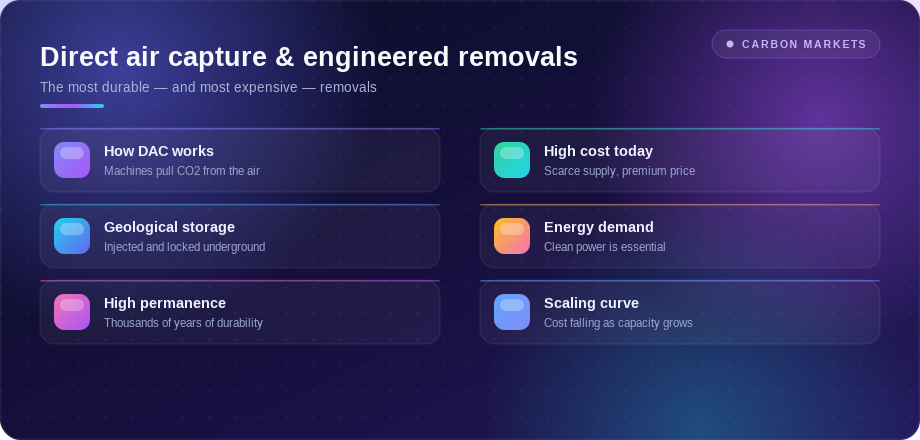
Quick answer: Direct air capture (DAC) uses fans and chemical sorbents or solvents to pull carbon dioxide out of ordinary air, then concentrates it so it can be stored deep underground or locked into minerals. Stored that way, each tonne is a durable carbon removal, which is why DAC carbon removal credits sit at the top of the durability scale. It is also the most expensive removal (the IEA estimated USD 500 to 1,900 per tonne for current projects in 2025). The US 45Q tax credit pays up to USD 180 per tonne for DAC with secure storage. Buyers usually hold DAC as a small, high-durability slice of a removal portfolio.
Direct air capture is the technology that pulls carbon dioxide straight out of the atmosphere, wherever the machine happens to sit, rather than from a chimney or exhaust pipe. When that CO2 is stored permanently, the result is a tonne physically removed from the air, which is the most defensible kind of climate claim a buyer can make. It is also the most expensive, the slowest to scale and the most dependent on policy.
This guide explains how direct air capture technology works, how it compares with point-source carbon capture and storage (CCS) and BECCS, the US 45Q and DAC hubs position after the 2025 changes, what the first plants have delivered, and how DACCS credits are certified. It is written for buyers and investors in the US, the Middle East and Europe. For the wider removal market and the full CORSIA picture, see our carbon removal credits hub; if you are new to the topic, start with what a carbon credit is.
What Is Direct Air Capture?
Direct air capture is a group of engineered processes that separate CO2 from ambient air. The air contains only about 0.04% CO2 (around 420 parts per million), so a DAC plant has to move very large volumes of air across a capture material to collect a meaningful amount. Once captured, the CO2 is released from the material as a concentrated stream, compressed, and then either stored or used.
Three points matter for anyone buying or financing DAC:
- It is location-independent. Air is well mixed, so a plant can sit wherever storage geology and low-carbon energy exist.
- It is a removal only if the CO2 is stored durably. CO2 turned into fuel or drinks returns to the air within months.
- Its net benefit depends on energy. If the plant runs on fossil energy, its own emissions can cancel much of what it captures. Credible DAC carbon removal accounting subtracts every tonne emitted along the way.
When DAC is paired with permanent storage it is usually called DACCS (direct air carbon capture and storage). DACCS credits are the tradeable units that represent one net tonne removed and stored after those deductions.
How Does Direct Air Capture Work?
All DAC systems follow the same basic cycle: contact air with a material that binds CO2, then use energy to release that CO2 as a pure stream and regenerate the material for the next cycle. The two main families differ in the material and in the temperature needed to regenerate it.
Liquid Solvent Systems
Liquid systems pass air through contactors where it meets a strong alkaline solution, typically potassium hydroxide, which reacts with CO2 to form a carbonate. Through a series of chemical loops, the carbonate is converted to a solid (calcium carbonate pellets) that is then heated in a calciner to around 900 degrees Celsius to drive off pure CO2. The process was developed at scale by Carbon Engineering, which Occidental acquired in 2023 and whose technology is used at the Stratos plant in Texas.
Liquid systems suit very large plants and continuous operation, but the high-temperature step has historically been met with natural gas combustion, with the resulting CO2 captured alongside the air-derived CO2. Electrifying that step is one of the main engineering challenges.
Solid Sorbent Systems
Solid sorbent systems blow air through modules lined with a porous material, often an amine-functionalised sorbent, which binds CO2 at its surface. When the material is saturated, the module is closed and heated to roughly 80 to 120 degrees Celsius, sometimes under vacuum, to release the CO2. Climeworks in Switzerland uses this approach at its Iceland plants, and several newer companies use variants of it.
Because the regeneration temperature is low, solid sorbent plants can use waste heat, geothermal heat or heat pumps. They are modular, which makes them easier to build in stages, but the sorbents degrade over time and must be replaced, and module performance can vary with humidity and temperature.
Developers are also testing electrochemical, moisture-swing and limestone-based designs (Heirloom uses the last), mostly at pilot or early commercial stage.
Energy Needs Compared
| Feature | Liquid solvent | Solid sorbent |
|---|---|---|
| Capture material | Alkaline solution (for example potassium hydroxide) | Amine or similar sorbent on a solid support |
| Regeneration temperature | Around 900 degrees Celsius | Roughly 80 to 120 degrees Celsius |
| Typical heat source | Natural gas with capture today, electrification in development | Waste heat, geothermal, heat pumps |
| Scale profile | Large single plants | Modular, built in units |
| Main engineering issues | High-temperature heat, water use, plant size | Sorbent lifetime, humidity effects, unit cost |
| Example | Stratos (1PointFive, Texas) | Orca and Mammoth (Climeworks, Iceland) |
Published estimates of total energy demand for both families have generally fallen in the range of several gigajoules per tonne of CO2, with wide uncertainty and with most of it as heat. For buyers, the practical question is not the exact number but whether the plant's energy is low-carbon and fully counted in the credit methodology.
Where the CO2 Goes: Storage, Mineralisation and Utilisation
The capture step is only half of the removal. The other half is putting the carbon somewhere it will stay.
- Geological storage in saline formations. Dense-phase CO2 is injected more than about 800 metres down into porous, brine-filled rock under an impermeable cap rock. In the US these are Class VI wells under the Safe Drinking Water Act, with monitoring and post-injection care rules.
- In-situ mineralisation. CO2 dissolved in water is injected into reactive rock such as basalt, where it forms solid carbonates. Carbfix in Iceland, which stores Climeworks' CO2, has reported most injected CO2 mineralising within about two years.
- Mineralisation in materials. CO2 injected into concrete or aggregates becomes a stable carbonate, at small volumes per site.
- Utilisation in short-lived products. Fuels, chemicals and beverages release the CO2 again. This can displace fossil carbon but is not a removal.
- Enhanced oil recovery (EOR). The CO2 stays largely underground, but the extra oil is burned, so the net removal is contested and most removal buyers exclude it.
| Destination | Typical durability | Counts as a removal credit? |
|---|---|---|
| Saline formation storage | Thousands of years or more | Yes, under removal methodologies, with monitoring |
| In-situ mineralisation in basalt | Effectively permanent | Yes, under removal methodologies |
| Mineralised building materials | Very long, tied to the product | Often yes, under specific protocols |
| Synthetic fuels and chemicals | Weeks to months | No |
| Enhanced oil recovery | Contested net effect | Usually not by removal buyers |
The distinction between utilisation and storage is the first thing to check in any DAC offer. A tonne of CO2 captured is not the same as a tonne of CO2 removed.
DAC vs Carbon Capture (CCS) and BECCS
Direct air capture is often confused with carbon capture and storage at power stations and factories. They share compression, pipeline and storage infrastructure, but they do different jobs.
- Point-source CCS captures CO2 from a concentrated exhaust stream, such as a cement kiln, gas processing plant or ammonia unit, before it reaches the atmosphere. It prevents new emissions. It does not take existing CO2 out of the air, so it is an emission reduction, not a removal.
- BECCS (bioenergy with carbon capture and storage) captures CO2 from burning or processing biomass, which drew that carbon from the air as it grew. If the biomass is sustainably sourced and storage is permanent, the result can be a net removal.
- DACCS captures CO2 directly from the air and stores it, so it is a removal by design, regardless of what any particular emitter does.
| Criterion | Point-source CCS | BECCS | DACCS |
|---|---|---|---|
| CO2 source | Fossil or process flue gas | Biomass combustion or fermentation | Ambient air |
| CO2 concentration at capture | High (roughly 3% to over 90%) | Moderate to high | Very low (around 0.04%) |
| Climate effect | Avoids emissions | Net removal if biomass is sustainable | Net removal |
| Energy per tonne | Lowest | Moderate | Highest |
| Main integrity risk | Capture rate, residual emissions, lock-in | Biomass sourcing, land use, carbon debt | Energy source, life-cycle accounting |
| Siting | Must be at the emitter | Must be at the biomass plant | Flexible, near storage and clean energy |
| US 45Q rate (secure storage, full rate) | Up to USD 85 per tonne | Up to USD 85 per tonne | Up to USD 180 per tonne |
The DAC vs CCS question comes down to need: an emitter cutting its own Scope 1 emissions needs point-source capture; a company neutralising residual emissions needs a removal. Our guide to Scope 1, 2 and 3 accounting explains where each sits in a GHG inventory.
Direct Air Capture Cost: What Sources Say
Direct air capture cost is the main barrier to scale, and published numbers vary widely because sources measure different things (capture only or full removal including storage, first-of-a-kind or at scale, with or without subsidies). The figures below are estimates attributed to their sources and dates, not current market prices.
| Source and date | Estimate | What it covers |
|---|---|---|
| IEA, Direct Air Capture 2022 | Around USD 125 to 335 per tonne | Projected capture cost for a large plant built at that time, with wide uncertainty |
| BCG, 2023 | Around USD 600 to 1,000 per tonne | End-to-end removal cost including storage at that time; argued it needed to fall below USD 200 by 2050 |
| IEA, 2025 update | Around USD 500 to 1,900 per tonne | Estimated cost of current projects; potential to fall to around USD 300 per tonne by mid-century |
The shift between the IEA's 2022 and 2025 estimates matters: the first plants have proved harder and costlier to run than early models assumed, and future cost cuts now look dependent on deployment volume, cheaper clean heat and better sorbents.
The main cost drivers are energy price and carbon intensity, capital cost spread over output, capacity factor (a plant running below design carries the same capital over fewer tonnes), sorbent or solvent replacement, transport and storage, and MRV and certification. Tax credits and grants reduce the developer's net cost but not the underlying cost.
Credit prices for DAC tonnes in offtake agreements are generally confidential. Market trackers report that DAC sits at the top of the removal price range, well above biochar and far above nature-based credits. Our carbon credit prices explained guide covers how those ranges form.
The 45Q Tax Credit and DAC Hubs in the United States
The US is the largest policy market for direct air capture, through a tax credit for each tonne stored and a grant programme for regional hubs. Both changed in 2025.
How the 45Q Tax Credit Works
Section 45Q of the Internal Revenue Code pays a credit for each metric tonne of qualified carbon oxide that is captured and then securely stored or used. The Inflation Reduction Act of 2022 raised the values and lowered the capture thresholds. For DAC facilities, the threshold is 1,000 tonnes of CO2 captured per year. Projects must begin construction before 1 January 2033 and can claim the credit for 12 years from the date the equipment is placed in service.
The full rates apply only where prevailing wage and apprenticeship requirements are met; otherwise the base rate is one fifth of the full rate.
| Pathway | Full rate per tonne (secure geological storage) | Utilisation and EOR before July 2025 | Utilisation and EOR after the 2025 changes |
|---|---|---|---|
| Point-source capture | USD 85 | USD 60 | USD 85 (parity) |
| Direct air capture | USD 180 | USD 130 | USD 180 (parity) |
What Changed in 2025
The budget reconciliation law signed on 4 July 2025, commonly called the One Big Beautiful Bill Act, kept 45Q while repealing or phasing down several other clean energy credits. According to summaries by law firms and the Global CCS Institute, its main 45Q changes were:
- Parity for utilisation. Qualifying utilisation, including EOR, now earns the same rate as dedicated geological storage, so DAC with utilisation can reach USD 180 per tonne.
- Transferability kept. Developers can still sell 45Q credits to third-party taxpayers.
- Foreign entity restrictions apply to taxpayers linked to specified foreign entities.
- Inflation adjustment. Commentators describe the indexing dates differently, so check the statute and IRS guidance before modelling.
For buyers, parity means a US DAC developer earns the same 45Q value whether its CO2 goes to saline storage or EOR, so the storage route must be fixed in the contract. A developer can generally claim 45Q and also sell a removal credit for the same stored tonne, since 45Q is a tax incentive, not a claim; how that affects additionality is a standard question in our carbon credit quality assessment guide.
The DAC Hubs Programme
The Infrastructure Investment and Jobs Act of 2021 allocated USD 3.5 billion to the Department of Energy (DOE) for regional DAC hubs. In August 2023, DOE selected two projects for award negotiations, with up to USD 1.2 billion between them:
- South Texas DAC Hub in Kleberg County, led by Occidental's 1PointFive.
- Project Cypress in Louisiana, led by Battelle with technology partners including Heirloom.
Initial awards of around USD 50 million each followed in 2024. In 2025 a DOE list reported in the press flagged the awards for possible termination. Trade press in April 2026 reported both hubs' funding retained after review, while the fiscal 2027 budget request proposed rescinding much of the unallocated programme money. We have not seen a primary DOE statement, so check DOE's pages before relying on hub status.
Our page on CORSIA and carbon credit services in the United States covers how US buyers and developers use these credits in practice.
Notable Direct Air Capture Projects
The projects below are described from public company statements and press reporting. Capacities are design figures unless stated, and real output has often been lower.
| Project | Developer and location | Technology | Design capacity | Status from public sources |
|---|---|---|---|---|
| Orca | Climeworks, Hellisheidi, Iceland | Solid sorbent, Carbfix mineralisation | About 4,000 tonnes per year | Operating since 2021 |
| Mammoth | Climeworks, Hellisheidi, Iceland | Solid sorbent, Carbfix mineralisation | Up to 36,000 tonnes per year | Operating since 2024, ramping up well below design |
| Stratos | 1PointFive (Occidental), Ector County, Texas | Liquid solvent, saline storage | Up to 500,000 tonnes per year | Start-up repeatedly delayed; reported target end of 2026 |
| Aramco test unit | Aramco and Siemens Energy, Saudi Arabia | Test platform for capture materials | About 12 tonnes per year | Launched March 2025 |
| UAE megaton study | ADNOC and 1PointFive | Liquid solvent planned | 1 million tonnes per year studied | Preliminary engineering study agreed 2023 |
Climeworks Orca and Mammoth
Climeworks' Orca opened in Iceland in 2021, using geothermal energy and Carbfix mineralisation. Mammoth began operating in 2024, with early output a small fraction of design, and the company reduced staff in 2025. Climeworks later reported that Mammoth's net removals in the first half of 2026 were several times those of a year earlier, with operating cost per tonne cut by more than half, though still far below nameplate. Early plant delivery schedules deserve conservative assumptions.
1PointFive Stratos
Stratos, in West Texas, is designed for up to 500,000 tonnes per year, which would make it the largest DAC plant so far. It holds EPA Class VI permits for saline storage. Its start slipped from 2025 into 2026, with Occidental attributing a later delay to non-process components. Announced credit buyers include Microsoft, Amazon and Airbus. At the time of writing we have not confirmed commercial operation.
Middle East Interest in Direct Air Capture
Gulf producers have saline aquifers and reactive rock for storage, cheap solar power, CO2 infrastructure and net-zero targets. Two initiatives are verified from public sources:
- Saudi Arabia. Aramco and Siemens Energy launched the Kingdom's first DAC test unit in March 2025. At about 12 tonnes per year it is a platform for testing capture materials in hot, dusty conditions, not a commercial plant.
- United Arab Emirates. In October 2023 ADNOC and 1PointFive agreed to fund a preliminary engineering study for a plant of up to 1 million tonnes per year, with saline storage. We have not seen a public investment decision. ADNOC also reported a 2023 pilot mineralising captured CO2 in rock in Fujairah.
Heat and dust are a real technical question for sorbent systems, which is why test units come first. Buyers in the Gulf preparing for CORSIA or voluntary claims can see our CORSIA services for the UAE and Middle East.
In Europe, Iceland is the main operating base, and storage capacity is being developed in Norway, Denmark and the UK.
How DAC Carbon Removal Credits Are Certified
A DACCS credit is only as good as the methodology behind it. Most volume is certified by removal-specialist programmes rather than the large general standards.
What a DAC Methodology Measures
A credible DAC methodology calculates net removal as:
Net removal = CO2 stored - (emissions from energy use + embodied emissions in equipment and materials + transport and injection emissions + any leakage)
In practice: metering captured and injected CO2, a life-cycle assessment of energy and materials, storage monitoring under a permit, independent verification, and serialised registry issuance so each tonne is claimed once. Quantities follow the conventions in our CO2e explainer.
The Main Certification Routes
| Programme | DAC route | Notes |
|---|---|---|
| Isometric | Direct Air Capture protocol, with storage modules | Removal-only registry; publishes verification documents for each issuance; some protocols approved for CORSIA (see below) |
| Puro.earth | Geologically Stored Carbon methodology | Issues CO2 Removal Certificates (CORCs); public listings include Climeworks DAC with Carbfix mineralisation |
| EU CRCF | DACCS methodology under the EU framework | Voluntary EU certification, with methodologies for permanent removals adopted from 2026 |
The biochar methodology comparison shows how Isometric and Puro.earth handle another removal type, which is useful for understanding their general approach. For registry mechanics, see our carbon credit registries compared guide.
DACCS Credits and CORSIA
The full analysis of removals under the aviation scheme is in our carbon removal credits hub, so only the essentials are summarised here. CORSIA does not approve project types; the ICAO Council approves crediting programmes, each with a defined scope, on the recommendation of its Technical Advisory Body (TAB). Isometric was the first removal-focused programme approved, and public reporting describes its approved scope as including direct air capture with storage in saline aquifers or construction materials. Puro.earth was still under assessment in the sources we reviewed.
For a DACCS credit to be usable in CORSIA's first phase (2024 to 2026), it must also carry a host-country Letter of Authorization and a corresponding adjustment, along with other unit-level conditions. That authorisation is often the practical bottleneck, as explained in our guides to corresponding adjustments and Article 6 of the Paris Agreement. The ICAO TAB 2026 assessment cycle will inform eligibility for the second phase (2027 to 2035), so scopes may change. Always check the current CORSIA Eligible Emissions Units document and the label on the specific unit.
How Buyers Use DAC in a Removal Portfolio
Few buyers build a portfolio only from direct air capture. It is too expensive and too scarce at volume. Instead DAC usually anchors the most durable slice of a mix that also includes biochar and nature-based removals.
Three uses are common:
- Neutralising residual emissions. Frameworks such as the Science Based Targets initiative expect deep cuts and then removals for residual emissions; DACCS matches the permanence of fossil CO2.
- Forward offtakes. Technology and aviation buyers sign multi-year agreements for tonnes from plants not yet built, securing supply and helping developers raise finance.
- Compliance preparation. Operators watching CORSIA's second phase buy small volumes to build experience.
Our carbon neutral vs net zero guide explains how these claims differ, and greenwashing red flags covers claims to avoid.
Worked Example: A Buyer's DAC Portfolio Share (Illustrative)
The numbers below are illustrative only. They use a relative cost index rather than real prices, because DAC offtake prices are mostly confidential and change over time.
A company has a 2030 target to neutralise 10,000 tonnes of residual emissions per year. In 2026 it decides to buy 2,000 tonnes of removals as a first step and wants to understand how much of its budget a DAC slice would absorb.
Step 1: Set relative costs (illustrative). Treat a nature-based ARR removal tonne as index 1. Assume a biochar tonne costs 5 times that, and a DACCS tonne 20 times that.
Step 2: Choose a tonnage split. 70% ARR, 20% biochar, 10% DACCS.
| Removal type | Tonnes | Share of tonnes | Cost index per tonne | Budget units | Share of budget |
|---|---|---|---|---|---|
| ARR (nature-based) | 1,400 | 70% | 1 | 1,400 | 19% |
| Biochar | 400 | 20% | 5 | 2,000 | 27% |
| DACCS | 200 | 10% | 20 | 4,000 | 54% |
| Total | 2,000 | 100% | 7,400 | 100% |
Step 3: Read the result. DAC is 10% of the tonnes but more than half of the spend. The average durability of the portfolio is much higher than ARR alone, but the budget is dominated by the smallest slice.
Step 4: Test a ramp to 2030. Suppose the company plans to reach 10,000 tonnes in 2030 with 25% DACCS, expecting the relative cost of DAC to fall from 20 to 12 (again illustrative).
| 2030 scenario | Tonnes | Cost index | Budget units |
|---|---|---|---|
| ARR | 4,500 | 1 | 4,500 |
| Biochar | 3,000 | 5 | 15,000 |
| DACCS | 2,500 | 12 | 30,000 |
| Total | 10,000 | 49,500 |
Even with the assumed cost decline, DACCS takes about 61% of the 2030 budget. If the relative cost stayed at 20, DACCS alone would need 50,000 units, and the total would be about 69,500. The sensitivity to the DAC cost assumption is the main planning risk.
Step 5: Add delivery risk. If the supplier delivers only 60% of contracted tonnes during ramp-up, the contract needs make-good, substitution or refund terms. This is why buyers start small and model several cost paths.
How to Evaluate a Direct Air Capture Offer: Step by Step
- Confirm the claim you need: neutralisation, contribution or CORSIA compliance.
- Check the storage route. Reject or reprice EOR or short-lived product routes if you need a removal claim.
- Review the life-cycle assessment: energy sources, emission factors, embodied emissions and gross-to-net ratio.
- Identify the methodology and programme, and the version in force.
- Check storage permits and monitoring, such as US Class VI status or the national regime.
- Assess delivery risk: plant status, operating history and shortfall terms.
- For CORSIA, check eligibility at unit level using our CORSIA eligibility workflow.
- Clarify subsidy stacking with 45Q or grants.
- Plan retirement and reporting: who retires, on which registry, and how serial numbers are disclosed.
Common Mistakes With DAC Credits
- Treating captured CO2 as removed CO2.
- Ignoring the energy source behind the net tonnes.
- Assuming design capacity equals delivery.
- Assuming any DAC credit works for CORSIA.
- Confusing 45Q support with a removal certificate.
- Over-weighting DAC early, before deeper emission cuts are funded.
The ICVCM Core Carbon Principles give a useful baseline for judging integrity across credit types.
How DSTechnoverse Helps
DSTechnoverse works on the data and diligence side of carbon removal. For buyers, we review DAC and other removal offers, check methodology, storage route and life-cycle accounting, screen programme scope and CORSIA eligibility, and check host-country authorisation and corresponding adjustment status. For aircraft operators, we estimate offsetting requirements and support sourcing and registry cancellation of CORSIA Eligible Emissions Units. We are not a verification body and do not verify emissions reports. See our CORSIA carbon credit services and data analytics for portfolio modelling, or contact us to discuss a specific offer.
Frequently Asked Questions
What is direct air capture? Direct air capture is a set of technologies that use fans and chemical sorbents or solvents to remove CO2 from ambient air. The CO2 is concentrated and stored underground or mineralised. When storage is durable and energy use is fully counted, each net tonne can be issued as a removal credit.
How does direct air capture work? Air is blown across a material that binds CO2. Liquid solvent systems release it by heating a carbonate to around 900 degrees Celsius; solid sorbent systems regenerate at roughly 80 to 120 degrees Celsius. The pure CO2 is compressed for storage and the material is reused.
What is the difference between DAC and carbon capture (CCS)? Point-source CCS captures CO2 from a concentrated exhaust before it is emitted, so it reduces emissions. DAC takes CO2 already in the atmosphere, so with permanent storage it is a removal. DAC uses more energy per tonne but can be sited wherever storage and clean energy exist.
How much does direct air capture cost? Estimates vary by source and definition. The IEA's 2022 report projected about USD 125 to 335 per tonne for a large plant, BCG estimated USD 600 to 1,000 end to end in 2023, and the IEA's 2025 update put current projects at about USD 500 to 1,900 per tonne.
What is the 45Q tax credit for direct air capture? Section 45Q pays up to USD 180 per tonne of CO2 captured by a DAC facility and securely stored, if prevailing wage and apprenticeship rules are met. Since the July 2025 law, qualifying utilisation including EOR earns the same rate. Facilities must capture at least 1,000 tonnes a year.
What are the US DAC hubs? They are regional projects funded through a USD 3.5 billion DOE programme created in 2021. The South Texas DAC Hub led by 1PointFive and Project Cypress in Louisiana led by Battelle were selected in 2023. Funding was reviewed in 2025 and reported retained in 2026; check DOE for current status.
Are DACCS credits eligible for CORSIA? Some can be. Isometric is an ICAO-approved programme, and public reporting describes its scope as including DAC with storage in saline aquifers or construction materials. Units also need a host-country Letter of Authorization and corresponding adjustment. Scopes can change, so check the current ICAO document.
Is CO2 from DAC used in products a carbon removal? Usually not. CO2 in fuels, chemicals or drinks is released again within months. Mineralisation in concrete or aggregates can count under specific protocols because the carbon stays locked in a stable mineral. Enhanced oil recovery is contested and excluded by most removal buyers.
Does direct air capture actually work at scale? Technically yes, but scale is limited. Climeworks' Iceland plants have run below design during ramp-up, and the 500,000-tonne Stratos plant in Texas has faced start-up delays. Global DAC capacity is tiny compared with the removal volumes climate scenarios assume.
What share of a removal portfolio should be DAC? There is no fixed rule. Many buyers start with a small share of tonnes because DAC can take more than half the budget even at a tenth of volume. The right share depends on the claim, durability required, budget and how much delivery risk contracts can manage.
Talk to our team, or read what a carbon credit is and our CORSIA overview.
Navigating carbon credits and climate claims? DSTechnoverse works on the data and integrity side of carbon — project screening, registry and eligibility verification, MRV and monitoring-data analysis, reconciliation and defensible reporting. See our CORSIA carbon credit services and data analytics. We are based in Indore, Madhya Pradesh and work across India and internationally.
Apply as a carbon credit buyer or seller
Talk to our team, or start with the complete carbon credits guide.
Related services
Related articles
- Biochar Carbon Credit Methodologies Compared: Puro.earth, Verra VM0044, Isometric and Global C-Sink
- Biochar Carbon Credit Price: What Drives It, Who Buys and How to Achieve More
- Biochar Carbon Credits: How Biochar Carbon Removal Works
- Carbon Removal Credits Explained: Types, Durability, Net-Zero Use and CORSIA