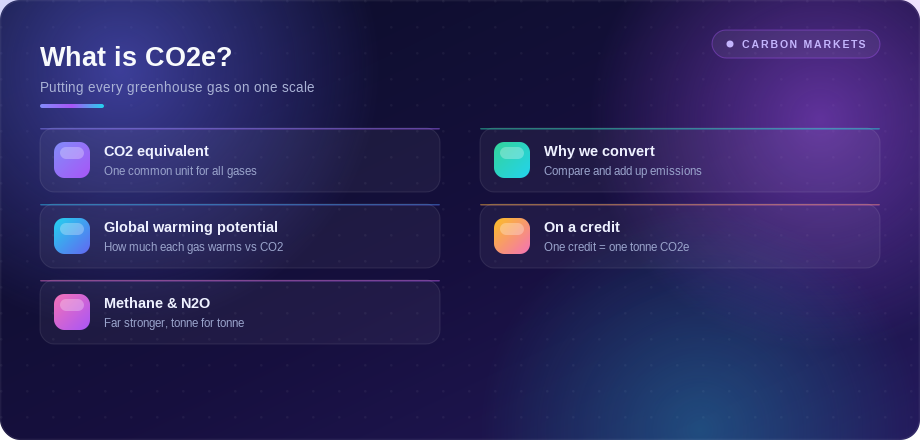
Quick answer: CO2e (carbon dioxide equivalent) is a unit that expresses the warming effect of any greenhouse gas as the mass of carbon dioxide that would cause the same warming over a chosen period, usually 100 years. You calculate it by multiplying the mass of each gas by its global warming potential (GWP) and adding the results. One tonne of methane is about 28 tCO2e using IPCC AR5 values and 27 to 29.8 tCO2e using AR6 values, depending on whether the methane is fossil or not. Always state which GWP set you used.
CO2e, short for carbon dioxide equivalent, is the unit that sits behind almost every number in climate work: corporate footprints, national inventories, net-zero targets and every carbon credit ever issued. If you have asked "what is CO2e?" because a report, a supplier questionnaire or a credit purchase put the term in front of you, this guide explains the definition, the global warming potential values that drive it, which version of those values different rules require, how to do the calculation by hand, and the mistakes that most often make two CO2e figures disagree.
The idea is simple. The details, especially which GWP table to use, are where real reports go wrong. Both are covered here, with worked examples you can check on a calculator.
What Is CO2e? The Definition
CO2e means the amount of carbon dioxide that would have the same warming effect, over a stated time horizon, as a given amount of another greenhouse gas or mix of gases. It is a metric, not a physical gas. Nobody can measure "CO2e" coming out of a chimney; you measure the individual gases and convert them.
You will see several spellings that mean the same thing: CO2e, CO2eq, CO2-eq, CO₂e and "carbon dioxide equivalent". In tables, the unit is usually written as tCO2e (tonnes of carbon dioxide equivalent), and larger totals as ktCO2e (thousand tonnes) or MtCO2e (million tonnes). A tonne here is a metric tonne of 1,000 kg.
The CO2e meaning has three parts that should always travel together:
- The mass of each gas. For example, 10 tonnes of methane.
- The metric used to convert it. Almost always the 100-year global warming potential (GWP100).
- The source of the values. Usually an IPCC Assessment Report, such as AR4, AR5 or AR6.
A CO2e figure that omits the second and third items is incomplete, because the same physical emissions can give different totals depending on which values were applied.
The Problem CO2e Solves
Carbon dioxide is the largest single contributor to human-caused warming, but it is not the only greenhouse gas. Methane (CH4), nitrous oxide (N2O) and a family of industrial fluorinated gases (HFCs, PFCs, SF6 and NF3) also trap heat, and they do so with very different strengths and lifetimes. A tonne of methane traps far more heat than a tonne of CO2 while it lasts, but it breaks down in the atmosphere within roughly a decade. A tonne of SF6 is many thousands of times more potent than CO2 and stays for thousands of years.
If you added these gases together by weight, the total would be meaningless. A farm that emits 100 tonnes of methane and a factory that emits 100 tonnes of CO2 do not have the same climate impact. CO2e solves this by putting every gas on one scale, so that emissions can be added up, compared across sources and years, and traded. This is what allows a greenhouse gas inventory to report one total, a target to be set in one unit, and a methane capture credit to be compared with a forestry credit.
The internationally recognised basket of gases has been, since the Kyoto Protocol, CO2, CH4, N2O, HFCs, PFCs and SF6, with NF3 added for the second Kyoto commitment period. Corporate standards such as the GHG Protocol cover the same seven gases or gas groups.
Global Warming Potential (GWP): The Conversion Factor
The conversion uses a value called global warming potential, or GWP. GWP compares the total energy a pulse of one tonne of a gas traps in the atmosphere over a set period with the energy trapped by one tonne of CO2 over the same period. CO2 is the reference, so its GWP is always exactly 1.
Two properties drive a gas's GWP:
- Radiative efficiency. How strongly each molecule absorbs infrared radiation. Methane and fluorinated gases absorb much more strongly per molecule than CO2.
- Atmospheric lifetime. How long the gas stays before it is removed. Methane has an adjustment time of roughly 12 years, N2O roughly 109 to 121 years depending on the assessment, while SF6 persists for millennia.
The IPCC calculates and publishes GWP values in each Assessment Report. The values change between reports because the underlying science improves: better measurements of radiative properties, revised lifetimes, revised treatment of indirect effects and updated estimates of how CO2 itself behaves over time. That is why a GWP is not a fixed constant like the speed of light. It is a consensus estimate with stated uncertainty, revised every few years.
Time Horizons: GWP100, GWP20 and Why the Choice Matters
A GWP must be calculated over a chosen time horizon. The common choices are 20, 100 and 500 years. Because methane is potent but short-lived, its GWP is much higher over 20 years than over 100 years. Long-lived gases such as SF6 show the opposite pattern or change little.
| Gas | GWP20 (AR6) | GWP100 (AR6) | What the gap tells you |
|---|---|---|---|
| CO2 | 1 | 1 | Reference gas by definition |
| CH4, fossil | 82.5 | 29.8 | Most of methane's warming happens in the first two decades |
| CH4, non-fossil | 79.7 | 27.0 | Same pattern; slightly lower value (explained below) |
| N2O | 273 | 273 | Lifetime is close to a century, so the two horizons give similar values |
Source: IPCC AR6 Working Group I, Chapter 7, Table 7.15.
The 100-year horizon (GWP100) is the convention used by the UNFCCC, the GHG Protocol, carbon credit programmes and almost every regulatory scheme. It was a policy choice rather than a scientific necessity, but because nearly everyone uses it, figures remain comparable. Some organisations also disclose methane on a GWP20 basis to show its near-term effect, which is reasonable as supplementary information as long as it is clearly labelled and not mixed into a GWP100 total.
Why is non-fossil methane lower in AR6? When fossil methane (for example from a gas pipeline leak or a coal mine) oxidises, it adds new carbon to the atmosphere as CO2. Biogenic methane from landfills, livestock or wastewater comes from carbon that plants recently absorbed, so its eventual CO2 is not counted as an addition. AR6 reflects this by giving fossil methane a slightly higher GWP. AR5 also published a separate fossil methane value of 30, but most regimes using AR5 apply the single value of 28.
GWP100 Values: AR4, AR5 and AR6 Compared
The table below shows 100-year GWP values for the main gases from the last three IPCC Assessment Reports. AR5 values are from Table 8.A.1 of the Working Group I report (the commonly used values without climate-carbon feedbacks). AR6 values are from Table 7.15 of the Working Group I report. Check the exact table your rules require before using any figure.
| Gas | Chemical formula | AR4 (2007) | AR5 (2013/2014) | AR6 (2021) |
|---|---|---|---|---|
| Carbon dioxide | CO2 | 1 | 1 | 1 |
| Methane, general or non-fossil | CH4 | 25 | 28 | 27.0 |
| Methane, fossil | CH4 | 25 | 30 (where used) | 29.8 |
| Nitrous oxide | N2O | 298 | 265 | 273 |
| HFC-23 | CHF3 | 14,800 | 12,400 | 14,600 |
| HFC-32 | CH2F2 | 675 | 677 | 771 |
| HFC-125 | CHF2CF3 | 3,500 | 3,170 | 3,740 |
| HFC-134a | CH2FCF3 | 1,430 | 1,300 | 1,530 |
| HFC-143a | CH3CF3 | 4,470 | 4,800 | 5,810 |
| PFC-14 (tetrafluoromethane) | CF4 | 7,390 | 6,630 | 7,380 |
| Sulphur hexafluoride | SF6 | 22,800 | 23,500 | 25,200 |
| Nitrogen trifluoride | NF3 | 17,200 | 16,100 | 17,400 |
A few points stand out. Methane has risen from 25 to 28 and then to 27.0 or 29.8. N2O fell between AR4 and AR5 and rose again in AR6. Several HFCs rose noticeably in AR6. These shifts are why an inventory recalculated with a newer GWP set can move by a few per cent without any change in real-world emissions.
Refrigerant blends do not have their own IPCC entry; you calculate their GWP from the mass fraction of each component. R-410A, for example, is 50 per cent HFC-32 and 50 per cent HFC-125 by mass, so its AR5 GWP100 is 0.5 × 677 + 0.5 × 3,170 = about 1,924, and its AR6 GWP100 is 0.5 × 771 + 0.5 × 3,740 = about 2,256.
Which GWP Values Different Regimes Use
Knowing what CO2e is matters less in practice than knowing which version your reporting rule demands. The main regimes differ, and they change over time, so always read the current text of the rule that applies to you.
| Regime or standard | GWP values used | Notes |
|---|---|---|
| UNFCCC national inventories under the Paris Agreement (Enhanced Transparency Framework, Biennial Transparency Reports from 2024) | IPCC AR5, 100-year, from Table 8.A.1 | Parties report using AR5 GWP100; the separate fossil methane value is excluded, so methane is 28. Other metrics may be reported in addition |
| UNFCCC inventories under the Kyoto Protocol era (submissions from 2015 to 2020) | IPCC AR4, 100-year | Explains why older national and project documents use 25 for methane and 298 for N2O |
| GHG Protocol corporate and product standards | Most recent IPCC values recommended; the GHG Protocol's GWP reference table was updated to AR6 in August 2024 | Companies may use other values where a regulator or programme requires them, but should disclose the source and apply it consistently |
| US EPA Greenhouse Gas Reporting Program | IPCC AR5 for most gases, after a 2024 rule update, with AR6 values for some gases lacking AR5 figures | Applies to US facility reporting; check the rule for effective reporting years |
| Carbon credit programmes (Verra, Gold Standard, ACR, CAR and others) | Set by each programme's rules and the methodology version a project applies | Values used for a given crediting period are stated in the project description and monitoring report; older projects and the Clean Development Mechanism often used AR4 values |
| CORSIA (aviation) | Not GWP-based for operator emissions: CO2 only, from fuel burned | Operators multiply fuel mass by a fuel conversion factor, for example 3.16 tonnes of CO2 per tonne of Jet-A or Jet A-1 and 3.10 for AvGas. The offsetting requirement is in tonnes of CO2 and is met with emissions units, each representing one tonne of CO2e |
The practical rule: use the GWP set your regulator, programme or standard specifies, state it in the report, and do not mix sets within one total. If you report under more than one framework, you may need to run the calculation twice. For more on how the inventory itself is built, see GHG accounting: scope 1, 2 and 3 explained.
How to Calculate CO2e: Step by Step
The formula for how to calculate CO2e is the same in every context:
CO2e (tonnes) = mass of gas (tonnes) × GWP of that gas
For a mix of gases, calculate each one and add:
Total CO2e = Σ (mass of gas i × GWP of gas i)
In practice, follow these steps:
- Identify every gas in scope. Combustion produces mainly CO2 with small amounts of CH4 and N2O. Refrigeration and air conditioning leak HFCs. Electrical switchgear can leak SF6. Waste and agriculture produce CH4 and N2O.
- Quantify each gas in mass units. Use metered data, purchase and service records, or activity data multiplied by gas-specific emission factors. Convert kilograms or pounds to tonnes before you go further.
- Choose the GWP set your rules require. Write down the Assessment Report and time horizon, for example "IPCC AR5, GWP100".
- Multiply each gas mass by its GWP. Keep the gases on separate lines so the work can be checked.
- Add the results to get total tCO2e. Round only at the end.
- Document the inputs. Record the data sources, emission factors, GWP set and any assumptions, so a reviewer or verifier can recompute the number.
Many published emission factors are already expressed in kgCO2e per unit of activity, with the GWP applied inside the factor. If you use those, do not apply a GWP again, and check which GWP set the factor publisher used. The detail of choosing emission factors and boundaries belongs to inventory work, covered in the GHG accounting guide.
Worked Example 1: A Methane Leak in tCO2e (AR5 vs AR6)
Illustrative numbers. A gas distribution company finds that a faulty compressor station seal released an estimated 50 tonnes of methane over a year. Because this is natural gas from a fossil source, the AR6 fossil value applies when AR6 is used.
| GWP set | GWP100 for CH4 | Calculation | Result |
|---|---|---|---|
| IPCC AR4 | 25 | 50 × 25 | 1,250 tCO2e |
| IPCC AR5 (single value) | 28 | 50 × 28 | 1,400 tCO2e |
| IPCC AR6, fossil | 29.8 | 50 × 29.8 | 1,490 tCO2e |
| IPCC AR6, fossil, GWP20 (supplementary only) | 82.5 | 50 × 82.5 | 4,125 tCO2e |
The same 50 tonnes of gas is reported as anything from 1,250 to 1,490 tCO2e on a 100-year basis, depending only on the GWP set. Moving from AR5 to AR6 adds 90 tCO2e, about 6.4 per cent. On a 20-year basis the figure is roughly three times higher, which is why methane reduction gets attention in near-term climate policy.
Now compare a landfill releasing the same 50 tonnes of methane. That methane is biogenic, so under AR6 the non-fossil value of 27.0 applies: 50 × 27.0 = 1,350 tCO2e. Under AR5 it would be 1,400 tCO2e, the same as the fossil leak, because AR5 is normally applied as a single value.
This sensitivity explains why methane capture projects, such as landfill gas flaring or biogas digesters, can generate many credits from modest physical quantities of gas. If a project destroys 50 tonnes of methane and its methodology uses AR5, the reduction before deducting project emissions and leakage is 1,400 tCO2e, not 50 tonnes. Burning the methane does release some CO2, which the methodology accounts for. See what is a carbon credit for how such reductions become issued units, and additionality in carbon credits for why the baseline matters as much as the arithmetic.
Worked Example 2: A Mixed Inventory
Illustrative numbers. A manufacturing site has the following annual emissions of direct (scope 1) greenhouse gases, measured or estimated in tonnes of each gas:
- 12,000 t CO2 from natural gas boilers and furnaces
- 40 t CH4 (fossil) from incomplete combustion and gas system leaks
- 3 t N2O from a process step
- 0.8 t HFC-134a leaked from chillers (from refrigerant top-up records)
- 0.02 t SF6 (20 kg) leaked from high-voltage switchgear
| Gas | Mass (t) | AR5 GWP100 | AR5 tCO2e | AR6 GWP100 | AR6 tCO2e |
|---|---|---|---|---|---|
| CO2 | 12,000 | 1 | 12,000 | 1 | 12,000 |
| CH4 (fossil) | 40 | 28 | 1,120 | 29.8 | 1,192 |
| N2O | 3 | 265 | 795 | 273 | 819 |
| HFC-134a | 0.8 | 1,300 | 1,040 | 1,530 | 1,224 |
| SF6 | 0.02 | 23,500 | 470 | 25,200 | 504 |
| Total | 15,425 | 15,739 |
Three things are worth noticing.
First, the non-CO2 gases make up 3,425 tCO2e of the AR5 total, about 22 per cent, even though their combined physical mass is under 44 tonnes compared with 12,000 tonnes of CO2. Leaving out refrigerant and switchgear leaks because they look small by weight would understate this site's footprint significantly.
Second, 20 kg of SF6 is worth 470 to 504 tCO2e. That is why switchgear maintenance records and leak checks matter in an inventory.
Third, switching from AR5 to AR6 raises the total by 314 tCO2e, about 2 per cent, with no change in operations. If the site sets a reduction target against a base year calculated with AR5 and then reports progress with AR6, it will appear to have gone backwards. The fix is to recalculate the base year with the same GWP set, which most standards require when the GWP basis changes.
CO2 vs CO2e vs Carbon: The 12/44 Conversion
Three terms are often used loosely, and confusing them can introduce errors of a factor of nearly four.
| Term | What it measures | Typical use |
|---|---|---|
| CO2 | Mass of carbon dioxide gas only | Fuel combustion emissions, CORSIA operator emissions |
| CO2e | Warming effect of all greenhouse gases, expressed as CO2 mass | Inventories, targets, carbon credits |
| Carbon (C) | Mass of carbon atoms only | Forest and soil carbon stocks, some older literature and carbon pricing quoted "per tonne of carbon" |
The conversion between carbon and CO2 comes from molecular weights. Carbon has an atomic mass of about 12, oxygen about 16, so CO2 has a molecular mass of about 44. Each tonne of CO2 therefore contains 12/44 of a tonne of carbon, about 0.273 tonnes. Going the other way, one tonne of carbon becomes 44/12, about 3.667 tonnes of CO2 when fully oxidised.
Illustrative examples:
- A forest survey reports 120 tonnes of carbon per hectare in above-ground biomass. In CO2 terms that is 120 × 44/12 = 440 tCO2 per hectare.
- A paper states that a country emits 2 billion tonnes of carbon a year. In CO2 that is 2 × 3.667 = about 7.3 billion tonnes.
- A tonne of jet fuel is roughly 86 per cent carbon by mass, which is why burning it produces about 3.16 tonnes of CO2: 0.86 × 44/12 ≈ 3.15. The extra mass comes from oxygen taken from the air.
Always check whether a figure is in tonnes of C, tonnes of CO2 or tonnes of CO2e before you compare or add it. Forestry project documents in particular move between carbon stocks and CO2e and should show the 44/12 step explicitly; REDD+ and afforestation projects explains where those conversions appear.
CO2e in Carbon Credits and CORSIA
A standard carbon credit represents one tonne of CO2e reduced, avoided or removed. That single unit is what lets a methane destruction credit, a cookstove credit and a carbon removal credit all be measured on the same scale, even though their quality, permanence and price differ widely. The GWP set used by the methodology affects how many credits a non-CO2 project earns: a project destroying the same methane earns more credits under AR6 fossil values than under AR4 values. Buyers who compare vintages or projects should know which values were applied. The programme rules are summarised in carbon credit standards explained.
CORSIA works differently on the emissions side. Under ICAO's Carbon Offsetting and Reduction Scheme for International Aviation, aircraft operators monitor and report CO2 only, calculated from the mass of fuel burned multiplied by a fixed fuel conversion factor. Operators that emit more than 10,000 tonnes of CO2 a year from international flights must monitor and report. There is no GWP step and no non-CO2 multiplier for contrails or nitrogen oxides in the CORSIA calculation. The offsetting requirement, calculated for the first phase (2024 to 2026) against a baseline of 85 per cent of 2019 emissions, is expressed in tonnes of CO2. It is met by cancelling CORSIA Eligible Emissions Units, each of which represents one tonne of CO2e from an eligible programme approved by the ICAO Council on the recommendation of its Technical Advisory Body.
For the fuel-to-CO2 detail, see CORSIA emission factors and fuel types, and for passenger and corporate flight calculations, which sometimes add non-CO2 effects, see how to calculate a flight's carbon footprint. The obligation arithmetic is covered in CORSIA offsetting requirements, and monitoring, reporting and verification in the CORSIA MRV knowledge base page.
Units You Will See: tCO2e, ktCO2e and MtCO2e
Scale matters when you read reports. The prefixes follow metric conventions:
| Unit | Equals | Typical scale |
|---|---|---|
| kgCO2e | 1 kilogram of CO2e | Product footprints, a single journey |
| tCO2e | 1,000 kgCO2e | Small business footprints, one carbon credit |
| ktCO2e | 1,000 tCO2e | Factories, mid-sized companies, projects |
| MtCO2e | 1,000,000 tCO2e | Large companies, sectors, smaller countries |
| GtCO2e | 1,000,000,000 tCO2e | National totals for the largest emitters, global totals |
Some US sources use short tons (about 907 kg) or metric tons; check which before converting. "MMTCO2e" in US documents means million metric tonnes of CO2e, the same as MtCO2e.
Common Mistakes With CO2e
These are the errors that most often make CO2e figures wrong or impossible to compare.
- Not stating the GWP set. A total of "15,400 tCO2e" without "IPCC AR5, GWP100" cannot be checked or compared. Put the basis in a footnote to every table.
- Mixing GWP sets in one total. Taking some emission factors with AR4 values built in and applying AR6 to others gives a number that matches no standard. Recalculate on one basis.
- Applying a GWP twice. Factors already expressed in kgCO2e per unit include the GWP. Multiplying them again by 28 or 273 inflates the result enormously.
- Confusing carbon with CO2. A factor of 3.667 separates them. Forestry and soil figures are the usual source of this error.
- Changing GWP sets without recalculating the base year. Progress against a target looks better or worse than it is. Recalculate the base year whenever the GWP basis changes, as described in science-based targets guidance.
- Dropping small-mass, high-GWP gases. Refrigerant and SF6 leaks can be a large share of scope 1 for some sites, as the mixed inventory example showed.
- Mixing GWP20 and GWP100. A 20-year figure for methane is about three times the 100-year figure. Report it separately if at all.
- Using the wrong methane value. Under AR6, fossil and non-fossil methane differ. Under UNFCCC AR5 reporting, the single value of 28 applies.
- Treating CO2e as precise. GWP values carry stated uncertainty of tens of per cent for methane. The convention makes reports comparable; it does not make the climate effect exact.
- Rounding too early. Round once, at the final total, and keep the working at full precision.
Beyond GWP: Other Metrics
GWP100 is the standard, but it is not the only metric. The global temperature change potential (GTP) compares the temperature change at a future point in time rather than accumulated energy, and gives methane a much lower value on a 100-year basis. GWP* (GWP-star) is a research metric that treats a sustained change in the rate of short-lived gas emissions differently from a one-off pulse, and is discussed mainly in agriculture and research settings. Neither replaces GWP100 for compliance reporting or carbon credits, but you may see them in scientific papers or in claims about methane from livestock. If a company uses an alternative metric in a public claim, it should also give the GWP100 figure so that readers can compare. Claims built on unusual metrics are worth questioning, as discussed in carbon neutral vs net zero and ESG reporting and carbon credits.
How DSTechnoverse Helps
DSTechnoverse works on the data side of carbon. For aircraft operators and project developers, our CORSIA carbon credit services cover eligibility checks, sourcing and due diligence of CORSIA Eligible Emissions Units, offsetting requirement estimates, emissions monitoring plan and MRV support, and registry cancellation support. We are not a verification body and do not verify emissions reports. For organisations building or checking an inventory, our data analytics team can recompute CO2e totals on a stated GWP basis, reconcile emission factors and document the working so reviewers can follow it. To discuss your figures, contact us.
Frequently Asked Questions
What is CO2e in simple terms? CO2e, or carbon dioxide equivalent, is a way of expressing any greenhouse gas as the amount of carbon dioxide that would cause the same warming over a chosen period, usually 100 years. It lets methane, nitrous oxide and fluorinated gases be added to CO2 in one total, so footprints, targets and carbon credits can all use a single unit.
How do you calculate CO2e? Multiply the mass of each greenhouse gas by its global warming potential and add the results. For example, 2 tonnes of N2O with an AR5 GWP100 of 265 equals 530 tCO2e. Always use the GWP set your regulator or standard requires, and state it next to the result so others can check it.
What does tCO2e mean? tCO2e means tonnes of carbon dioxide equivalent, using metric tonnes of 1,000 kg. It is the standard unit for organisational footprints and carbon credits; one credit normally represents one tCO2e reduced or removed. Larger totals use ktCO2e for thousands and MtCO2e for millions of tonnes.
What is the difference between GWP100 in AR5 and AR6? AR6 revised many values. Methane went from 28 in AR5 to 27.0 for non-fossil and 29.8 for fossil methane; N2O went from 265 to 273; SF6 from 23,500 to 25,200; HFC-134a from 1,300 to 1,530. Recalculating an inventory from AR5 to AR6 usually changes totals by a few per cent.
Which GWP values should I use? Use the values your reporting framework specifies. National inventories under the Paris Agreement use AR5 GWP100. The GHG Protocol recommends the most recent IPCC values, now AR6, unless a programme requires otherwise. Carbon credit projects follow their programme and methodology. Whatever you choose, disclose it and apply it consistently, including to the base year.
Is CO2e the same as CO2? No. CO2 counts only carbon dioxide. CO2e counts all greenhouse gases converted to the CO2 scale. For fuel combustion the two are close, because combustion is mostly CO2, but for agriculture, waste, refrigeration or gas leaks, CO2e can be much larger than the CO2 figure alone.
How do I convert carbon to CO2? Multiply tonnes of carbon by 44/12, about 3.667, to get tonnes of CO2. To go the other way, multiply tonnes of CO2 by 12/44, about 0.273. The ratio comes from the molecular weights of carbon (12) and carbon dioxide (44). Forestry and soil figures are often stated in tonnes of carbon.
Does CORSIA use CO2e? Operator emissions under CORSIA are CO2 only, calculated from fuel burned multiplied by a fuel conversion factor, such as 3.16 tonnes of CO2 per tonne of Jet-A. No GWP step applies. The offsetting requirement is met by cancelling CORSIA Eligible Emissions Units, each representing one tonne of CO2e reduced or removed.
Why is methane counted as more than one tonne of CO2e? Methane absorbs far more infrared radiation per tonne than CO2. Even though it breaks down within about a decade, its total warming over 100 years is roughly 27 to 30 times that of CO2, depending on the IPCC report and whether it is fossil. Over 20 years it is roughly 80 times.
Why do CO2e figures for the same emissions differ? Usually because different GWP sets or time horizons were used, a GWP was applied twice, carbon was confused with CO2, or some gases were left out. Comparing figures requires the same gases, the same GWP set and the same boundary. Ask for the calculation basis before comparing any two totals.
Working with carbon credits or a climate target? DSTechnoverse works on the data and integrity side of carbon — project screening, registry and eligibility verification, MRV and monitoring-data analysis, reconciliation and defensible reporting. See our CORSIA carbon credit services and data analytics. We are based in Indore, Madhya Pradesh and work across India and internationally.
Apply as a carbon credit buyer or seller
Talk to our team, or start with the complete carbon credits guide.