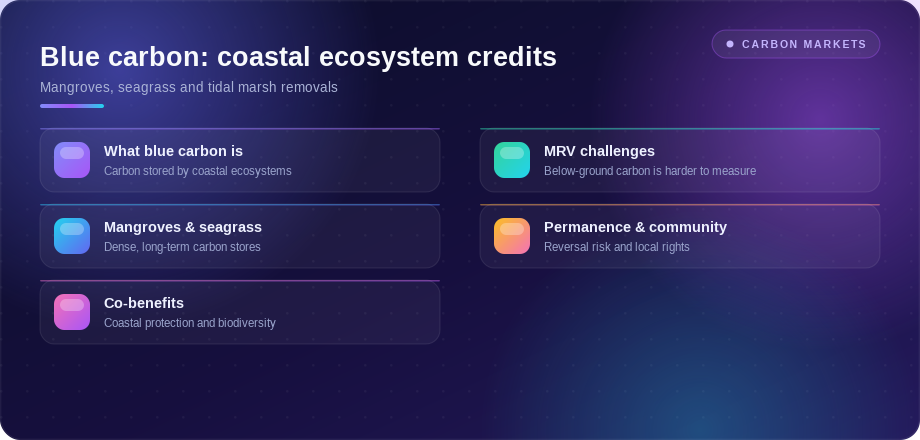
Quick answer: Blue carbon credits are carbon credits issued for protecting or restoring coastal ecosystems that store carbon: mangroves, tidal salt marshes and seagrass meadows. Each credit represents one tonne of CO2e removed from the atmosphere or kept out of it. Most restoration projects use Verra's VM0033 methodology. The hardest parts are measuring soil carbon, planning for sea-level rise and making sure coastal communities share the benefits. Buyers should check the methodology version, the soil sampling, the buffer contribution and the tenure arrangements before they pay a premium.
Blue carbon credits pay for coastal ecosystems that pull carbon out of the air and lock it into waterlogged soil, often for centuries. The term covers mangrove carbon credits, seagrass carbon and tidal marsh restoration credits. All of these sit within the wider family of nature-based credits, but they behave differently from forest credits. Most of their carbon is below ground, the coastline they sit on keeps moving, and they are usually tied to fishing communities whose land rights are often informal.
This guide is for buyers and developers in the United States, Europe, the Middle East and India. If you are new to the basics, start with what a carbon credit is. For removals in general, including how durable they are, see carbon removal credits explained. Forest-based projects are covered in REDD+ and afforestation carbon projects.
What Are Blue Carbon Credits?
Blue carbon is the carbon captured and stored by coastal and marine vegetated ecosystems. In carbon markets, the term usually means three habitats: mangrove forests, tidal salt marshes and seagrass meadows. A blue carbon credit is a tradable certificate, issued by a crediting programme such as Verra's Verified Carbon Standard, that represents one tonne of carbon dioxide equivalent (see what CO2e means) that a coastal project has removed or avoided compared with a credible baseline.
Blue carbon projects come in two broad types, and buyers should know which one they are buying:
| Project type | What it does | What the credit represents | Typical claim |
|---|---|---|---|
| Restoration | Replants or rewets degraded mangroves, marshes or seagrass; restores tidal flow | CO2 removed by new biomass and growing soil carbon, plus emissions avoided from degraded soil | Mostly removal |
| Conservation (avoided loss) | Protects existing coastal wetlands that would otherwise be cleared or drained | Emissions avoided by preventing loss of biomass and soil carbon | Avoided emissions |
| Mixed | Protects intact areas and restores degraded ones within the same project | A blend of both, reported separately | Mixed |
The distinction matters because many corporate net-zero frameworks treat removals and avoided emissions differently. A restoration credit and a conservation credit from the same coastline are not interchangeable, even when both carry the "blue carbon" label.
Why Coastal Ecosystems Store So Much Carbon
Coastal wetlands are among the most carbon-dense ecosystems on the planet per hectare, and the reason is chemistry, not tree size.
- High productivity. Mangroves and salt marsh grasses grow quickly in warm, nutrient-rich tidal water. Seagrass meadows also photosynthesise at high rates.
- Waterlogged, low-oxygen soils. Regular tidal flooding keeps sediments saturated. Without oxygen, dead roots and leaf litter break down very slowly, so organic carbon builds up layer by layer.
- Sediment trapping. Roots and leaves slow the water and trap particles washed in from rivers and the sea, including carbon produced elsewhere. As sea level rises slowly, the soil surface builds upward and buries more carbon.
- Low methane in saline water. Sulphate in seawater suppresses the microbes that produce methane, so saline wetlands usually emit far less methane than freshwater wetlands. Where salinity is low, methane becomes a real accounting issue.
The result is that most of the carbon in a healthy mangrove or salt marsh sits in the soil, not in the trees. Soil carbon can extend a metre or more deep and be thousands of years old. That is a strength for permanence, but it is also why disturbance is so damaging: when a mangrove is cleared for a shrimp pond or a marsh is drained, the exposed soil oxidises and releases carbon that took centuries to build up.
The Three Main Blue Carbon Ecosystems
| Ecosystem | Where it occurs | Where the carbon is | Main threats | Crediting maturity |
|---|---|---|---|---|
| Mangroves | Tropical and subtropical coasts (South and Southeast Asia, Africa, Latin America, the Gulf) | Large biomass plus deep organic soils | Aquaculture, rice, urban and port development, cutting for fuelwood | Most mature; most issued blue carbon credits are mangrove-based |
| Tidal salt marshes | Temperate coasts (US East and Gulf coasts, Europe, Australia) | Mostly in soil | Diking, drainage, coastal squeeze, development | Growing, especially in the US and Europe |
| Seagrass meadows | Shallow coastal waters worldwide, including the Gulf and the Mediterranean | Almost entirely in sediment | Dredging, poor water quality, anchoring, warming | Least mature; measurement and permanence harder |
Seagrass carbon draws a lot of attention because the meadows are extensive. Credit issuance has lagged, though, because accounting for imported carbon, sediment movement and meadow die-back is difficult. Expect fewer seagrass credits, more conservative crediting and closer scrutiny from rating agencies.
Blue Carbon Methodologies: Verra VM0033 and Others
A blue carbon methodology sets out the rules for defining the project area, setting the baseline, measuring carbon pools, deducting leakage and uncertainty, and calculating credits. The main methodologies are summarised below. Always check the current version on the programme's own website, because these documents are revised fairly often.
| Methodology | Programme | Scope | Notes |
|---|---|---|---|
| VM0033 Methodology for Tidal Wetland and Seagrass Restoration | Verra (VCS) | Restoration of tidal forests (mangroves), tidal marshes and seagrass; global | Version 2.1 has been active since September 2023. Verra opened public consultation on a major revision (v3.0) in September to October 2026 |
| VM0007 REDD+ Methodology Framework, tidal wetland modules | Verra (VCS) | Conservation of tidal wetlands at risk of loss | Verra has said it is moving tidal wetland conservation into VM0033 and will inactivate these modules when the revised methodology is released; check current status |
| VMD0051 monitoring module | Verra (VCS) | Methods for monitoring carbon stock changes in tidal wetland restoration and conservation | Used alongside the methodologies above |
| Plan Vivo standard | Plan Vivo Foundation | Community-led land use projects, including several well-known mangrove projects | Smaller volumes; strong focus on community governance |
| Afforestation and reforestation methods for wetlands | CDM legacy and others | Mangrove planting on degraded land | Mostly historical; few new registrations |
How VM0033 Works in Practice
VM0033 is the reference blue carbon methodology, and its logic shapes most project designs. In simplified form:
- Define the project area and strata. The area is divided into strata by vegetation, elevation, tidal range and soil type. Because sea level rises, the methodology lets the project boundary shift landward over the crediting period where the analysis supports it.
- Establish the baseline scenario. This describes what would happen without the project: continued degradation, a pond left abandoned, a drained marsh, or natural recovery. The baseline must show whether the area would regenerate on its own, because natural recovery reduces the credits a project can claim.
- Quantify carbon pools. These are above-ground and below-ground biomass, dead wood and, most importantly, soil organic carbon. Methane and nitrous oxide emissions must be considered, especially in low-salinity areas.
- Account for soil carbon properly. Projects can use direct measurement (cores, bulk density, carbon content), approved default factors or proxies, with conservative deductions where data are thin. The methodology also deals with allochthonous carbon, meaning carbon that arrived from outside the site and should not be credited as if the project produced it.
- Assess sea-level rise and permanence. Projects must use Verra's AFOLU Non-Permanence Risk Tool, which includes sea-level rise as a natural risk. The result sets the share of credits paid into the pooled buffer.
- Deduct leakage and uncertainty. If restoration displaces activities such as aquaculture elsewhere, the emissions from that displacement must be estimated and deducted.
- Monitor and verify. Monitoring covers vegetation cover, survival rates, elevation, water levels and soil carbon, and a validation and verification body checks the results before credits are issued.
Verra's v3.0 consultation draft proposes changes that matter to developers, including a dynamic performance benchmark for some restoration activities, updated default factors and new modules for biomass, tidal wetland soils, afforestation and reforestation, and leakage. Until a new version is final, VM0033 v2.1 is the version in use. Projects partway through design should ask their validation body how any transition rules apply.
Measurement, Reporting and Verification Challenges
The measurement, reporting and verification (MRV) problems in blue carbon projects are specific to coastal systems. These are the issues that most often separate a credible project from an optimistic one.
Soil Carbon
Most of the credited carbon is in the soil, and soil carbon varies a great deal across short distances. A credible project needs enough cores, taken to a sufficient depth and spread across strata, with bulk density and organic carbon measured in an accredited laboratory. Common problems include too few cores, coring only to shallow depth, applying regional default values to a site that does not match them, and failing to separate carbon produced on site from carbon washed in. Soil carbon also changes slowly, so in the early years a restoration project may be crediting modelled accumulation rather than measured change. Buyers should ask how and when those models will be checked against field data. Sensor-based monitoring is discussed in digital MRV for carbon projects.
Sea-Level Rise and Coastal Squeeze
Coastal wetlands can keep pace with moderate sea-level rise by building their soil surface upward, provided sediment supply is adequate and there is space to migrate inland. Where sea walls, roads or ponds block that inland migration (known as coastal squeeze), the wetland can drown. A good project includes an elevation and sediment assessment, identifies migration space and explains how the boundary will be handled if the seaward edge is lost.
Permanence
Blue carbon stored in soil is durable while the ecosystem stays intact, but it can be released quickly by clearing, drainage, cyclones or die-back. Permanence is managed through the buffer pool, long crediting periods, legal protection of the site and monitoring after the crediting period. Buyers comparing durability across credit types should read the permanence section in carbon removal credits explained, which applies here as well.
Leakage
Many degraded mangrove sites are former or active aquaculture ponds. If a project takes ponds out of production and the owners simply clear mangroves elsewhere, the climate benefit shrinks. Credible projects assess leakage, deduct for it and usually pair restoration with alternative livelihoods or agreements on pond use. Conservation projects face the same question about whether deforestation pressure simply moves down the coast.
Survival and Planting Quality
Restoration is not the same as planting. Many past mangrove plantings failed because seedlings went into the wrong elevation, onto mudflats that were never mangrove habitat, or as a single species unsuited to the site. Look for survival data by stratum, not just the number of seedlings planted.
Additionality and Baselines
As with any credit, the project must show that the activity would not have happened anyway. Coastal sites raise particular questions. Would the area have recovered naturally? Was restoration already required by law or by a permit condition? Is public funding already paying for the work? The general tests are explained in additionality in carbon credits.
Community, Tenure and Benefit Sharing
Blue carbon projects sit where people live, fish, collect wood and farm shrimp. Their social design is part of credit quality, not an add-on.
- Tenure. Intertidal land is often state-owned, customary or disputed. A developer needs a clear legal basis for claiming the carbon rights, usually through an agreement with the government, a community body or both. Ask who holds the carbon rights and how that was established.
- Free, prior and informed consent. Communities affected by the project must have agreed to it on an informed basis, and that agreement should be documented, not assumed.
- Benefit sharing. The project documents should state what share of credit revenue reaches communities, through what mechanism, and how payments are audited. Vague promises are a warning sign.
- Livelihood effects. Restricting access to mangroves can harm people who depend on them for fuelwood or fishing. Good projects plan for alternatives, and many improve fisheries over time.
- Grievance mechanism. There should be a working channel through which complaints are raised and resolved.
Independent social data matters here. Household surveys at baseline and during monitoring, covering income, fishing catch, fuel use and perceptions of the project, are often the most reliable evidence that benefits are real. This is also where co-benefit labels such as Verra's CCB Standards come in, since they require social and biodiversity monitoring alongside carbon.
Blue Carbon Projects in the UAE and the Middle East
The Gulf has a strong interest in mangroves. Mangroves are among the few native coastal forests in the region, and governments have made them part of their climate and coastal protection plans.
- UAE national planting target. In its updated Nationally Determined Contribution, announced around COP26 in 2021, the UAE raised its mangrove planting target from 30 million to 100 million mangroves by 2030. Progress figures in public reporting vary by source and date, so check the latest figure from the Ministry of Climate Change and Environment before quoting a number.
- Mangrove Alliance for Climate. The UAE and Indonesia launched this alliance at COP27 in 2022 to promote mangrove conservation and restoration and to mobilise finance. A strategy for the alliance to 2031 was presented at COP29.
- Mangrove Breakthrough. The UAE endorsed this global initiative, which aims to restore and protect 15 million hectares of mangroves worldwide by 2030 and to mobilise investment for it.
- Wider region. Other Gulf states, including Saudi Arabia on its Red Sea and Gulf coasts, have announced mangrove planting as part of national greening programmes. Seagrass meadows in the Gulf support dugong and fisheries and are increasingly discussed as a carbon asset, though crediting is at an early stage.
Gulf mangroves are a special case for crediting. They grow in arid conditions with high salinity and temperature, usually as a single species (grey mangrove, Avicennia marina), and they are often smaller and slower-growing than tropical mangroves. Per-hectare carbon gains may therefore be lower than headline global figures. Planting on sites where mangroves did not historically grow raises questions about the baseline and survival. Large state-funded planting programmes also raise additionality questions if credits are sought for work that public policy already requires or pays for.
For Middle East buyers, blue carbon also appeals because it can be sourced close to home and fits national sustainability narratives. Buyers using credits for compliance purposes, such as airlines under CORSIA, should check eligibility separately, because a programme being approved does not mean every project or vintage qualifies. Our CORSIA services for the UAE and Middle East cover that question.
Blue Carbon Projects in India
India has a long and varied coastline with large mangrove areas, and several blue carbon projects are in development or already issuing credits.
- The Sundarbans. The Sundarbans delta, shared with Bangladesh, is the largest contiguous mangrove forest in the world. On the Indian side, in West Bengal, restoration projects have planted mangroves on degraded mudflats and embankments, often with community involvement. Cyclone exposure, embankment failure, salinity changes and dense human settlement make permanence and community design central.
- Gujarat. Gujarat has one of India's largest mangrove areas, mainly in the Gulf of Kachchh and the Gulf of Khambhat. The state has carried out large mangrove plantation programmes, some linked to industrial and port development. For carbon purposes, the questions are which areas are additional, how arid-zone growth rates compare with defaults, and how plantation survival is monitored.
- Other coasts. Odisha (Bhitarkanika), Andhra Pradesh (Godavari and Krishna deltas), Maharashtra, Kerala, Tamil Nadu and the Andaman and Nicobar Islands all have significant mangrove areas. Seagrass occurs in the Gulf of Mannar, Palk Bay and around the islands.
- Policy. The Government of India announced the MISHTI programme (Mangrove Initiative for Shoreline Habitats and Tangible Incomes) in its 2023 budget to support mangrove planting along the coast. Public programmes like this support restoration, but they also mean developers must show clearly how a carbon project is additional to publicly funded work.
India's emerging domestic market under the Carbon Credit Trading Scheme may also affect how coastal projects are registered and authorised. See the Indian carbon market and CCTS and carbon credit project types in India. For credits that will be counted under Article 6 or CORSIA, host-country authorisation and corresponding adjustments become relevant; corresponding adjustments under Article 6 explains how these work.
Listings of nature-based projects, including coastal ones, appear in the marketplace section of our site. A listing is a starting point for enquiries, not a substitute for project-level due diligence.
What Drives Blue Carbon Credit Prices
Blue carbon credits have generally traded at a premium to many other nature-based credits, but published price levels vary widely by source, date, contract type and project. This guide does not quote numbers. These are the factors that move the price:
| Driver | Effect on price | Why |
|---|---|---|
| Removal versus avoided loss | Restoration removals usually command more | Buyers with net-zero targets prefer removals |
| Ecosystem | Mangroves are most liquid; seagrass is scarce and sometimes priced higher, sometimes discounted for risk | Track record and measurement confidence differ |
| Methodology version and soil data | Recent methodology versions and measured soil carbon support higher prices | Lower risk of over-crediting |
| Co-benefit labels | CCB or similar labels add value | Verified community and biodiversity outcomes |
| Ratings and CCP label | Higher ratings and ICVCM approval support a premium | Many buyers screen on them |
| Vintage | Recent vintages are usually priced higher | Buyers favour recent, monitored performance |
| Contract structure | Forward offtakes are often priced below spot but carry delivery risk | The buyer funds early-stage work |
| Authorisation and corresponding adjustment | Authorised credits can carry a premium | Needed for some compliance and Article 6 uses |
| Supply scarcity | Limited issuance supports prices | Blue carbon issuance is still small |
For the general economics behind these patterns, read carbon credit prices explained. If you are judging whether a credit is worth its premium, the ICVCM Core Carbon Principles and carbon credit ratings are the most useful external benchmarks.
Worked Example: A Mangrove Restoration Project
The figures below are illustrative only. They show how the accounting works and do not describe a real project or typical results.
A developer restores 1,000 hectares of degraded former shrimp ponds on a tropical delta by breaching pond walls to restore tidal flow, then assisting regeneration with native species where natural recruitment is slow. The project uses VM0033 with a 30-year crediting period.
Step 1: Stratify the site. Survey and elevation data split the area into three strata:
| Stratum | Area (ha) | Condition | Expected outcome |
|---|---|---|---|
| A: Low ponds, good tidal access | 500 | Bare mud, suitable elevation | Natural recolonisation after wall breaching |
| B: High ponds | 350 | Elevated, needs earthworks | Assisted planting after regrading |
| C: Deep ponds | 150 | Too low for mangrove | Excluded from carbon claims; becomes mudflat habitat |
Step 2: Estimate gross removals (illustrative). Assume the creditable area of 850 hectares averages 8 tCO2e per hectare per year across biomass and soil once established. That gives about 6,800 tCO2e a year at full rate. Assume uptake ramps up in equal steps over the first five years (20%, 40%, 60%, 80%, then 100%), which is equivalent to eight full years out of ten. Over the first 10 years, the model estimates about 54,400 tCO2e of gross removals.
Step 3: Apply baseline deductions. The baseline analysis finds that about 10% of Stratum A would have recolonised naturally without the project. Stratum A accounts for about 32,000 tCO2e of the modelled total, so this deduction lowers 10-year removals by about 3,200 tCO2e, leaving about 51,200 tCO2e.
Step 4: Deduct leakage. Some pond owners may shift aquaculture elsewhere. A livelihood programme and pond-use agreements reduce this risk, and the project applies a 5% leakage deduction: about 2,600 tCO2e. The net is about 48,600 tCO2e.
Step 5: Apply an uncertainty deduction. Soil carbon sampling has wide confidence intervals in Stratum B, so the project applies a further conservative deduction of about 3%: about 1,500 tCO2e. The net is about 47,100 tCO2e.
Step 6: Contribute to the buffer pool. The non-permanence risk assessment, including sea-level rise and cyclone exposure, gives a buffer contribution of 15%: about 7,100 tCO2e. Credits available for sale over 10 years: about 40,000.
What the example shows. Only about three-quarters of the modelled gross removals become saleable credits, and that is before any later verification corrects the soil carbon estimates. A buyer who sees a forecast based on gross figures should ask for the step-by-step deductions. A buyer who sees no deductions at all should ask harder questions.
| Line item (10 years, illustrative) | tCO2e |
|---|---|
| Gross modelled removals | 54,400 |
| Less natural regeneration baseline | -3,200 |
| Less leakage | -2,600 |
| Less uncertainty | -1,500 |
| Less buffer contribution | -7,100 |
| Saleable credits | 40,000 |
Buyer Due Diligence for Blue Carbon Credits
Use this sequence before you contract. It builds on the general approach in how to assess carbon credit quality and adds blue carbon specifics.
- Confirm the registry record. Check the project ID, methodology and version, issuance history and retirement status on the registry. See carbon credit registries compared.
- Identify the credit type. Is it restoration (removal), conservation (avoided loss) or mixed? Make sure your intended claim matches it.
- Check the methodology version. Projects on older versions or on modules due for inactivation may face transition issues. Ask how the project will handle VM0033 revisions.
- Review the soil carbon evidence. How many cores, how deep, in which strata, and analysed by which laboratory? Were defaults used, and do they fit the site?
- Look at survival and cover data. Ask for monitoring results by stratum and satellite imagery over time, not planting counts.
- Assess sea-level rise and migration space. Is there an elevation and sediment assessment? Is there room for the wetland to migrate inland?
- Check the buffer and risk rating. What buffer percentage was applied, and what assumptions drove it?
- Test additionality. Is there public funding or a legal obligation for the same restoration? Would the site have recovered without the project?
- Examine tenure and consent. Who holds the carbon rights, on what legal basis, and how was community consent obtained and documented?
- Read the benefit-sharing terms. What share of revenue reaches communities, and is it audited?
- Check ratings, labels and eligibility. Look for independent ratings, CCB or similar labels, CCP approval, and, if relevant, CORSIA eligibility and host-country authorisation.
- Agree contract protections. For forward purchases, include delivery schedules, replacement obligations if issuance falls short, and termination rights if the project's registration status changes.
A worked buyer-side review is in our carbon credit due diligence case study. Before making public claims, check the wording against the guidance in carbon credit greenwashing red flags.
Where Blue Carbon Fits in a Credit Portfolio
Blue carbon credits suit buyers who want nature-based removals with strong coastal protection, fisheries and biodiversity benefits and who can accept a premium and some measurement uncertainty. They do not replace cutting your own emissions, and their storage depends on the coastline staying intact, so many buyers hold them alongside other credit types to spread risk. The carbon credit standards explained guide sets out how the main programmes compare if you are building a mixed portfolio.
How DSTechnoverse Helps
DSTechnoverse supports the data and integrity side of blue carbon. For buyers, we screen projects, check registry records and methodology versions, review soil carbon and monitoring data, and compile due diligence notes covering additionality, buffers and tenure. For developers, we analyse monitoring data and design baseline and follow-up household surveys to evidence community benefits. Where credits are intended for aviation compliance, our CORSIA carbon credit services check eligibility and authorisation. We do not act as a validation or verification body. Survey work runs through our socio-economic and baseline surveys service. Contact us to discuss a project.
Frequently Asked Questions
What are blue carbon credits? They are carbon credits issued for protecting or restoring coastal ecosystems, mainly mangroves, tidal salt marshes and seagrass meadows. Each credit represents one tonne of CO2e removed or avoided against a baseline, verified by an independent body and issued on a registry such as Verra's. Most of the carbon is stored in waterlogged soil rather than in the vegetation.
What is Verra VM0033? VM0033 is Verra's Methodology for Tidal Wetland and Seagrass Restoration. It covers mangroves, tidal marshes and seagrass globally and sets rules for baselines, soil carbon, sea-level rise, leakage and monitoring. Version 2.1 has been active since September 2023, and Verra consulted on a major revision in late 2026, so check the current version before relying on it.
Are mangrove carbon credits removals or avoided emissions? It depends on the project. Restoration projects that replant or rewet degraded areas generate mostly removals. Conservation projects that protect intact mangroves at risk of clearing generate avoided emissions. Some projects do both and report them separately. Buyers should check which type they are buying and match it to the claim they plan to make.
Why is soil carbon so hard to measure in blue carbon projects? Coastal soil carbon varies sharply across short distances and can extend a metre or more deep. Accurate estimates need many cores across strata, laboratory analysis and careful separation of carbon produced on site from carbon washed in. Soil carbon changes slowly, so early credits often rest on models that need checking against later field data.
How does sea-level rise affect blue carbon credits? Healthy wetlands can build their soil surface upward and migrate inland as seas rise, but only with enough sediment and space. Where sea walls or development block migration, the wetland can drown and release carbon. Verra's risk tool includes sea-level rise, which raises the buffer contribution for exposed projects.
Are there blue carbon projects in the UAE? The UAE has a national target, set in its updated NDC, to plant 100 million mangroves by 2030, and it co-launched the Mangrove Alliance for Climate with Indonesia. Publicly funded planting is not automatically creditable, though. Any carbon project must show additionality, survival and suitable sites, which is harder for slow-growing arid-zone mangroves.
Are there blue carbon projects in India? Yes. Restoration projects have operated in the Indian Sundarbans in West Bengal, and Gujarat, Odisha, Andhra Pradesh and other coastal states have large mangrove areas with crediting potential. Developers must show additionality against public programmes such as MISHTI and handle cyclone risk, tenure and community benefit-sharing carefully.
Why do blue carbon credits often cost more? Buyers pay for removals with strong co-benefits: coastal protection, fisheries support, biodiversity and community income. Supply is also limited. The premium varies with the methodology version, soil data quality, ratings, labels, vintage and contract structure, so two blue carbon credits can be priced very differently. Published price levels differ widely by source.
Can blue carbon credits be used for CORSIA? Only if the specific project, programme, vintage and units meet ICAO's eligibility criteria. For the first phase (2024 to 2026), units need a host-country Letter of Authorization and a corresponding adjustment. Being on Verra does not by itself make a blue carbon credit CORSIA-eligible, so check eligibility unit by unit.
What should I check first when buying blue carbon credits? Start with the registry record and methodology version, then the soil carbon evidence, survival and cover data, buffer contribution and tenure documents. Confirm whether the credit is a removal or avoided emission, look for independent ratings or co-benefit labels, and make sure forward contracts include replacement terms if issuance falls short.
Navigating carbon credits and climate claims? DSTechnoverse works on the data and integrity side of carbon — project screening, registry and eligibility verification, MRV and monitoring-data analysis, reconciliation and defensible reporting. See our CORSIA carbon credit services and data analytics. We are based in Indore, Madhya Pradesh and work across India and internationally.
Apply as a carbon credit buyer or seller
Talk to our team, or start with the complete carbon credits guide.