AERMOD Air Dispersion Modelling Consultant & Subcontractor
White-label AERMOD air dispersion modelling and reporting for environmental consultancies, EPCs, and industries. We run the models, you keep the client relationship.
AERMOD Modelling Subcontractor for Environmental Consultancies
DSTechnoverse is a specialist AERMOD air dispersion modelling subcontractor. We work behind the scenes for environmental consultancies, EPC contractors, EHS teams, and industries that need regulatory-grade air quality modelling but do not want to build an in-house modelling desk. You keep the client relationship and sign-off; we do the technical heavy lifting.
Air dispersion modelling is time-consuming, tool-heavy, and easy to get wrong under regulatory scrutiny. Outsourcing the modelling to a dedicated team lets you take on more Environmental Impact Assessment (EIA) and consent-to-establish projects without hiring, training, or maintaining expensive modelling software and meteorological data pipelines.
AERMOD Consultant for Industries and Project Developers
Not every client is a consultancy. Plant owners, project developers and EPC contractors also come to us directly as their AERMOD consultant: a manufacturing unit applying for Consent to Establish or an expansion, a real-estate or township project whose Environmental Clearance needs the air chapter, a hospital or data centre with a bank of DG sets, or a site answering a State Pollution Control Board query about stack height, fugitive dust or odour.
For these clients we scope the study from what you already have: stack details or DG ratings, a site plan and any baseline monitoring. We tell you on the first reply which pollutants and averaging periods the study needs, what data is missing and what it will cost. You receive the modelling report signed by our modeller, with the GLC tables, isopleth maps and NAAQS comparison the regulator expects, and we answer technical queries after submission. See our guides to odour dispersion modelling and environmental studies for construction and real-estate projects.
What Our AERMOD Modelling Service Covers
- AERMOD (US EPA preferred model) runs for point, area, volume, and line sources.
- AERMET meteorological data pre-processing from surface and upper-air stations.
- AERMAP terrain processing using SRTM/DEM elevation data.
- BPIP-PRIME building downwash analysis for stacks near structures.
- Emission inventory preparation and stack parameter validation.
- GLC (ground level concentration) contour maps and receptor-grid outputs.
- Comparison against NAAQS, WHO, and site-specific ambient air quality standards.
- Full modelling report ready to drop into your EIA / EC application.
Who We Support
- Environmental consultancies needing overflow or white-label modelling capacity.
- EIA coordinators preparing Environmental Clearance (EC) documentation.
- EPC and infrastructure contractors bidding on projects with air quality obligations.
- Industries (cement, power, chemical, pharma, steel, mining) needing stack impact studies.
- International consultancies looking for a cost-effective offshore modelling desk.
Why Outsource AERMOD Modelling to DSTechnoverse
- 1Regulatory-Ready Output: Every run is documented, reproducible, and defensible under review by pollution control boards and appraisal committees.
- 2Faster Turnaround: A dedicated modelling desk delivers standard studies in days, not weeks, so you never miss a submission deadline.
- 3Lower Cost Than In-House: No software licences, no meteorological data subscriptions, no idle specialist salaries — you pay per project.
- 4Confidential & White-Label: Reports are delivered unbranded so you present them as your own work to your client.
- 5QA/QC Built In: Independent review of inputs, parameters, and outputs before anything reaches you.
Industries and Sources We Model
- Cement plants — kiln, raw mill, coal mill and cooler stacks, plus fugitive dust from crushers, stockpiles and packing.
- Thermal power plants and captive power — boiler stacks for SO₂, NOx and particulates, coal handling and ash dyke dust.
- Steel, sponge iron and ferro-alloy units — furnace, DRI kiln and sinter stacks, and material handling.
- Chemical, pharmaceutical API and pesticide plants — process vents, incinerators, boilers and thermic fluid heaters.
- Sugar mills, distilleries and food processors — bagasse and coal-fired boilers, DG sets.
- Refineries, fertiliser and petrochemical units — multiple stacks, flares and cumulative assessments.
- Mines, crushers and quarries — fugitive dust from blasting, haul roads and loading, modelled as area and volume sources.
- Hospitals, common biomedical waste and hazardous waste facilities — incinerator stacks.
- Commercial and residential projects — DG set stacks for building-permission and EC studies.
What You Receive
- Maximum incremental GLC for each pollutant and averaging period, with its distance, direction and coordinates.
- Concentrations at every sensitive receptor — villages, schools, hospitals — with background and cumulative totals.
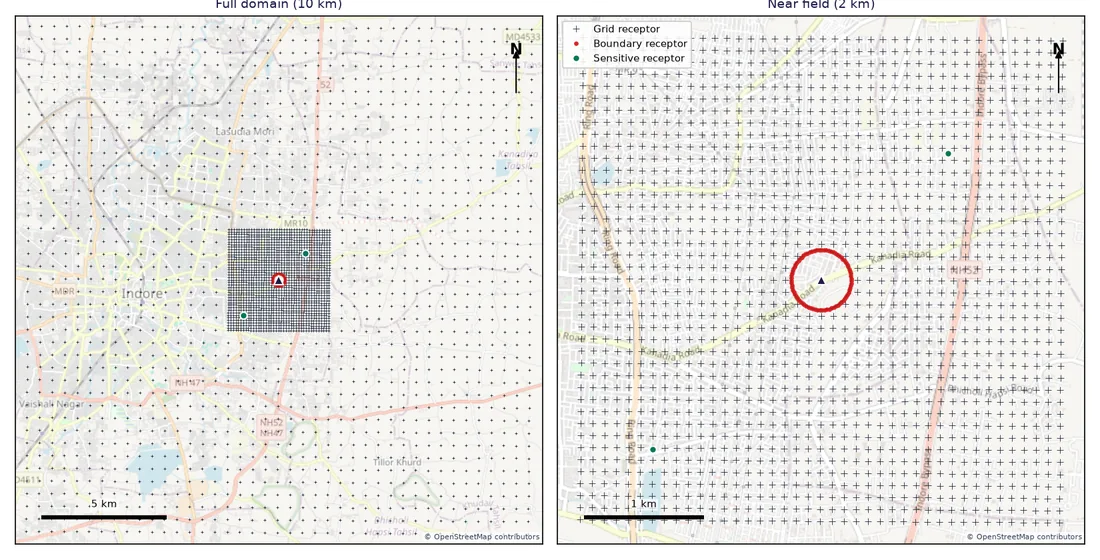
- Isopleth maps on a basemap, wind rose, site location map and receptor grid map.
- Comparison with the NAAQS 2009, including the project’s share of each total.
- A modelling report in the structure used in Indian EIA practice, or written to your consultancy’s template and delivered unbranded.
- The model archive — AERMET and AERMOD input and output files — so the study can be reviewed and reproduced.
Two Ways to Work With Us
Hire our modelling team for complete studies, complex sites and anything that will be scrutinised at appraisal. Or run standard stack studies yourself in AERMOD Studio, our browser-based software that runs the US EPA models and produces the same tables, maps and report — the demo is free and uses your own site. Many consultancies use both: the software for screening and design iterations, our team for the final submission study.
When an AERMOD Study Is Needed in India
Most of our AERMOD work supports one of a small number of regulatory moments. Knowing which one you are in decides the scenarios, the averaging periods and how the results must be presented, so we confirm it before quoting.
- Environmental Clearance (EC) under the EIA Notification, 2006 — the Terms of Reference usually require predicted incremental ground-level concentrations (GLCs) from the project, added to the measured baseline and compared with the National Ambient Air Quality Standards.
- Consent to Establish (CTE) from the State Pollution Control Board for a new plant, a new stack or a capacity expansion.
- Expansion and modernisation projects, where the existing and proposed sources must be modelled separately and together.
- Cumulative impact assessment for industrial clusters, where neighbouring sources contribute to the same receptors.
- Stack height justification and design optimisation, where modelling tests whether a taller or relocated stack actually lowers the maximum GLC.
- Complaint, odour and dust investigations, where modelling helps show which source can and cannot explain what nearby residents experience.
Inputs We Need From You
Turnaround depends far more on the completeness of inputs than on model run time. A complete input pack lets us freeze the model on day one; a partial one means assumptions that a reviewer may later question.
- Source list with coordinates (or a georeferenced layout), stack height, internal diameter, exit temperature and exit velocity or volumetric flow.
- Emission rates for each pollutant, with their basis: design values, CEMS or stack monitoring results, or emission factors for fugitive sources.
- Building dimensions near the stacks, so building downwash can be assessed with BPIP-PRIME.
- Site boundary and the study area agreed in the ToR (often a 10 km radius for EIA).
- Baseline ambient air quality results from your monitoring stations, so the predicted increment can be added to the right baseline value.
- Hourly meteorological data from the site station for the monitoring season, if available; otherwise we discuss representative alternatives.
What Drives the Cost and Turnaround of an AERMOD Study
We quote per project. The price and the timeline are set by the scope, not by the software:
- Number of sources, pollutants and averaging periods to report.
- Meteorological data: one season of site data versus a full year, and how much processing it needs.
- Terrain: flat sites are simpler than hilly or coastal sites that need careful terrain and land-use treatment.
- Building downwash and the number of nearby structures.
- Scenarios: existing, proposed, cumulative, upset or alternative stack designs each add runs and reporting.
- Report format: tables and contours for your own chapter, or a full standalone modelling report.
Why Modelling Reports Get Queried, and How We Prevent It
These are the issues reviewers raise most often. Each one is checked in our QA review before anything reaches you, and every study is delivered with its input files and a method statement so it can be rerun if a reviewer asks.
- Meteorological data that does not represent the site, or calm hours handled without explanation.
- Stack parameters that do not match the emission rates or the process description elsewhere in the EIA.
- A receptor grid too coarse to find the true maximum, or one that stops short of sensitive receptors.
- Increments added to the wrong baseline statistic, or compared with a standard for a different averaging period.
- Building downwash ignored for stacks close to tall structures.
- No record of model versions, options and input files, so the results cannot be reproduced on request.
AERMOD Studies by Industry
Each industry brings its own sources, pollutants and reviewer questions. Our sector guides set out how we model them:
- Refineries and petrochemical plants: process heaters, FCC and SRU stacks, flares, tank farms and fugitive VOC and benzene. See air dispersion modelling for refineries.
- Thermal power plants: tall unit stacks, FGD retrofits, coal handling and ash pond dust. See air dispersion modelling for thermal power plants.
- Cement plants: kiln, mill and cooler stacks, co-processing, limestone mines and clinker handling. See air quality modelling for cement plants.
- Steel plants: sinter, blast furnace, coke ovens, steel melt shops and stockyards. See AERMOD for steel plants.
- Mining projects: drilling, blasting, haul roads, crushers and stockpiles. See air quality modelling for mining projects.
- Pharmaceutical and chemical units, sugar mills and distilleries, waste-to-energy plants and road projects, each covered in our AERMOD guides.
Tenders, PSU Projects and Environmental Audits
Public sector undertakings and large industrial groups often procure dispersion modelling through tenders, alongside environmental audits, expansion EIAs and consent renewals. A clear scope of work decides whether the study is useful: who supplies the meteorology, which sources and scenarios are modelled, whether cumulative impacts are included, and whether the model files are handed over.
We work directly with industries where the tender allows it, and as the modelling partner of EIA consultancies and contractors who bid for this work. Our guide to air dispersion modelling tenders and scope of work gives a model scope and evaluation criteria procurement teams can use.
AERMOD Studies Across India
We work with industries, real estate developers and EIA consultancies across India from our base in Indore, with site data exchanged online and meetings by video. Regional guides cover the pollution control board practice, industrial clusters, meteorological data and typical projects in each area:
Specialist AERMOD Studies
Beyond standard stack studies, we handle the parts of AERMOD modelling that most often draw questions from appraisal committees and State Pollution Control Boards. Our guides explain each in detail:
- NO2 assessment with the tiered NOx-to-NO2 methods (full conversion, ARM2, OLM, PVMRM): NO2 modelling in AERMOD.
- Correct averaging periods, ranks and background for the NAAQS 2009 comparison: AERMOD averaging periods and NAAQS compliance.
- Fugitive dust, stockpiles, haul roads and open pits as volume, area, line and open-pit sources: AERMOD source types explained.
- Road and highway corridors with line and RLINE sources: air quality modelling for road projects.
- Sector studies for steel plants, sugar mills and distilleries, pharmaceutical and chemical plants and waste-to-energy plants and incinerators, including deposition of metals and dioxins.
- Sensitivity tests and honest uncertainty statements: how accurate is AERMOD?.
- Isopleth maps prepared in GIS to EIA report standard: AERMOD isopleth maps in QGIS.
How DSTechnoverse Can Help
- Scoping Call: We agree on sources, pollutants, averaging periods, receptor grid, and the standards to screen against.
- Data Handling: You share stack data and site coordinates; we handle met data, terrain, and land use.
- Modelling & QA: We build, run, and independently check the AERMOD model.
- Deliverables: You receive contour maps, result tables, and a write-up formatted to your template.
- Revisions: We support responses to regulator queries until the study is accepted.
Frequently Asked Questions
Is AERMOD accepted for Environmental Clearance in India?
AERMOD is the most widely used regulatory dispersion model in Indian EIA practice and is routinely accepted by appraisal committees for near-field studies. The model choice should still be justified in the report. For long-range transport, complex coastal meteorology or frequent calm conditions, a model such as CALPUFF can be more appropriate, and we will say so at scoping.
How much meteorological data does an AERMOD study need?
For an EIA, hourly site data for the baseline monitoring season is common, matched to the season of the ambient monitoring. A full year of data gives a more representative picture of worst-case conditions. We review data capture and calm hours before modelling and tell you if the dataset is not adequate.
Who signs the modelling report?
As a white-label subcontractor we deliver unbranded outputs and a method statement; your firm reviews, signs and submits. We remain available to answer technical queries from you and, through you, from the regulator.
Can you model fugitive dust and odour as well as stacks?
Yes. Fugitive dust from stockpiles, haul roads and handling points is modelled as area or volume sources with emission rates estimated from recognised emission factors. Odour studies use the same model with odour-specific emission rates and short averaging times.
How long does an AERMOD study take?
Once the inputs are complete and agreed, a single-site study with a handful of stacks is usually delivered as a draft within one to two weeks. Multi-source, cumulative or complex-terrain studies take longer; we give a firm date with the quote.
Do you help with regulator queries after submission?
Yes. Revisions and additional runs needed to answer appraisal or SPCB queries on the same scope are part of the engagement, and we provide written technical responses you can adapt.
Should I hire you or use your AERMOD software?
Use AERMOD Studio, our browser-based software, for standard stack studies over flat terrain that you want to run and re-run yourself; the demo is free. Hire us for studies with complex terrain, building downwash, fugitive or area sources, cumulative cluster assessments, or when a regulator query needs a modeller to defend the work.
How do I get a quote?
Send the site location, the stack or source list with emission rates, the pollutants and the purpose (EC, CTE, expansion) on WhatsApp or through the form on this page. We reply with the scope, the data we need, a firm delivery date and a quote at a standard nominal charge.
Which industries do you carry out AERMOD studies for?
We model refineries and petrochemical plants, thermal power plants, cement, steel, mining, pharmaceutical and chemical units, sugar mills and distilleries, waste-to-energy plants, real estate projects with DG sets and road projects. Each sector has its own source mix, from tall stacks to fugitive dust, and the study is set up to match it.
Can you support a PSU tender for air dispersion modelling?
Yes. We can work as the modelling partner of the EIA consultant or contractor bidding for the tender, or directly where the eligibility criteria allow. We help define the technical scope, the meteorology and data responsibilities and the deliverables, and we deliver the modelling report and files to the standard the tender specifies.
Is air dispersion modelling the same as air quality modelling or AERMOD modeling?
Broadly, yes. Air dispersion modelling (often written air dispersion modeling) predicts how emissions spread and what concentrations they cause at ground level; air quality modelling is the wider term that also covers chemistry and forecasting. AERMOD is the specific model most Indian regulators expect for near-field studies, so an AERMOD study, AERMOD modeling and an air dispersion study usually mean the same piece of work. It is sometimes searched as aeromod.
Do you only work on projects near Indore?
No. We take AERMOD studies for projects anywhere in India, including Bengaluru, Hyderabad, Gujarat, Mumbai, Pune, Delhi NCR, Chennai and the Odisha and Chhattisgarh industrial belts. Site data, drawings and monitoring results are shared online, and reviews happen by video; our regional pages describe the local regulators and data sources for each area.
Which averaging periods and standards does an Indian EC study report?
Predicted increments are reported for the averaging periods in the National Ambient Air Quality Standards, 2009: 24-hour and annual values for PM10, PM2.5, SO2 and NO2, and 1-hour and 8-hour values for CO. Each increment is added to the baseline for the same period and compared with the matching standard. Where the ToR or a consent condition asks for other pollutants or periods, we add them.
What if we do not have hourly site meteorological data?
Tell us at the start. For Environmental Clearance, hourly data from the baseline monitoring season is normally expected, and a wind rose alone cannot drive the model. Where site data is missing or patchy, we propose a representative alternative, such as a nearby station or site-specific modelled data, explain the choice in the report and flag the risk of a reviewer query before you commit.
Do you need to visit the site?
No. AERMOD studies are desk-based, and we work remotely with clients across India and abroad. What we need is accurate source data, a georeferenced layout, building heights near the stacks and the baseline monitoring results. Site photographs help us check building downwash and nearby receptors. Monitoring itself is done by your laboratory or monitoring agency.
Is our project data kept confidential?
Yes. Stack data, emission rates and client details are used only for your study and are not shared with anyone else. We can sign your non-disclosure agreement before you send anything, and white-label deliverables carry no reference to DSTechnoverse, so the end client sees only your consultancy's name.
Guides and Resources
- Run standard stack studies yourself: AERMOD Software (free demo)
- Meteorological data for AERMOD after NOAA ISD stopped in 2025
- What an AERMOD modelling subcontractor does
- The AERMOD input data checklist
- How much AERMOD modelling costs
- Turnaround time for outsourced AERMOD studies
- 10 common AERMOD mistakes that fail review
- Choosing an air dispersion model
- Air quality modelling for Environmental Clearance
- Air quality modelling for Consent to Establish
- QA/QC of a dispersion modelling report
Get a Quote on the First Reply
Send us these details and we can scope and quote without a back-and-forth:
- Stack details for each source: location, height, inner diameter, exit temperature and exit velocity (or flow).
- Emission rates for PM10, PM2.5, SO2, NOx and CO (g/s or kg/hr), with their basis: monitoring, design or consent limit.
- Hourly site meteorological data for the study period (wind speed and direction, temperature, humidity, cloud cover or solar radiation). A wind rose alone is not enough; if you have no hourly data, we can prepare it.
- Baseline ambient air quality results for each monitoring station.
- Plant layout with nearby building heights, the plant boundary and sensitive locations (villages, schools, hospitals).
- Purpose and deadline: EC, CTE, expansion or a compliance study.
A complete sample report showing the structure, tables and figures you receive.
Interested in AERMOD Air Dispersion Modelling Consultant & Subcontractor?
Tell us a little about your requirement and our team will get back to you with the right guidance. Prefer to talk now? Reach us directly on any channel below.
I'm Interested
Fill in your details and hit send. Your enquiry reaches our team instantly and we'll get back to you quickly.