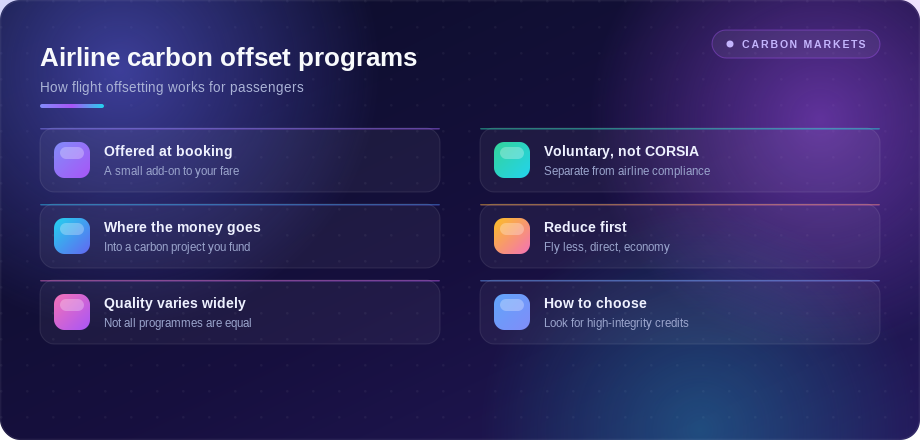
Quick answer: Airline carbon offset programs let a passenger, a company or a cargo shipper pay to compensate for the emissions of a flight, either by funding the retirement of carbon credits, by paying towards sustainable aviation fuel (SAF), or by buying a book-and-claim certificate that records a SAF emissions reduction in their name. They are voluntary and separate from CORSIA, the airline's own compliance scheme. A credible programme tells you how it calculates your emissions, names the projects, standards and registries behind the credits, publishes retirement records, explains how it avoids double claiming, and never says your flight became "carbon neutral".
Airline carbon offset programs are the options you see at the end of a booking, in a frequent flyer account or in a corporate travel contract that let you pay for the emissions linked to your trip. Some fund carbon credits, some fund sustainable aviation fuel, and some sell certificates that let a company claim a share of a SAF reduction. Air cargo shippers now have similar choices for the freight they move. This guide explains each model, how emissions are calculated, how to judge credibility, how programmes sit alongside CORSIA, and what shippers should do about air freight.
What Airline Carbon Offset Programs Actually Are
When you tick "offset my flight" at checkout, you are making a small voluntary purchase. The airline, or a specialist partner it has appointed, takes your payment and uses it for one of three things:
- Buying and retiring carbon credits equal to the estimated emissions of your seat. Each credit represents one tonne of CO2 equivalent reduced or removed by a project somewhere else, such as forestry, clean cooking, landfill gas or renewable energy.
- Contributing to sustainable aviation fuel, which pays part of the price gap between SAF and conventional jet fuel so that the airline can buy more of it.
- Issuing a SAF certificate under a book-and-claim system, which records that a defined quantity of SAF emissions reduction has been allocated to you or your company.
None of these makes your own flight cleaner in the physical sense. A carbon credit funds a reduction elsewhere to compensate for your flight. A SAF contribution helps reduce emissions somewhere in the airline's network, usually not on your aircraft. A certificate is an accounting record of that reduction. That honest description applies to every passenger carbon offsetting product, however it is marketed.
Who Runs the Programme
Most airline programmes are delivered with a partner: a carbon credit retailer, a SAF platform or a climate services company. The airline provides the booking interface and branding; the partner handles calculation, procurement, retirement and reporting. This matters when you assess credibility, because the information you need (registry serial numbers, project documents, retirement certificates) usually sits with the partner, not the airline's marketing page.
Where the Programmes Appear
| Channel | Typical buyer | What is usually offered |
|---|---|---|
| Booking checkout | Individual traveller | Offset per flight, sometimes a SAF option |
| Frequent flyer account | Regular traveller | Annual or per-trip offsets, sometimes paid in miles |
| Standalone calculator page | Any traveller | Calculate and pay after travel |
| Corporate SAF programme | Company travel or sustainability team | SAF contribution or certificates for Scope 3 |
| Cargo shipper programme | Freight forwarder or shipper | Offsets or SAF certificates per shipment or annual volume |
Three Models: Offsets, SAF Contributions and Book-and-Claim Certificates
The three models are often presented side by side on the same page, but they deliver different things and support different claims.
| Feature | Carbon credit offset | SAF contribution | Book-and-claim SAF certificate |
|---|---|---|---|
| What you pay for | Retirement of credits from an external project | Part of the SAF price premium | A documented share of a SAF emissions reduction |
| Where the reduction happens | Outside aviation | In aviation fuel supply | In aviation fuel supply |
| Unit you receive | Retired credits, ideally with serial numbers | Often just a receipt or statement | Certificate with fuel batch, life cycle value and volume |
| Typical claim supported | "I compensated for my emissions" | "I contributed to SAF" | "I claim X tonnes of SAF emissions reduction" (subject to accounting rules) |
| Main integrity questions | Additionality, permanence, double counting | Was extra SAF actually bought? | Was the same reduction claimed twice? |
| Relative cost per tonne | Lower, varies widely by credit type | Higher | Higher |
Carbon Credit Offsets
This is the oldest and most common model. The price per tonne is usually low compared with SAF, which is why the checkout amount is often only a few dollars. Quality depends almost entirely on the credits chosen. A programme that uses credits with weak additionality, where the reductions would probably have happened anyway, offers little real benefit. A programme that buys credits approved against recognised integrity benchmarks, or durable removals, costs more but supports a stronger statement. For the difference between reductions and removals, see carbon removal credits explained.
SAF Contribution Programmes
SAF contribution programmes ask you to pay towards the extra cost of sustainable aviation fuel. Because SAF is produced from feedstocks such as waste oils, residues or, in future, synthetic routes, it can cut life cycle emissions compared with fossil jet fuel, though the saving depends on the pathway. A contribution model is attractive because it addresses aviation's own fuel rather than an unrelated project. The weakness is that a simple contribution may not tell you how much SAF was bought, when, from which pathway, or whether your payment changed the airline's purchasing. Ask whether contributions are ring-fenced and reported.
Book-and-Claim Certificates and Corporate SAF Programmes
Corporate SAF programmes usually use book-and-claim. SAF is blended into the fuel supply at an airport, and because it mixes with conventional fuel it cannot be traced to a specific aircraft. Book-and-claim separates the environmental attributes of that SAF from the physical fuel and records them in a registry, so that a company paying for those attributes can claim the associated reduction against its business travel or freight emissions. Several industry registries and certification bodies now operate book-and-claim rules, and the details differ.
A good certificate states the volume of SAF, the feedstock and pathway, the life cycle emissions value used, the sustainability certification scheme, the delivery location and period, and who else (if anyone) holds a claim on the same fuel. Without those fields a certificate is hard to defend. The technical side of how eligible fuels reduce an airline's obligation is covered in CORSIA sustainable aviation fuels, and the related question of insetting is covered in carbon insetting vs offsetting.
How Programmes Calculate Your Flight Emissions
The amount a programme asks you to pay starts with an emissions estimate for your seat. Two methodologies sit behind most airline and third-party calculators. This section explains what each does at a high level; for the step-by-step formula and route examples, use our guide on how to calculate a flight's carbon footprint.
The ICAO Carbon Emissions Calculator Approach
ICAO, the UN aviation agency, publishes a public carbon emissions calculator. In broad terms it estimates fuel burn for a route from the aircraft types typically flown on it and the flight distance (with a correction for routing that is longer than the straight-line distance), converts fuel to CO2 using the standard factor of about 3.16 kg of CO2 per kg of jet fuel, then shares the result between passengers and cargo and across cabin classes using load factor and seating assumptions. It is designed to be neutral and consistent across airlines, which is why many programmes and corporate travel tools reference it.
The IATA Recommended Practice 1726 Approach
IATA Recommended Practice 1726 sets out a passenger CO2 calculation methodology intended to use airlines' own measured fuel data rather than modelled averages. Key features include allocating fuel between passengers and belly cargo by mass, using a standard passenger weight that includes baggage, and applying cabin class weighting so that premium seats, which take more floor space, carry a larger share. IATA offers a calculation service based on this methodology to airlines and corporate buyers. Because it uses actual operating data, results can differ from the ICAO calculator for the same route.
Why Two Calculators Give Different Numbers
| Variable | Effect on the estimate |
|---|---|
| Actual versus modelled fuel burn | Actual airline data may be higher or lower than averages |
| Passenger and cargo split | Allocating more to cargo lowers the passenger figure |
| Cabin class weighting | Business and first class can be two to several times economy |
| Load factor assumption | Fuller flights mean lower emissions per seat |
| Non-CO2 effects | Some programmes add an uplift for contrails and nitrogen oxides; others do not |
| CO2 only or CO2e | Including other gases and upstream fuel emissions raises the figure |
The practical lesson: a credible programme states which methodology it uses, whether it includes non-CO2 effects or well-to-wake fuel emissions, and how it treats cabin class. If you report travel emissions for a company, use one method consistently rather than whatever each airline's checkout produces. The business travel emissions guide covers how to build that into a travel policy.
Worked Example: A Passenger Booking
The figures below are illustrative only. They are round numbers chosen to show the mechanics, not real calculator outputs or market prices.
A traveller books a return trip between a Gulf hub and a city on the US East Coast, roughly 11,000 km each way, and is offered three options at checkout.
Step 1: The emissions estimate. The programme's calculator gives an illustrative 0.6 tonnes of CO2 per economy passenger each way, so 1.2 tonnes for the return trip. Had the traveller booked business class, a cabin weighting of, say, 2.5 would raise this to 3.0 tonnes.
Step 2: Option A, carbon credit offset. At an illustrative price of 15 per tonne (in the booking currency), offsetting 1.2 tonnes costs 18. The traveller should receive a confirmation naming the project, standard and registry, and ideally a link to the retirement record.
Step 3: Option B, SAF contribution. Suppose SAF costs an illustrative 1.0 more per kilogram than conventional fuel and the pathway cuts life cycle emissions by 80% compared with fossil jet fuel. Each kilogram of SAF then avoids about 0.8 times the roughly 3.8 kg of life cycle CO2e associated with a kilogram of fossil jet fuel (using an illustrative well-to-wake figure), so about 3.0 kg. Covering 1.2 tonnes would need around 400 kg of SAF, costing about 400 in premium. In practice, programmes usually offer a smaller contribution, covering a fraction of the trip.
Step 4: Option C, partial SAF plus offset. A blended option might pay for SAF covering 10% of the emissions (about 40) and offset the remaining 1.08 tonnes with credits (about 16), for roughly 56 in total.
| Option | Illustrative cost | What the traveller can say |
|---|---|---|
| A: credits only | 18 | "I paid to retire 1.2 tonnes of credits to compensate for this trip." |
| B: full SAF | about 400 | "I paid for SAF that reduced aviation emissions by about 1.2 tonnes." |
| C: blend | about 56 | "I funded SAF for part of the trip and compensated the rest with credits." |
None of the options allows the traveller to say the trip was "zero emission". The example also shows why SAF contributions are usually small: the price premium per tonne is far higher than for most credits. The trade-off is that the reduction happens in aviation fuel itself.
How Credible Are Airline Carbon Offset Programmes?
The honest answer to how credible airline carbon offset programmes are is that they vary from strong to weak, and the difference is mostly visible in what the programme discloses. Because these purchases are voluntary and individual buyers rarely check, some older schemes relied on inexpensive credits from project types that were later criticised for over-crediting or weak additionality. Newer programmes increasingly use credits assessed against high-integrity frameworks, publish annual reports, and offer SAF options.
What Has Changed in the Market
Three developments have raised the bar. First, the ICVCM Core Carbon Principles provide a benchmark for credit quality at programme and methodology level. Second, independent carbon credit ratings give buyers a view on individual projects. Third, consumer protection regulators have become more active on environmental claims. In the European Union, rules adopted in 2024 restrict product claims of climate neutrality based on offsetting, and in the United States the Federal Trade Commission's Green Guides set out how environmental marketing claims should be substantiated. Several airlines have faced complaints or legal challenges in different countries over carbon neutral marketing. The direction is clear: claims should describe what was funded, not promise that a flight has no impact.
The Credibility Checklist
Use this checklist for any passenger, corporate or cargo programme.
- Methodology disclosed. The programme names its calculation method (ICAO, IATA RP 1726 or another) and says whether it includes non-CO2 effects and cabin class weighting.
- Projects named. You can see which projects your money supports, their location and type, not just "we plant trees".
- Standards and registries identified. Credits are issued under recognised standards (for example Verra, Gold Standard, ACR or CAR) and retired on a public registry. See carbon credit standards explained.
- Retirement evidence available. Serial numbers or retirement records are published, ideally per period, and match the volumes sold.
- Integrity screening explained. The programme describes how it screens credits for additionality, permanence, leakage and over-crediting, or references an external benchmark or rating.
- SAF details given. For SAF options, the programme states volumes, pathways, certification schemes, life cycle values and whether the fuel is additional to what the airline would have bought.
- Double claiming addressed. It explains how it prevents the same credit or SAF reduction from being counted by the airline, another customer or a country.
- Money flow transparent. It says whether the airline takes any margin or administration fee and how much of the payment reaches projects or fuel.
- Claims language is careful. It avoids "carbon neutral flight" and "guilt-free travel" wording and distinguishes compensation from reduction.
- Annual reporting exists. There is a yearly report, ideally with independent assurance, covering tonnes sold, credits retired and SAF purchased.
A programme that scores well on most of these points is one you can explain to a colleague, an auditor or a customer. One that fails on points 2 to 4 should be treated as a donation rather than an offset. The broader warning signs are set out in carbon credit greenwashing red flags.
Good Signs and Red Flags
| Good sign | Red flag |
|---|---|
| Names projects, standards and registries | Vague claims with no traceable credits |
| Publishes retirement serial numbers | No retirement evidence, or "available on request" only |
| States calculation method and assumptions | A single number with no method |
| Explains SAF accounting and double claiming controls | SAF claims with no volumes or certification |
| Uses careful claims wording | Promises a "carbon neutral" or "zero impact" flight |
| Independent assurance of the annual report | Unverified totals or no report at all |
Airline Carbon Offset Programs and CORSIA
A frequent confusion is between voluntary programmes and CORSIA, the Carbon Offsetting and Reduction Scheme for International Aviation. They are different systems with different buyers. For a full explanation of the compliance side, see the CORSIA carbon credits complete guide and the knowledge base entry what is CORSIA.
Voluntary Versus Compliance
| Aspect | Voluntary airline programme | CORSIA |
|---|---|---|
| Who pays | Passenger, company or shipper | The aircraft operator |
| Legal basis | Optional purchase | ICAO scheme implemented through national rules |
| What it covers | Emissions of a booking, trip or shipment | Growth in international aviation emissions above a baseline |
| Unit rules | Programme's own choice of credits or SAF | CORSIA Eligible Emissions Units or CORSIA eligible fuels |
| Who checks | The programme, sometimes an assurance provider | Verification bodies and national authorities |
CORSIA ran a pilot phase from 2021 to 2023 and is in its first phase from 2024 to 2026, with a second phase from 2027 to 2035. From 2024 the baseline is set at 85% of 2019 emissions. Operators with more than 10,000 tonnes of CO2 a year from international flights must monitor and report. Offsetting must be met with CORSIA Eligible Emissions Units, which are approved by the ICAO Council on the recommendation of its Technical Advisory Body; for the first phase, these units need a host country Letter of Authorization and a corresponding adjustment. How airlines meet these obligations in practice is explained in how airlines use carbon credits under CORSIA.
No Double Claiming
Your passenger offset does not reduce the airline's CORSIA obligation, and the airline's CORSIA units do not offset your trip. Problems arise when the boundaries blur:
- The same credit sold twice. A credit retired for a passenger cannot also be cancelled for CORSIA compliance. A good programme retires passenger credits in a way that names the voluntary purpose.
- SAF claimed by the airline and sold to a customer. If an airline claims the emissions reduction from a SAF batch to lower its CORSIA requirement (or under another compliance scheme), selling the same reduction to a corporate buyer for its own claim raises double counting questions. Accounting rules for Scope 1 and Scope 3 claims on the same fuel are still developing, so the programme should state clearly who claims what. The interaction between SAF and offsetting under CORSIA is explored in SAF or offsets for a CORSIA obligation.
- Country claims. Where a credit is authorised for international use, the host country makes a corresponding adjustment so the reduction is not also counted towards its own climate target. Voluntary credits without authorisation are not adjusted, which is acceptable for some claims but should be disclosed.
For a side-by-side view of the two markets, read CORSIA vs the voluntary carbon market.
How Programmes Typically Differ in Practice
Without ranking or criticising any airline, it is useful to recognise the common designs you will meet.
- Checkout credit offset. The simplest model. A box at the end of booking adds a small amount for credits, usually from a portfolio of projects. Quality depends on the portfolio.
- Credit and SAF choice. The passenger chooses between credits, SAF or a mix, often with SAF presented as the higher-impact option. Look for SAF volume reporting.
- Loyalty-linked programmes. Frequent flyers can pay with miles or points, or earn status credit for SAF contributions. Check whether the underlying purchase is disclosed in the same detail as cash payments.
- Corporate SAF agreements. Companies sign annual agreements to buy SAF certificates linked to their staff travel, often with reporting designed for Scope 3 disclosure.
- Cargo programmes. Airlines and forwarders offer shippers offsets or SAF certificates per shipment or per year, with emissions calculated from tonne-kilometres.
In the United States, interest in corporate SAF programmes is linked to companies' Scope 3 targets and to federal and state SAF incentives. In the UAE and the wider Gulf, hub carriers and airports have announced SAF initiatives, and regional companies are asking the same Scope 3 questions. The checklist above applies in both.
Air Cargo Emissions: Whose Are They?
Air freight is the most carbon-intensive way to move goods per tonne-kilometre, often many times the intensity of sea freight for the same journey. That is why air cargo carbon offsetting and SAF programmes for shippers have grown alongside passenger schemes.
The airline operates the flight, but the shipper creates the demand. Under the GHG Protocol, emissions from transporting a company's goods by third parties fall within the shipper's Scope 3 (upstream or downstream transportation and distribution, depending on who pays for the freight). A retailer air-freighting stock, a manufacturer expediting components and an e-commerce business promising fast delivery all carry that carbon in their value chain footprint. Customers, investors and regulators increasingly ask about it. For the scope categories, see GHG accounting: Scope 1, 2 and 3 explained.
How Freight Emissions Are Measured
Freight emissions are driven by weight multiplied by distance, giving tonne-kilometres, converted with an emission factor for air transport. Recognised frameworks for logistics emissions include the GLEC Framework and the international standard ISO 14083, which set out how to allocate emissions across shipments and transport legs. IATA also publishes a recommended practice for measuring cargo CO2 so that airlines report per-shipment figures consistently. Factors differ between belly cargo on passenger aircraft and dedicated freighters, and between short and long hauls, so the method should be stated.
| Freight mode | Relative carbon intensity per tonne-km |
|---|---|
| Sea freight | Lowest |
| Rail | Low |
| Road | Moderate |
| Air freight | Highest by a wide margin |
Worked Example: A Shipper's Annual Air Freight
Again, the figures are illustrative only.
A consumer electronics distributor ships 200 tonnes a year by air on a route of about 11,000 km.
- Tonne-kilometres: 200 tonnes x 11,000 km = 2,200,000 tonne-km.
- Emissions: using an illustrative factor of 0.6 kg CO2e per tonne-km, the total is 1,320,000 kg, or 1,320 tonnes CO2e.
- Mode shift: after reviewing urgency, the company moves 25% of volume to sea freight, removing roughly 330 tonnes of air emissions (sea freight adds a much smaller amount back).
- SAF certificates: for the remaining 990 tonnes, it buys book-and-claim certificates covering 10%, about 99 tonnes.
- Offsets for the residual: it retires high-integrity credits for the remaining 891 tonnes, or decides to report them as unabated while it builds its SAF share.
That is far easier to defend than offsetting 1,320 tonnes of cheap credits with no change in behaviour.
Shipper Offsetting and SAF Programmes for Air Cargo
When choosing an air cargo carbon offsetting or SAF programme, a shipper should follow the same order as a traveller, but with more data.
- Measure. Capture shipment weight, origin, destination and carrier for all air freight. Ask forwarders for emissions per shipment and the method used.
- Reduce. Identify shipments that do not need air speed and move them to sea, rail or sea-air combinations. Consolidate shipments and improve packaging density.
- Choose carriers and routes. Direct routings and newer aircraft generally lower emissions per tonne-kilometre.
- Buy SAF attributes. Use book-and-claim certificates through an airline or forwarder programme, checking volume, pathway, life cycle value, certification and double claiming controls.
- Offset the residual. Retire credits that pass a quality screen, in the company's name, with serial numbers kept on file. The steps for screening are covered in how to evaluate carbon offset quality.
- Report clearly. Show gross air freight emissions, reductions from mode shift, SAF claims and offsets separately rather than netting everything to zero.
Questions to Ask a Cargo Programme
| Question | Why it matters |
|---|---|
| Which methodology calculates my shipment emissions? | Allows comparison across carriers and years |
| Is the figure for belly cargo or freighter capacity? | Factors differ materially |
| Are SAF certificates registered, and with whom? | Prevents duplicate sale |
| Does the airline also claim this SAF for compliance? | Determines whether your claim is exclusive |
| Which credits are retired, and where can I see them? | Needed for audit and disclosure |
| Is the annual programme report assured? | Adds confidence for Scope 3 reporting |
The Honest Order of Operations
Offsetting a flight or a shipment is better than ignoring the emissions, but it is the last step. For travellers, the larger levers are flying less where alternatives exist, choosing direct routes (take-off and climb burn a large share of fuel on short trips), and travelling in economy. For companies, a travel policy and freight mode review usually remove more emissions than any programme. SAF then addresses aviation's own fuel, and carbon credits compensate for what remains, with a statement you would be comfortable explaining.
How DSTechnoverse Helps
DSTechnoverse supports airlines, travel managers, freight teams and project developers on the data and integrity side of aviation carbon. We review the calculation methods behind passenger and cargo programmes, screen carbon credits for eligibility and quality, check SAF claim documentation for double counting risk, and prepare offsetting requirement estimates and monitoring plan support for operators under CORSIA. For US-based operators and buyers see CORSIA services for the United States, and for Gulf carriers and companies see CORSIA services for the UAE and Middle East. Our wider CORSIA carbon credit services cover sourcing and registry support. We are not a verification body. To discuss a programme, contact us.
Frequently Asked Questions
What are airline carbon offset programs? They are voluntary schemes that let passengers, companies or shippers pay to compensate for the emissions of a flight or shipment. The payment funds retired carbon credits, contributions to sustainable aviation fuel, or book-and-claim SAF certificates. They are separate from the airline's own CORSIA obligation and do not make the flight itself emission free.
How credible are airline carbon offset programmes? Credibility varies widely. Stronger programmes disclose their calculation method, name the projects, standards and registries behind their credits, publish retirement records, report SAF volumes and explain how they prevent double claiming. Weak programmes give a single number and vague project descriptions. Use the ten-point checklist in this guide before relying on any programme for a claim.
Do carbon offset programs for flights count towards CORSIA? No. Passenger and corporate offsets are voluntary purchases. CORSIA is the aircraft operator's compliance obligation, met with CORSIA Eligible Emissions Units or eligible fuels. A credit retired for a passenger cannot also be cancelled for an airline's CORSIA compliance, and the airline's CORSIA units do not compensate for your trip.
How do airlines calculate the emissions for my seat? Most programmes use either the ICAO Carbon Emissions Calculator approach, which models fuel burn from typical aircraft and distance, or IATA Recommended Practice 1726, which uses airlines' measured fuel data. Both share emissions between passengers and cargo and weight premium cabins more heavily. Results can differ for the same route.
Is a SAF contribution better than a carbon offset? A SAF contribution reduces emissions within aviation's fuel supply, which many buyers see as more direct, but it costs much more per tonne. A carbon credit is cheaper and its value depends on project quality. Many programmes offer a blend. The better choice is the one with clear documentation that supports the claim you want to make.
What are corporate SAF programmes? Corporate SAF programmes let companies buy the environmental attributes of sustainable aviation fuel, usually through book-and-claim certificates, to address emissions from staff travel or freight. A good certificate records the fuel volume, pathway, life cycle value, certification scheme and delivery period, and makes clear whether the airline also claims the same reduction.
Can I offset air cargo emissions? Yes. Air cargo carbon offsetting works by calculating shipment emissions from tonne-kilometres, reducing what you can through mode shift and consolidation, buying SAF certificates where available, and retiring high-integrity credits for the remainder. Report each element separately in your Scope 3 disclosure rather than netting the total to zero.
Can I say my flight was carbon neutral after offsetting? It is safer not to. Consumer protection rules in several markets are tightening on climate neutrality claims based on offsets. Describe what you funded instead, for example that you paid to retire a stated number of credits from a named project or contributed to a stated volume of SAF.
Is passenger carbon offsetting worth it? Passenger carbon offsetting is worth doing if the programme is transparent and the credits are high quality, and if you treat it as compensation for emissions you could not avoid. Flying less, choosing direct routes and travelling economy usually cut more emissions than any offset purchase.
Buying carbon credits or measuring travel and freight emissions? DSTechnoverse works on the data and integrity side of carbon — footprint measurement, project screening, registry and eligibility verification, and defensible reporting. See our CORSIA carbon credit services and data analytics. We are based in Indore, Madhya Pradesh and work across India and internationally.
Apply as a carbon credit buyer or seller
Talk to our team, or start with the complete carbon credits guide.