ICAO writes the standards. It cannot fine an airline. Everything that actually binds an operator arrives through the law of the State responsible for it, which is why the obligation is uniform but the consequence of ignoring it is not.
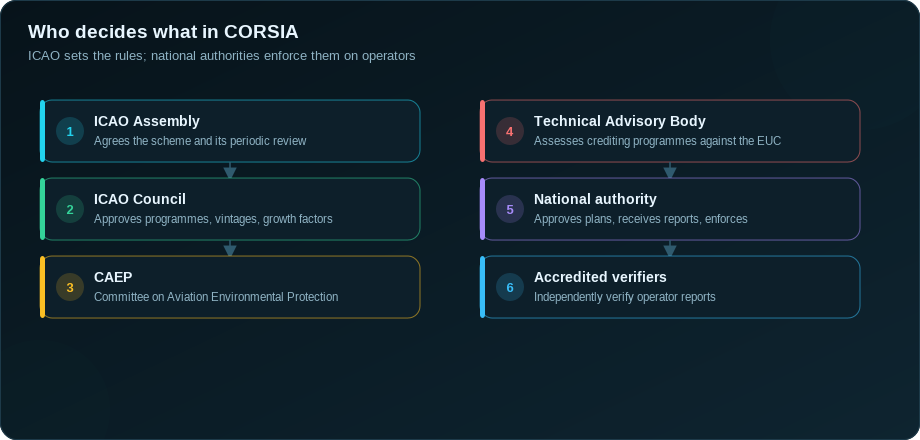
The Implementation Chain
- 1The ICAO Assembly adopts the scheme by resolution
- 2Standards are placed in Annex 16, Volume IV to the Chicago Convention
- 3Member States transpose those standards into national law
- 4The national authority administers and enforces against operators
Step 3 is where variation enters. States implement on their own timetable, through their own legislative instruments, with their own penalties and their own submission calendars.
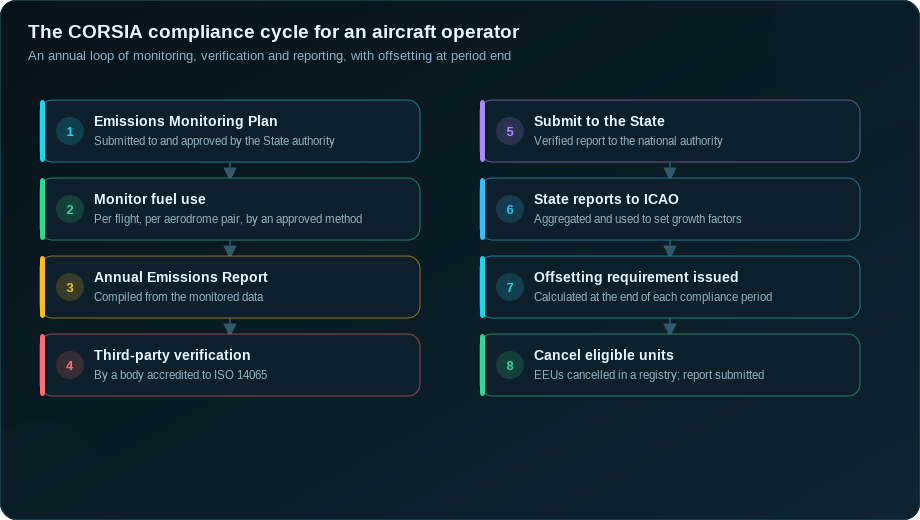
What the National Authority Does
| Function | Detail |
|---|---|
| Approve the Emissions Monitoring Plan | Reviews for completeness, consistency, plausibility |
| Receive Annual Emissions Reports | Verified reports, on the State's calendar |
| Oversee verification | Recognition of accredited bodies, review of findings |
| Report to ICAO | Aggregated data feeding the sectoral growth factor |
| Receive Cancellation Reports | Closing the compliance loop |
| Enforce | Under domestic law |
Which State Is Responsible for You
Generally the State that issued the operator's Air Operator Certificate — the State of the Operator.
This is not always the State of registry of the aircraft, and it is not the State where the operator's parent company sits. For groups holding multiple certificates across jurisdictions, each certificate can bring a different authority into play.
Why this needs settling early
Establishing which authority you answer to determines which submission calendar applies, which national implementing law binds you, and where your monitoring plan goes for approval.
Operators with complex structures — multiple certificates, wet leases, franchise arrangements — should document the determination and the reasoning. It will be tested, and it is not a question you want to be resolving in a reporting window.
See CORSIA scope and thresholds for the related question of which entity is the operator.
How Enforcement Varies
Because penalties are set nationally, they differ. Across implementing States they have included:
- Administrative financial penalties, sometimes scaled to the shortfall
- Publication of non-compliance
- Conditions or restrictions on operating permissions in serious cases
- Escalating penalties for repeat failures
The practical point is not the specific instrument. It is that enforcement is real, domestic and local to you, and that a general statement about CORSIA penalties is meaningless without naming the State.
Deadlines Are National
Exact submission dates for monitoring plans, Annual Emissions Reports and Emissions Unit Cancellation Reports are set in national implementing law.
Check your authority's published calendar. Do not assume a date common to all States, and do not assume this year's date matches last year's.
What the Operator Is Accountable For
This is worth stating plainly, because it is frequently blurred by the number of parties involved.
The operator is accountable. Not the consultant who prepared the report, not the verifier who checked it, not the broker who sourced the units.
A consultant can prepare a monitoring plan; the operator submits it and is bound by it. A verification body can verify; the operator remains responsible for the underlying data. An intermediary can source units; the operator carries the eligibility risk if they fail.
The practical consequence for how you resource this
Something in your organisation must be able to explain your own data. If nobody internally can say where the fuel figures come from, how discrepancies were resolved, or why a particular unit was accepted, verification will be painful and enforcement exposure is real.
Outsourcing execution is normal and sensible. Outsourcing understanding is how organisations become unable to defend their own filings.
Working With Your Authority
Engage early on the monitoring plan. Approval practice varies, and familiarity with a specific authority's emphases has genuine value. This is one of the few aspects of CORSIA that is meaningfully local.
Ask rather than assume. Where implementation detail is ambiguous, authorities generally prefer a question in advance to a correction afterwards.
Document interactions. Guidance received, positions agreed, clarifications given. These become part of the evidence trail defending a decision years later.
Raise difficulties while they are still hypothetical. An authority told in advance about a supply constraint or an unresolved finding has options available to it; one that discovers the same problem through a missed submission does not.
Where to Go Next
- CORSIA governance — the ICAO layer above this
- CORSIA in India — DGCA specifics
- The Emissions Monitoring Plan — the first submission
- Compliance periods and deadlines — the calendar
Indian operators deal with the DGCA. Standards are published by ICAO.
DSTechnoverse manages authority engagement and submissions for operators. Talk to our team.
Further Reading
Frequently Asked Questions
Which country's authority is responsible for my airline under CORSIA? An operator is attributed to one State, usually the State that issued its air operator certificate, or for operators without one, the State of registration or principal place of business under the attribution rules. That State's national authority approves the monitoring plan, receives reports and enforces compliance, whatever routes the operator flies.
What does a national authority do under CORSIA? The national authority maintains the list of operators it administers, approves Emissions Monitoring Plans, receives verified emissions reports, calculates offsetting requirements, receives cancellation reports and forwards data to ICAO. It also sets national deadlines and procedures within the ICAO framework and applies penalties where operators do not comply.
What are the penalties for CORSIA non-compliance? ICAO does not set penalties. Each State enforces CORSIA through its own law, so consequences vary widely, from administrative notices and fines to restrictions on operations in some jurisdictions. Operators should read their administering State's implementing rules rather than assuming the approach of another State applies to them.
How should an operator work with its national authority? Identify the right contact early, confirm national deadlines and templates, and raise uncertain points in writing before submission. Notify material changes promptly and keep a record of correspondence. Authorities differ in experience and capacity, so clear, early communication avoids late surprises during approval or reporting.