
Quick answer: A microbial limit test checks a non-sterile product against two questions: how many viable aerobic bacteria and fungi it contains (TAMC and TYMC under USP <61>), and whether specified organisms such as E. coli, Salmonella, S. aureus or P. aeruginosa are absent from a stated quantity (USP <62>). The acceptance criteria come from USP <1111>, where a limit written as 10² CFU/g means a maximum acceptable count of 200 CFU/g. A result is only valid if method suitability has shown the product does not suppress recovery.
Microbial limit testing releases most non-sterile pharmaceutical, nutraceutical and cosmetic products, from tablets and syrups to creams, nasal sprays and raw materials. This guide covers the microbial limit test procedure, USP <1111> acceptance criteria by dosage form, the interpretation rule, specified microorganisms by product type and a worked TAMC calculation.
What a Microbial Limit Test Covers: USP <61>, <62> and <1111>
The compendia divide the work into three chapters, and confusing them is the single most common specification error we see.
| Chapter | Title (short form) | What it does | Mandatory? |
|---|---|---|---|
| USP <61> | Microbial Enumeration Tests | Counts total aerobic microbes (TAMC) and total combined yeasts and moulds (TYMC) | Yes, when cited in a monograph or specification |
| USP <62> | Tests for Specified Microorganisms | Shows absence of named organisms in a stated quantity | Yes, when cited |
| USP <1111> | Acceptance Criteria for Nonsterile Products | Recommends limits by route and dosage form | Informational, but it is what specifications are built from |
The European equivalents are Ph. Eur. 2.6.12 (enumeration), 2.6.13 (specified micro-organisms) and 5.1.4 (acceptance criteria). The Japanese Pharmacopoeia carries matching texts, and the three were harmonised through the Pharmacopoeial Discussion Group, so a correctly run USP <61> test is also a valid Ph. Eur. 2.6.12 test. The Indian Pharmacopoeia follows the same harmonised structure for microbial contamination in non-sterile products, which is why most Indian exporters write one specification that cites IP, USP and Ph. Eur. together.
A complete specification needs both halves. "Microbial limit test as per USP <61>" gives counts and nothing else; an oral liquid also needs "absence of E. coli in 1 mL as per USP <62>" written in.
Products labelled sterile need a different test altogether; see sterility testing under USP <71>.
TAMC and TYMC: The Enumeration Half of Microbial Limit Testing
USP <61> produces two numbers, and each is defined by the medium it is counted on rather than by what the organisms actually are.
| Count | Medium | Incubation | Counted as |
|---|---|---|---|
| TAMC (Total Aerobic Microbial Count) | Soybean-Casein Digest Agar (SCDA) | 30 to 35 °C, 3 to 5 days | All colonies on SCDA, including any fungi that grow there |
| TYMC (Total Combined Yeasts and Moulds Count) | Sabouraud Dextrose Agar (SDA) | 20 to 25 °C, 5 to 7 days | All colonies on SDA, including any bacteria that grow there |
That last column surprises people. The chapter defines TAMC as the number of CFU found on SCDA, so a mould colony on the SCDA plate is part of the TAMC. Likewise a bacterial colony on SDA is part of the TYMC. Where bacterial growth on SDA would push the TYMC over its limit, the chapter allows SDA containing antibiotics, provided that medium has been shown suitable.
Three Enumeration Methods
| Method | How it works | When it is used | Practical limit of detection |
|---|---|---|---|
| Membrane filtration | Filter the prepared sample through a membrane of nominal pore size not greater than 0.45 µm, rinse, place the membrane on agar | Filterable liquids, soluble solids, products with antimicrobial activity | 1 CFU per quantity filtered (often 1 CFU/g) |
| Pour plate | 1 mL of prepared sample mixed with 15 to 20 mL molten agar at not more than 45 °C in a 9 cm dish | Most solids and non-filterable liquids | 10 CFU/g at a 1:10 preparation |
| Surface spread | Not less than 0.1 mL spread on solidified, dried agar | Heat-sensitive organisms, small volumes | 100 CFU/g at 0.1 mL of a 1:10 preparation |
| Most probable number (MPN) | Tubes at serial dilutions, read for growth | Only for TAMC, only where plating and filtration are unworkable | Poor precision; a last resort |
Membrane filtration is preferred wherever the product can be filtered: rinsing washes away preservatives, and filtering the equivalent of 1 g or more gives a far lower detection limit than plating 1 mL of a dilution.
For plate methods, at least two dishes per medium per dilution are required, and the result is the arithmetic mean. The chapter tells you which plates to count: the dilution giving the highest number of colonies below 250 for TAMC and below 50 for TYMC. Above those numbers colonies merge and compete, and counts become unreliable.
USP <1111> Acceptance Criteria by Dosage Form
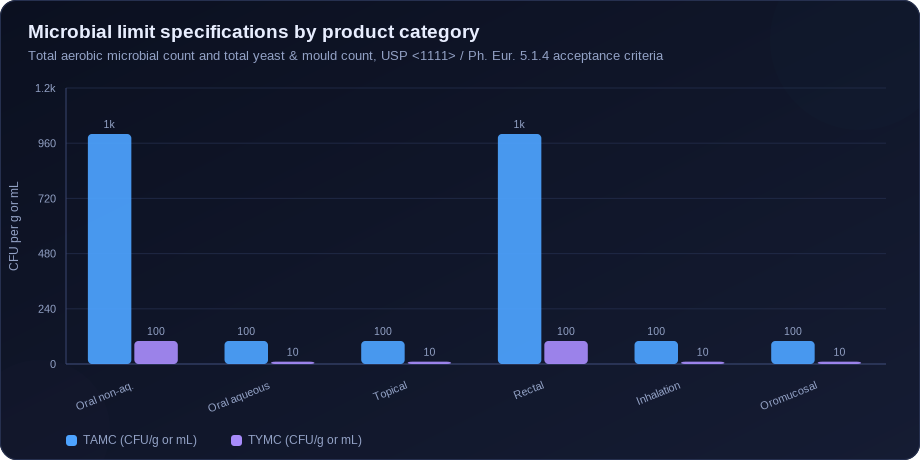
USP <1111> Table 1 sets the recommended criteria for non-sterile dosage forms. The figures below follow the harmonised text (identical in Ph. Eur. 5.1.4). Limits are expressed in CFU per gram or per mL, or per patch for transdermal systems.
| Route of administration | TAMC (CFU/g or mL) | TYMC (CFU/g or mL) | Specified microorganisms |
|---|---|---|---|
| Non-aqueous preparations for oral use | 10³ | 10² | Absence of E. coli (1 g or 1 mL) |
| Aqueous preparations for oral use | 10² | 10¹ | Absence of E. coli (1 g or 1 mL) |
| Rectal use | 10³ | 10² | None listed |
| Oromucosal, gingival, cutaneous, nasal and auricular use | 10² | 10¹ | Absence of S. aureus and P. aeruginosa (1 g or 1 mL) |
| Vaginal use | 10² | 10¹ | Absence of P. aeruginosa, S. aureus and C. albicans (1 g or 1 mL) |
| Transdermal patches (one patch, including adhesive and backing) | 10² per patch | 10¹ per patch | Absence of S. aureus and P. aeruginosa (1 patch) |
| Inhalation use (special requirements apply to liquids for nebulisation) | 10² | 10¹ | Absence of S. aureus, P. aeruginosa and bile-tolerant Gram-negative bacteria (1 g or 1 mL) |
The harmonised text adds a special provision for oral dosage forms containing raw materials of natural origin (animal, vegetable or mineral) where antimicrobial pre-treatment is not feasible and the competent authority accepts a raw material TAMC above 10³ CFU/g. For those products the criteria are TAMC 10⁴ CFU/g, TYMC 10² CFU/g, not more than 10² CFU/g of bile-tolerant Gram-negative bacteria, and absence of Salmonella (10 g), E. coli (1 g) and S. aureus (1 g). Herbal medicinal products in Europe have their own chapter (Ph. Eur. 5.1.8), and dietary supplements in the US are covered by USP <2023>; our guide to herbal and nutraceutical microbial limits deals with those in detail.
Table 2 of USP <1111> covers non-sterile substances for pharmaceutical use (APIs and excipients): TAMC 10³ CFU/g and TYMC 10² CFU/g, with specified organisms set according to the material's origin and use. Raw material programmes are discussed further in our raw material testing service.
Limits tighten as the route reaches more vulnerable tissue and as water content rises: a dry tablet cannot support growth, an aqueous syrup can. Our article on water activity and microbial growth explains why moisture is the parameter that really drives risk.
Reading Limits Correctly: The 10ⁿ Interpretation Rule
USP <1111> states how a limit written as a power of ten is interpreted. It is not a tolerance added on top of the limit; it is the limit.
| Limit as written | Maximum acceptable count | A result of ... | Verdict |
|---|---|---|---|
| 10¹ CFU/g | 20 CFU/g | 18 CFU/g | Pass |
| 10² CFU/g | 200 CFU/g | 190 CFU/g | Pass |
| 10² CFU/g | 200 CFU/g | 230 CFU/g | Fail |
| 10³ CFU/g | 2,000 CFU/g | 1,890 CFU/g | Pass |
| 10⁴ CFU/g | 20,000 CFU/g | 21,500 CFU/g | Fail |
The rule exists because plate counting is inherently variable. Colony counts follow an approximately Poisson distribution at low numbers and add dilution and pipetting error at higher ones, so a twofold band is roughly what repeat testing of the same sample can produce. Three consequences follow.
- Write limits in the 10ⁿ form if you want the rule to apply. "NMT 1000 CFU/g" in plain numbers is, on a strict reading, a limit of 1,000, not 2,000. Some companies halve their own acceptance range this way without realising it; that is fine only if intended.
- The rule applies to counts only. It never applies to absence tests. One confirmed Salmonella in 10 g is a failure; there is no "twice absent".
- Compare before rounding. Report the calculated value against the maximum acceptable count, then round for the certificate. Rounding 2,050 CFU/g down to "2.0 × 10³" and calling it a pass is a data integrity issue, not a reporting convention; see data integrity in the microbiology laboratory.
Specified Microorganisms by Product Type
USP <62> describes how to test for each organism; USP <1111> and the product monograph decide which ones a product needs. The table below gathers the routine panel.
| Specified organism | Product types where it is normally required | Test quantity | Enrichment and selective media |
|---|---|---|---|
| Escherichia coli | Oral products (aqueous and non-aqueous), natural-origin oral products, many oral raw materials | 1 g or 1 mL | Soybean-Casein Digest Broth, then MacConkey broth at 42 to 44 °C, then MacConkey agar |
| Salmonella species | Natural-origin oral products, botanicals, raw materials of animal or plant origin | 10 g or 10 mL | Soybean-Casein Digest Broth, then Rappaport Vassiliadis Salmonella Enrichment Broth, then Xylose Lysine Deoxycholate agar |
| Staphylococcus aureus | Topical, oromucosal, nasal, auricular, vaginal, inhalation, transdermal; natural-origin oral | 1 g or 1 mL (or 1 patch) | Soybean-Casein Digest Broth, then Mannitol Salt agar |
| Pseudomonas aeruginosa | Topical, oromucosal, nasal, auricular, vaginal, inhalation, transdermal | 1 g or 1 mL (or 1 patch) | Soybean-Casein Digest Broth, then Cetrimide agar |
| Bile-tolerant Gram-negative bacteria | Inhalation products; natural-origin oral products (quantitative) | 1 g or 1 mL, or a dilution series | Resuscitation in Soybean-Casein Digest Broth, then Enterobacteria Enrichment Broth Mossel, then Violet Red Bile Glucose agar |
| Candida albicans | Vaginal products | 1 g or 1 mL | Sabouraud Dextrose Broth, then Sabouraud Dextrose agar |
| Clostridia | Where a monograph requires it (anaerobic; see anaerobic testing) | Usually 2 portions, one heat-treated | Reinforced Medium for Clostridia, then Columbia agar, both anaerobic |
Outside this panel, USP <60> covers the Burkholderia cepacia complex, relevant to aqueous and inhaled products, and cosmetics follow ISO methods instead (see cosmetic microbiology testing).
The compendial list is a minimum. USP <1111> itself says the significance of other recovered organisms must be assessed, and an organism that is not "specified" can still make a batch unfit for its patients. That judgement is the subject of our article on objectionable organisms in non-sterile products, so it is only signposted here.
The Microbial Limit Test Procedure, Step by Step
This is the sequence a laboratory follows for a routine release test once the method has been validated for the product. Timings assume standard compendial incubation.
- Receive and log the sample. Record condition, arrival temperature, batch and quantity, then open it aseptically in a laminar air flow cabinet.
- Prepare the primary dilution. Typically 10 g or 10 mL of product in 90 mL of pH 7.0 buffered sodium chloride-peptone solution, phosphate buffer or Soybean-Casein Digest Broth (1:10), with neutralisers exactly as validated.
- Make further dilutions if needed. Tenfold dilutions (1:100, 1:1,000) so at least one falls in the countable range.
- Plate or filter for enumeration. In duplicate, on SCDA for TAMC and SDA for TYMC, using the validated volumes.
- Set up specified organism enrichments. For example, 10 mL of the 1:10 preparation (1 g) into Soybean-Casein Digest Broth for E. coli.
- Run controls alongside. A diluent negative control, plus growth-promotion records for the media lots in use.
- Incubate. SCDA at 30 to 35 °C for 3 to 5 days; SDA at 20 to 25 °C for 5 to 7 days; enrichments as tabulated below.
- Subculture enrichments onto the specified selective agars.
- Count and calculate using the dilution factor, as in the worked example below.
- Confirm presumptive colonies by biochemical tests or microbial identification before reporting presence.
- Review and report. A second analyst checks counts, calculations and controls before the certificate is issued.
Enumeration therefore takes five to seven days. Rapid methods can shorten this once validated; see rapid microbiological methods validation.
Worked Example: Calculating TAMC From Plate Counts
The data below are illustrative, constructed to show the arithmetic. The product is a non-aqueous oral tablet, so the limits are TAMC 10³ CFU/g (maximum acceptable 2,000 CFU/g) and TYMC 10² CFU/g (maximum acceptable 200 CFU/g).
Preparation. 10 g of powdered tablets is suspended in 90 mL of buffered sodium chloride-peptone solution with polysorbate 80. That is a 1:10 preparation, so 1 mL contains 0.1 g of product. A further 1:100 dilution is made by transferring 1 mL into 9 mL of diluent; 1 mL of that contains 0.01 g. Pour plates are prepared in duplicate, 1 mL per plate.
TAMC plate counts on SCDA after 5 days at 30 to 35 °C (illustrative):
| Dilution | Product per plate | Plate A | Plate B | Mean |
|---|---|---|---|---|
| 1:10 | 0.1 g | 182 | 196 | (182 + 196) / 2 = 189 |
| 1:100 | 0.01 g | 21 | 17 | (21 + 17) / 2 = 19 |
Choose the plates. USP <61> says to use the dilution with the highest count below 250 for TAMC. Both 1:10 plates are below 250, so the 1:10 dilution is used.
Calculate. CFU per gram = mean count × dilution factor ÷ volume plated (mL).
- Mean count = 189
- Dilution factor = 10
- Volume plated = 1 mL
- TAMC = 189 × 10 ÷ 1 = 1,890 CFU/g
Cross-check. The 1:100 plates give 19 × 100 = 1,900 CFU/g, which agrees closely with 1,890 and confirms the dilution series behaved properly. If the two dilutions had disagreed by much more than about twofold, that would point to inhibition at the lower dilution or a pipetting error, and the result would need investigating.
Interpret. 1,890 CFU/g is below the maximum acceptable count of 2,000 CFU/g, so the batch passes for TAMC. It is reported as 1,890 CFU/g, or 1.9 × 10³ CFU/g, with a pass statement. It is also 94.5 per cent of the maximum acceptable count (1,890 ÷ 2,000 × 100 = 94.5), which is a result that should be flagged for trending even though it passes.
TYMC on SDA after 7 days at 20 to 25 °C (illustrative): at 1:10, plates of 4 and 7 colonies. Both are below 50, so the mean is (4 + 7) / 2 = 5.5, and TYMC = 5.5 × 10 ÷ 1 = 55 CFU/g. Against a maximum acceptable count of 200 CFU/g, this passes.
Variations on the Same Calculation
| Situation | Data (illustrative) | Calculation | Result |
|---|---|---|---|
| Surface spread, 0.1 mL of 1:10 | Plates 12 and 14, mean 13 | 13 × 10 ÷ 0.1 | 1,300 CFU/g |
| Membrane filtration, 10 mL of 1:10 filtered (1 g) | Membranes 37 and 41, mean 39 | 39 ÷ 1 g | 39 CFU/g |
| Pour plate, no colonies at 1:10 | Plates 0 and 0 | Less than 1 × 10 ÷ 1 | Less than 10 CFU/g |
| Pour plate, 1:10 above 250, 1:100 countable | 1:100 plates 142 and 158, mean 150 | 150 × 100 ÷ 1 | 15,000 CFU/g |
"No growth" is never reported as zero but as less than the detection limit. That limit must sit well below the specification: for an aqueous oral liquid with a TYMC limit of 10¹ CFU/mL (maximum 20), a 10 CFU/mL detection limit gives almost no resolution, so filter a larger amount.
Sample Preparation by Matrix
Preparation decides whether the organisms present ever reach the plate. A single generic approach across a product range reliably under-reports.
| Matrix | Preparation approach | What goes wrong if it is skipped |
|---|---|---|
| Water-soluble solids | Dissolve in buffered sodium chloride-peptone solution, typically 1:10, with gentle mixing | Little, provided the solution is clear |
| Non-water-soluble solids | Suspend with a wetting agent such as polysorbate 80 | Hydrophobic powder floats and never contacts the diluent |
| Tablets and capsules | Disintegrate or gently crush; open capsules aseptically | Over-milling generates heat and shear that kill vegetative cells |
| Fatty products and oils | Dissolve in isopropyl myristate (sterilised by filtration) or emulsify with polysorbate 80, warming to not more than 40 °C | Higher temperatures cause thermal death and a falsely low count |
| Creams and ointments | Disperse with an emulsifier, warming only as far as validated (generally not above 45 °C) | Phase separation blocks filters and gives uneven plating |
| Transdermal patches | Remove the liner and extract from the whole patch, adhesive side included | Organisms held in the adhesive are not released |
The preparation is fixed during method suitability and then followed exactly; changing it without re-verification invalidates the method.
Running the USP <62> Absence Tests
Each specified organism test follows the same shape: a non-selective or mildly selective enrichment to resuscitate stressed cells, a selective step, and confirmation. The table summarises the routine conditions in the harmonised chapter.
| Organism | Enrichment | Selective step | Typical presumptive appearance |
|---|---|---|---|
| E. coli | SCDB 30 to 35 °C, 18 to 24 h | 1 mL into 100 mL MacConkey broth, 42 to 44 °C, 24 to 48 h; streak to MacConkey agar, 30 to 35 °C, 18 to 72 h | Pink to brick-red colonies, often with a bile precipitate |
| Salmonella | SCDB (not less than 10 g) 30 to 35 °C, 18 to 24 h | 0.1 mL into 10 mL RVS broth, 30 to 35 °C, 18 to 24 h; streak to XLD agar, 30 to 35 °C, 18 to 48 h | Well-developed red colonies, with or without black centres |
| P. aeruginosa | SCDB 30 to 35 °C, 18 to 24 h | Streak to Cetrimide agar, 30 to 35 °C, 18 to 72 h | Growth, often greenish pigment; confirm with oxidase and identification |
| S. aureus | SCDB 30 to 35 °C, 18 to 24 h | Streak to Mannitol Salt agar, 30 to 35 °C, 18 to 72 h | Yellow or white colonies surrounded by a yellow zone |
| Bile-tolerant Gram-negatives | SCDB at 20 to 25 °C for about 2 h (not more than 5 h) to resuscitate | EE broth Mossel, 30 to 35 °C, 24 to 48 h; streak to VRBG agar, 30 to 35 °C, 18 to 24 h | Well-developed colonies, often with a reddish halo |
| C. albicans | Sabouraud Dextrose Broth, 30 to 35 °C, 3 to 5 days | Streak to Sabouraud Dextrose agar, 30 to 35 °C, 24 to 48 h | White colonies; confirm by identification |
| Clostridia | Two portions, one heated at 80 °C for 10 minutes; Reinforced Medium for Clostridia, anaerobic, 30 to 35 °C, 48 h | Columbia agar, anaerobic, 30 to 35 °C, 48 to 72 h | Catalase-negative rods, with or without endospores |
The bile-tolerant Gram-negative test can be run quantitatively, which the natural-origin provision requires. Enrichment cultures are prepared from amounts equivalent to 0.1 g, 0.01 g and 0.001 g of product, and the pattern of positive results gives the probable count:
| 0.1 g | 0.01 g | 0.001 g | Probable number of bacteria per gram |
|---|---|---|---|
| + | + | + | More than 10³ |
| + | + | - | Less than 10³ and more than 10² |
| + | - | - | Less than 10² and more than 10 |
| - | - | - | Less than 10 |
The short resuscitation at 20 to 25 °C matters: stressed cells will not grow directly on bile-containing media, and the brief incubation lets them repair without multiplying.
The recurring theme is that selective media give presumptive results, not confirmed ones. Many lactose-fermenting organisms look convincing on MacConkey agar and are not E. coli; many organisms grow on Cetrimide agar without being P. aeruginosa. Reporting an unconfirmed presumptive as a positive triggers an unnecessary out-of-specification investigation and, occasionally, an unnecessary batch rejection.
MLT Method Suitability: Why the Result Depends on It
Every microbial limit test must be shown to work in the presence of the specific product before routine results mean anything. This is method suitability, and it is the step most often missing when we review an incoming testing programme.
In outline, the product preparation is spiked with a low inoculum (not more than 100 CFU) of each compendial test organism, and recovery is compared with a control without product. For USP <61> the organisms are Staphylococcus aureus, Pseudomonas aeruginosa, Bacillus subtilis, Candida albicans and Aspergillus brasiliensis, and recovery must be within a factor of two of the control. For USP <62>, each specified organism must be detected in the presence of product under the test conditions.
When recovery fails, the laboratory adjusts neutralisers, dilution or rinsing until it passes and documents the final conditions. A preserved cream tested without validated neutralisation will usually report clean whether or not it is contaminated.
Neutraliser selection, toxicity checks and what to do when nothing works are covered in our guide to method suitability and neutralisation. The rule of thumb here: a microbial limit result without method suitability is not a result.
Incubation, Media and Controls
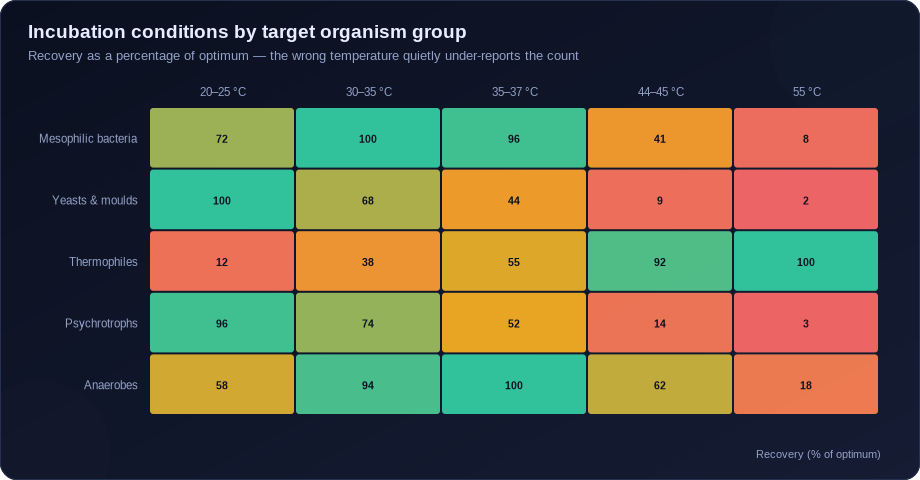
Wrong incubation quietly under-reports the count. Running everything at 30 to 35 °C under-recovers many yeasts and moulds; running everything at 20 to 25 °C under-recovers mesophilic bacteria. Incubators should be mapped when loaded and monitored continuously.
Every media lot must pass growth promotion with the compendial organisms at not more than 100 CFU, and selective media must also show inhibitory and indicative properties. Without that record a "no growth" result cannot be interpreted; see culture media quality control. Negative controls and diluent sterility checks on each occasion complete the picture.
Common Microbial Limit Testing Failures
| Failure | Consequence | Fix |
|---|---|---|
| Method suitability never performed | Antimicrobial products report clean regardless of contamination | Validate per formulation before routine use |
| Specification cites <61> only | No pathogen screening at all | Add the <62> organisms and quantities required by route |
| Limit written as a plain number | The 10ⁿ rule may not apply, halving the acceptance range | Write compendial limits as 10ⁿ, or document the internal choice |
| 2x rule applied to absence tests | A confirmed pathogen passed | Absence is absolute |
| Presumptive positives reported without confirmation | False OOS and rejected batches | Confirm and identify before reporting |
| Excessive dilution to overcome inhibition | Detection limit rises above the specification | Use filtration, neutralisers or larger volumes instead |
| Sample quantity missing from absence specifications | Test cannot be enforced consistently | Always state "absence in X g or mL" |
When a result does exceed the limit, the response is a documented investigation rather than a retest; our guide to out-of-specification microbiology investigations sets out the sequence.
A pass or fail comparison also discards most of what the testing generates. In the worked example, 1,890 CFU/g passed, but if every earlier batch ran below 50 CFU/g it is the most important number of the month. Trend log-transformed counts per product, as described in microbiological trend analysis, and see how release testing fits the wider control strategy in finished product microbiological release testing.
How DSTechnoverse Helps
DSTechnoverse runs microbial limit testing from its Indore laboratory under USP <61> and <62>, Ph. Eur. and IP. The work covers specification review against route and market, method suitability and neutralisation for each formulation, routine TAMC and TYMC by membrane filtration or plate count, the full specified organism panel with confirmation, and identification of recovered organisms. We also test raw materials and finished products as part of wider release programmes. Samples are collected the same day around Indore, Pithampur and Dewas (local service) and couriered under temperature control from elsewhere in India. Contact us to discuss a product.
Frequently Asked Questions
What is a microbial limit test?
A microbial limit test is the compendial examination of a non-sterile product for its total aerobic microbial count, total combined yeasts and moulds count, and the absence of specified organisms. It follows USP <61> and <62> (Ph. Eur. 2.6.12 and 2.6.13), and the results are judged against acceptance criteria based on USP <1111> or the product monograph.
What is the difference between USP <61> and USP <62>?
USP <61> is enumeration: it counts TAMC on Soybean-Casein Digest Agar and TYMC on Sabouraud Dextrose Agar. USP <62> is absence testing for named organisms such as E. coli, Salmonella, S. aureus and P. aeruginosa in a stated quantity. A complete specification for most products needs both, because counts alone say nothing about pathogens.
What does a limit of 10² CFU/g actually allow?
Under the USP <1111> interpretation rule, a limit written as 10² CFU/g means a maximum acceptable count of 200 CFU/g. Similarly 10¹ allows 20 and 10³ allows 2,000. The rule recognises the natural variability of plate counts. It applies only to counts, never to absence requirements for specified organisms.
Does the twofold rule apply to Salmonella or E. coli?
No. Absence requirements are absolute. A single confirmed colony of a specified organism in the quantity tested, for example Salmonella in 10 g or E. coli in 1 g, is a failure regardless of the count results. The twofold interpretation applies only to TAMC and TYMC limits expressed as powers of ten.
How is TAMC calculated from plate counts?
Take the dilution with the highest count below 250 colonies, average the duplicate plates, multiply by the dilution factor and divide by the volume plated. For example, plates of 182 and 196 at a 1:10 dilution with 1 mL plated give a mean of 189, so TAMC is 189 × 10 ÷ 1 = 1,890 CFU/g.
Which enumeration method should we use?
Membrane filtration wherever the product can be filtered, because rinsing removes inhibitory residues and filtering a larger amount gives a lower detection limit. Pour or spread plates suit most solids and non-filterable liquids. The most probable number method is a last resort for TAMC only, used where neither plating nor filtration can be made to work.
Why did our preserved product show no growth?
Most likely because the preservative was not neutralised, so it continued to kill organisms on the plate. A preserved product tested without validated method suitability will nearly always report clean. The fix is to establish and document neutralisers, dilution or membrane rinsing that allow at least half the control recovery of each test organism.
How long does a microbial limit test take?
Enumeration needs 3 to 5 days for TAMC and 5 to 7 days for TYMC, so a full report normally takes about a week from receipt. Absence tests for specified organisms are often complete in three to five days, though presumptive colonies needing confirmation or identification can add one to three days.
Do dietary supplements and herbal products need microbial limit testing?
Yes. Botanical and natural-origin products typically need the full panel, including Salmonella, E. coli and often bile-tolerant Gram-negative bacteria, at every lot, because plant raw materials carry high and variable loads. Applicable limits depend on the market and may come from USP <2023>, Ph. Eur. 5.1.8 or FSSAI regulations rather than USP <1111>.
A microbial limit result without method suitability is not a result. DSTechnoverse provides microbial limit testing under USP <61> and <62>, Ph. Eur. and IP, with neutralisation validation for every formulation. Based in Indore, Madhya Pradesh, serving manufacturers across India. Talk to our microbiology team.
Related services
Related articles
- Finished Product Microbiological Release Testing: Specifications, Sampling and What It Proves
- Industrial Microbiological Testing: The Complete Guide for Indian Manufacturers
- Objectionable Organisms in Non-Sterile Products: Why Compendial Compliance Is Not Enough
- Herbal and Nutraceutical Finished Products: Setting Microbial Specifications